Kirjojen hintavertailu – 12 859 827 kirjaa ja 27 kauppaa

Kirjailija

Bidyut Chakrabarty

Kirjat ja teokset yhdessä paikassa: 69 kirjaa, julkaisuja vuosilta 2004–2026, suosituimpiin kuuluu Depoliticisation and Ideational Vision. Vertaile teosten hintoja ja tarkista saatavuus suomalaisista kirjakaupoista.

69 kirjaa

Kirjojen julkaisuvuodet: 2004–2026.

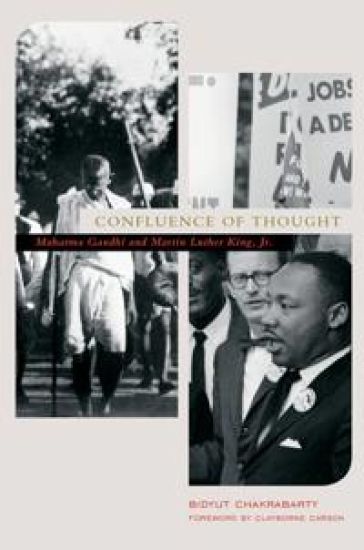
Confluence of Thought

Confluence of Thought

Bidyut Chakrabarty; Clayborne Carson

Oxford University Press Inc
2013
nidottu
While much has been written about Gandhi and Martin Luther King, Jr., never before has anyone compared the social and political origins and evolution of their thoughts on non-violence. In this path-breaking work, respected political theorist Bidyut Chakrabarty argues that there is a confluence between Gandhi and King's concerns for humanity and advocacy of non-violence, despite the very different historical, economic and cultural circumstances against which they developed their ideas. At the same time, he demonstrates that both were truly shaped by their historical moments, evolving their approaches to non-violence to best advance their respective struggles for freedom. Gandhi and King were perhaps the most influential individuals in modern history to combine religious and political thought into successful and dynamic social ideologies. Gandhi emphasized service to humanity while King, who was greatly influenced by Gandhi, pursued religion-driven social action. Chakrabarty looks particularly at the way in which each strategically used religious and political language to build momentum and attract followers to their movements. The result is a compelling and historically entrenched view of two of the most important figures of the twentieth century and a thoughtful meditation on the common threads that flow through the larger and enduring nonviolence movement.
Maoism in India

Maoism in India

Bidyut Chakrabarty; Rajat Kumar Kujur

Routledge
2012
nidottu
The rise of Maoism as one of the organized political movement in India is the outcome of a historical situation. Both colonialism and the failure of the Indian state to implement land reforms more stringently in the aftermath of independence resulted in terrible sufferings of the marginalized, land- dependent, sections of society. Through historical analysis, this book assesses the ideological articulation of the contemporary ultra-left movement in India, including Maoism which is expanding gradually in India. The author provides answers to the following issues: Is Maoism reflective of the growing disenchantment of the people in the affected areas with the state? Is it a comment on ‘the distorted development planning’ pursued by the Indian state? Is this an outcome of the processes of ‘deepening of democracy’ in India? Using Orissa as a case study, the book raises questions on India’s development strategy. The author argues that Maoism provides critical inputs for an alternative paradigm for development, relevant for ‘transitional societies’ and that it is a still a powerful ideology for the poorer parts of the world although its ideological appeal has declined internationally.
Corporate Social Responsibility in India

Corporate Social Responsibility in India

Bidyut Chakrabarty

Routledge
2011
sidottu
Presenting an analysis of Corporate Social Responsibility (CSR) in India, this book looks at the unique roots of the concept in India. It examines Gandhi’s philosophical moorings that inform India’s approach to CSR, and the role of civil society in setting an agenda for championing the rights of the stakeholders. The book goes on to focus on the role of the government in grooming the Indian business to be sensitive of its social concerns. Drawing on rich empirical data, the book shows that CSR in India cannot be conceptualized in ethnocentric terms. Arguing that it is not about ‘the typical Indianness’ of the articulation, it emphasizes the point that CSR in India needs to be conceptualized in a wider perspective by taking into account its philosophical roots with reference to the prevalent socio-economic and political context. The book is a valuable contribution to the literature on CSR, and is of interest to scholars of Asian Studies, business and development studies.
Maoism in India

Maoism in India

Bidyut Chakrabarty; Rajat Kumar Kujur

Routledge
2009
sidottu
The rise of Maoism as one of the organized political movement in India is the outcome of a historical situation. Both colonialism and the failure of the Indian state to implement land reforms more stringently in the aftermath of independence resulted in terrible sufferings of the marginalized, land- dependent, sections of society. Through historical analysis, this book assesses the ideological articulation of the contemporary ultra-left movement in India, including Maoism which is expanding gradually in India. The author provides answers to the following issues: Is Maoism reflective of the growing disenchantment of the people in the affected areas with the state? Is it a comment on ‘the distorted development planning’ pursued by the Indian state? Is this an outcome of the processes of ‘deepening of democracy’ in India? Using Orissa as a case study, the book raises questions on India’s development strategy. The author argues that Maoism provides critical inputs for an alternative paradigm for development, relevant for ‘transitional societies’ and that it is a still a powerful ideology for the poorer parts of the world although its ideological appeal has declined internationally.
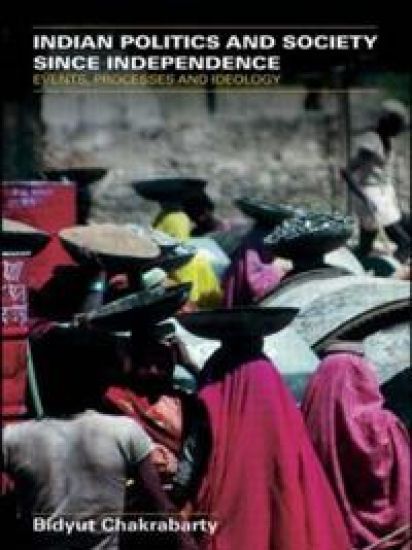
Indian Politics and Society since Independence
Focusing on politics and society in India, this book explores new areas enmeshed in the complex social, economic and political processes in the country. Linking the structural characteristics with the broader sociological context, the book emphasizes the strong influence of sociological issues on politics, such as social milieu shaping and the articulation of the political in day-to-day events. Political events are connected with the ever-changing social, economic and political processes in order to provide an analytical framework to explain ‘peculiarities’ of Indian politics. Bidyut Chakrabarty argues that three major ideological influences of colonialism, nationalism and democracy have provided the foundational values of Indian politics. Structured thematically and chronologically, this work is a useful resource for students of political science, sociology and South Asian studies.
Social and Political Thought of Mahatma Gandhi
During his campaign against racism in South Africa, and his involvement in the Congress-led nationalist struggle against British colonial rule in India, Mahatma Gandhi developed a new form of political struggle based on the idea of satyagraha, or non-violent protest. He ushered in a new era of nationalism in India by articulating the nationalist protest in the language of non-violence, or ahisma, that galvanized the masses into action. Focusing on the principles of satyagraha and non-violence, and their evolution in the context of anti-imperial movements organized by Gandhi, this fascinating book looks at how these precepts underwent changes reflecting the ideological beliefs of the participants. Assessing Gandhi and his ideology, the text centres on the ways in which Gandhi took into account the views of other leading personalities of the era whilst articulating his theory of action. Concentrating on Gandhi’s writings in Harijan, the weekly newspaper he founded, this volume provides a unique contextualized study of an iconic man’s social and political ideas.
The Partition of Bengal and Assam, 1932-1947
The fragmentation of Bengal and Assam in 1947 was a crucial moment in India's socio-political history as a nation state. Both the British Indian provinces were divided as much through the actions of the Muslim League as by those of Congress and the British colonial power. Attributing partition largely to Hindu communalists is, therefore, historically inaccurate and factually misleading. The Partition of Bengal and Assam provides a review of constitutional and party politics as well as of popular attitudes and perceptions. The primary aim of this book is to unravel the intricate socio-economic and political processes that led up to partition, as Hindus and Muslims competed ferociously for the new power and privileges to be conferred on them with independence. As shown in the book, well before they divorced at a political level, Hindus and Muslims had been cleaved apart by their socio-economic differences. Partition was probably inevitable.