Kirjojen hintavertailu – 12 903 725 kirjaa ja 27 kauppaa

Kirjailija

Björn Bjerke

Kirjat ja teokset yhdessä paikassa: 14 kirjaa, julkaisuja vuosilta 1999–2019, suosituimpiin kuuluu Methodology for Creating Business Knowledge. Vertaile teosten hintoja ja tarkista saatavuus suomalaisista kirjakaupoista.

Nimi esiintyy myös muodoissa: Bjorn Bjerke

14 kirjaa

Kirjojen julkaisuvuodet: 1999–2019.

Alternative Marketing Approaches for Entrepreneurs

Alternative Marketing Approaches for Entrepreneurs

Björn Bjerke

Edward Elgar Publishing Ltd
2019
nidottu
Consumers have, to a large extent, become their own producers; they are more aware of marketing and are active in adding value to the products and experiences they want. By assessing customers as active agents rather than passive consumers, Bjoern Bjerke explores alternative ways of marketing for new businesses and social entrepreneurial ventures. This book first presents the dominant approach to marketing theory used for the last half a century. After that, it presents an alternative approach to marketing theory by emphasizing how new infrastructures and organizations, including online platforms, influence new ways of linking the formal and informal economies together. Building on fundamental theories of science and methodological issues, Bjerke creates useful theoretical conceptions that can develop a greater connection between practice and research. He argues that as entrepreneurial activity is more accessible than ever it needs a fresh approach to include customers as co-creators and co-extractors of market value. An excellent book for exploring alternative marketing, students and researchers in marketing, social entrepreneurship and wider business and management studies will gain a greater understanding of what it means to be a marketer, customer and user.

Alternative Marketing Approaches for Entrepreneurs

Alternative Marketing Approaches for Entrepreneurs

Björn Bjerke

Edward Elgar Publishing Ltd
2018
sidottu
Consumers have, to a large extent, become their own producers; they are more aware of marketing and are active in adding value to the products and experiences they want. By assessing customers as active agents rather than passive consumers, Bjoern Bjerke explores alternative ways of marketing for new businesses and social entrepreneurial ventures. This book first presents the dominant approach to marketing theory used for the last half a century. After that, it presents an alternative approach to marketing theory by emphasizing how new infrastructures and organizations, including online platforms, influence new ways of linking the formal and informal economies together. Building on fundamental theories of science and methodological issues, Bjerke creates useful theoretical conceptions that can develop a greater connection between practice and research. He argues that as entrepreneurial activity is more accessible than ever it needs a fresh approach to include customers as co-creators and co-extractors of market value. An excellent book for exploring alternative marketing, students and researchers in marketing, social entrepreneurship and wider business and management studies will gain a greater understanding of what it means to be a marketer, customer and user.

About Entrepreneurship

About Entrepreneurship

Björn Bjerke

Edward Elgar Publishing Ltd
2013
sidottu
This engaging textbook offers a modern perspective on all that is essential to know about entrepreneurship. It will prove required reading for both lecturers and undergraduate and Masters students on upper-level entrepreneurship courses. Björn Bjerke covers all kinds of aspects of entrepreneurship including the history of the subject, our modern entrepreneurial society, local community development, entrepreneurship in different national cultures and women as entrepreneurs. He addresses some theoretical developments, and considers a narrow and a broad view of entrepreneurship, rational and natural entrepreneurial start-ups and entrepreneurship in space and place. At the end of every chapter, there are numerous 'Think' questions and a practice case, which may be useful when studying the subject alone or when teaching it. There are online resources for teachers to support the text. Contents: Introduction: A Book About, for or in Entrepreneurship? 1. The History of Entrepreneurship as an Academic Subject 2. Our Society During the Twenty-first Century 3. All These Preneurs 4. Business Entrepreneurship: The Narrow View 5. Business Entrepreneurship: The Broad View 6. Social Entrepreneurship 7. Entrepreneurship and Local Development 8. Start-ups of Entrepreneurial Activities 9. Women as Entrepreneurs 10. Entrepreneurial Activities in Different National Cultures 11. Some Philosophical and Theoretical Foundations References Index
About Entrepreneurship

About Entrepreneurship

Björn Bjerke

Edward Elgar Publishing Ltd
2013
nidottu
This engaging textbook offers a modern perspective on all that is essential to know about entrepreneurship. It will prove required reading for both lecturers and undergraduate and Masters students on upper-level entrepreneurship courses. Björn Bjerke covers all kinds of aspects of entrepreneurship including the history of the subject, our modern entrepreneurial society, local community development, entrepreneurship in different national cultures and women as entrepreneurs. He addresses some theoretical developments, and considers a narrow and a broad view of entrepreneurship, rational and natural entrepreneurial start-ups and entrepreneurship in space and place. At the end of every chapter, there are numerous 'Think' questions and a practice case, which may be useful when studying the subject alone or when teaching it. There are online resources for teachers to support the text. Contents: Introduction: A Book About, for or in Entrepreneurship? 1. The History of Entrepreneurship as an Academic Subject 2. Our Society During the Twenty-first Century 3. All These Preneurs 4. Business Entrepreneurship: The Narrow View 5. Business Entrepreneurship: The Broad View 6. Social Entrepreneurship 7. Entrepreneurship and Local Development 8. Start-ups of Entrepreneurial Activities 9. Women as Entrepreneurs 10. Entrepreneurial Activities in Different National Cultures 11. Some Philosophical and Theoretical Foundations References Index
Social Entrepreneurship

Social Entrepreneurship

Björn Bjerke; Mathias Karlsson

Edward Elgar Publishing Ltd
2013
sidottu
This informative book examines some social entrepreneurs in practice in several countries whilst concentrating on entrepreneurs in the third sector. The authors call them citizen entrepreneurs. Such people are not only becoming more common but also more necessary in the world of today. Entrepreneurs are seen as people who aim 'to act as if and make a difference', that is, who act out of the ordinary and come up with noticeable solutions to various problems without being restricted by existing resources or possibilities. This book applies these criteria to citizen entrepreneurs, focusing on public entrepreneurs operating in public places. The authors conduct in-depth case studies to examine these public entrepreneurs thoroughly and offer some theoretical reflections on social entrepreneurship. Students and researchers studying social entrepreneurship will find this book of great interest. Social entrepreneurs and practitioners would also benefit considerably from this enriching resource.
Entrepreneurial Imagination

Entrepreneurial Imagination

Björn Bjerke; Hans Rämö

Edward Elgar Publishing Ltd
2011
sidottu
Entrepreneurial Imagination innovatively focuses on entrepreneurial and economic action in time, timing, space and place. Schedules and places of production, working times and working places, are no longer fixed due to the effects of the contemporary economy. The authors expertly bring together a focused and themed book that deals wholly with the subjects of time and space in a phenomenological understanding of entrepreneurial ventures and related business action. They discuss theories and thinking of human action, space, place, timing and time in various entrepreneurial and business arenas, including social entrepreneuring, environmental and corporate social responsibility, network forms of entrepreneuring, urban governance and regional development. Taking a phenomenological approach to enable readers to understand entrepreneurship and related economic action clearly will prove to be inspiring for students, academics and practitioners interested in all areas of entrepreneurship and similar issues. Contents: 1. Entrepreneuring - When and Where?; 2. A Phenomenology of Entrepreneurial Action; 3. Our Entrepreneuring Society; 4. Various Kinds of Social Entrepreneuring, Networking and Social Capital; 5. On the Importance of Social Entrepreneuring to Local Government; 6. Entrepreneuring and Regional Development; 7. Entrepreneurial Action and Environment; 8. Entrepreneuring and ICT-Based Networking; 9. Summary and Conclusions; References ; Index
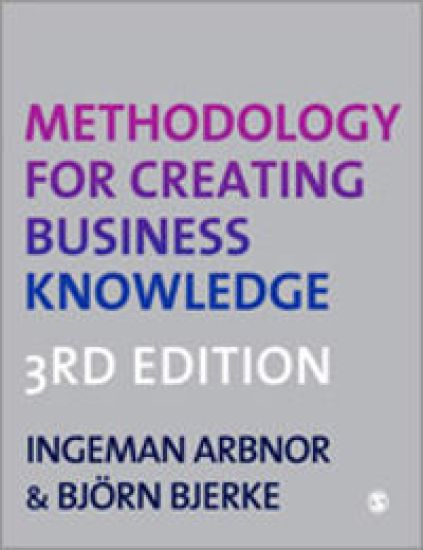
Methodology for Creating Business Knowledge

Methodology for Creating Business Knowledge

Ingeman Arbnor; Bjorn Bjerke

SAGE Publications Ltd
2008
sidottu
`Arbnor and Bjerke's deep insight into theory construction and their honest appraisal of knowledge creation makes this edition absolutely essential for business scholars. I recommend this book to scholars in any area of business seeking a more thoughtful and useful understanding of research methodology' - Morgan Miles, Professor of Marketing, Georgia Southern University `These are two authors on top of their game, using their vast experience and depth of knowledge to present a complex topic in a framework which is understandable and usable by anyone doing academic research. This third edition will ensure that this book remains the essential read for social science researchers' - David Carson, Professor of Marketing, University of Ulster Arbnor and Bjerke's best-selling text, first published in 1997, remains unrivalled; both in its contemporary relevance to research methodology, and in its coverage of the interplay between the philosophy of science, methodology and business. The authors make an in-depth examination into the circularity of knowledge and its foundations and analyze the repercussions for business, research and consulting. Where knowledge is a competitive necessity understanding its foundations is a necessity. The Third Edition has been updated to be even more relevant to the contemporary interests of business knowledge. Additional extras include: - Several more examples are included, plus previous examples have been updated - Improved illustrations and diagrams - Revised presentation makes the book easier to use - Useful summaries of the key points and concepts to aide accessibility - Points of reflection allow the reader to further their thinking on the topics - A glossary of terms - A teacher's manual which can be requested from the book's website
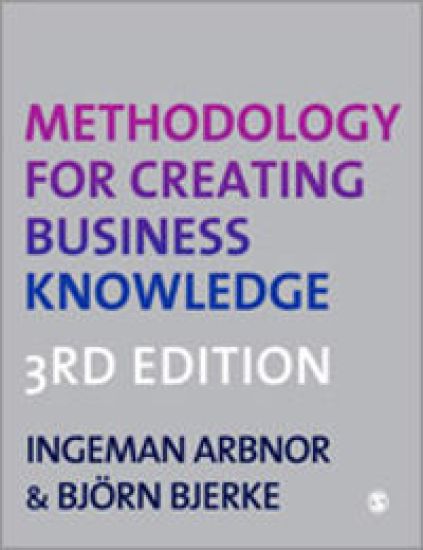
Methodology for Creating Business Knowledge

Methodology for Creating Business Knowledge

Ingeman Arbnor; Bjorn Bjerke

SAGE Publications Ltd
2008
nidottu
`Arbnor and Bjerke's deep insight into theory construction and their honest appraisal of knowledge creation makes this edition absolutely essential for business scholars. I recommend this book to scholars in any area of business seeking a more thoughtful and useful understanding of research methodology' - Morgan Miles, Professor of Marketing, Georgia Southern University `These are two authors on top of their game, using their vast experience and depth of knowledge to present a complex topic in a framework which is understandable and usable by anyone doing academic research. This third edition will ensure that this book remains the essential read for social science researchers' - David Carson, Professor of Marketing, University of Ulster Arbnor and Bjerke's best-selling text, first published in 1997, remains unrivalled; both in its contemporary relevance to research methodology, and in its coverage of the interplay between the philosophy of science, methodology and business. The authors make an in-depth examination into the circularity of knowledge and its foundations and analyze the repercussions for business, research and consulting. Where knowledge is a competitive necessity understanding its foundations is a necessity. The Third Edition has been updated to be even more relevant to the contemporary interests of business knowledge. Additional extras include: - Several more examples are included, plus previous examples have been updated - Improved illustrations and diagrams - Revised presentation makes the book easier to use - Useful summaries of the key points and concepts to aide accessibility - Points of reflection allow the reader to further their thinking on the topics - A glossary of terms - A teacher's manual which can be requested from the book's website
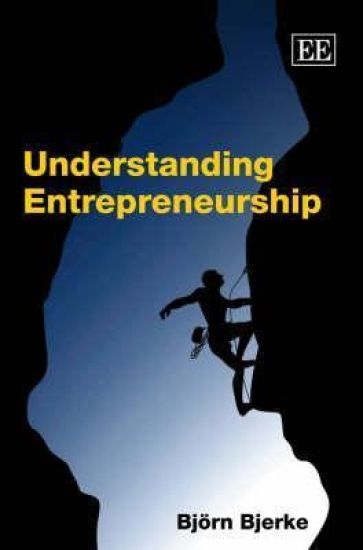
Understanding Entrepreneurship

Understanding Entrepreneurship

Björn Bjerke

Edward Elgar Publishing Ltd
2007
nidottu
This fascinating and original textbook - an excellent introductory text for both graduate and undergraduate students - attempts to enhance and advance our understanding of entrepreneurship. In this intriguing book, Bjorn Bjerke contends that entrepreneurship cannot, to any great extent, be planned in advance. He goes as far as to suggest that planning could be against the very essence of entrepreneurship. The book explains that entrepreneurship is about courage rather than willpower, is to be venturesome and undertaking whilst experimenting, networking and pushing oneself forward, and concerns exploiting mistakes as essential learning curves. The importance of the entrepreneur as a human being is strongly expressed, as is the idea that entrepreneurship is closer to art and aesthetics than science and mathematics. Language, argues the author, plays a decisive role and philosophy provides a solid basis when we try to come to grips with the nature of entrepreneurship. Finally, and perhaps most importantly, Bjorn Bjerke asserts that all these points alert us to one simple fact: it is not possible to define a 'typical' entrepreneur or to present a model method of operating and supporting an entrepreneurial venture. Understanding Entrepreneurship is a truly remarkable textbook that will provide an absorbing and illuminating read for all those - academics, students and practitioners alike - with an interest in entrepreneurship.
Understanding Entrepreneurship

Understanding Entrepreneurship

Björn Bjerke

Edward Elgar Publishing Ltd
2007
sidottu
This fascinating and original textbook - an excellent introductory text for both graduate and undergraduate students - attempts to enhance and advance our understanding of entrepreneurship. In this intriguing book, Bjorn Bjerke contends that entrepreneurship cannot, to any great extent, be planned in advance. He goes as far as to suggest that planning could be against the very essence of entrepreneurship. The book explains that entrepreneurship is about courage rather than willpower, is to be venturesome and undertaking whilst experimenting, networking and pushing oneself forward, and concerns exploiting mistakes as essential learning curves. The importance of the entrepreneur as a human being is strongly expressed, as is the idea that entrepreneurship is closer to art and aesthetics than science and mathematics. Language, argues the author, plays a decisive role and philosophy provides a solid basis when we try to come to grips with the nature of entrepreneurship. Finally, and perhaps most importantly, Bjorn Bjerke asserts that all these points alert us to one simple fact: it is not possible to define a 'typical' entrepreneur or to present a model method of operating and supporting an entrepreneurial venture. Understanding Entrepreneurship is a truly remarkable textbook that will provide an absorbing and illuminating read for all those - academics, students and practitioners alike - with an interest in entrepreneurship.
Entrepreneurial Marketing

Entrepreneurial Marketing

Björn Bjerke; Claes M. Hultman

Edward Elgar Publishing Ltd
2004
nidottu
Just as society has realised the value of entrepreneurs, so entrepreneurs are gradually realising the value of strategic marketing. In this book, the authors explain the substantial role of marketing in the success of small firms which have emerged in the new business environment of the past 10 to 15 years. Entrepreneurial marketing is especially important for small, developing firms which have to consider emerging business and market trends, and so a model is presented specifically tailored to the needs of expanding entrepreneurial ventures. The authors also critically analyse the extent to which mainstream marketing and entrepreneurship theory are useful in entrepreneurial marketing. They argue that to be fully effective, marketing must be viewed from a broad perspective and as a value-creating process. In order to understand the dynamic pattern of growth of small entrepreneurial ventures, they emphasise the importance of making a clear distinction between:managerial growth and entrepreneurial growth entrepreneurship, management and leadershiptransactional marketing, relationship marketing and complex combinations focal organisations and virtual organisationsexplorative learning and exploitative learningvalue configurations and value chains. This book will be of immense worth to students, scholars and practitioners of marketing and entrepreneurship, and will contribute to a new dialogue between the two disciplines. It will also be of considerable value to the wider business and management community learning to operate and succeed in the new economic era.
Entrepreneurial Marketing

Entrepreneurial Marketing

Björn Bjerke; Claes M. Hultman

Edward Elgar Publishing Ltd
2002
sidottu
Just as society has realised the value of entrepreneurs, so entrepreneurs are gradually realising the value of strategic marketing. In this book, the authors explain the substantial role of marketing in the success of small firms which have emerged in the new business environment of the past 10 to 15 years. Entrepreneurial marketing is especially important for small, developing firms which have to consider emerging business and market trends, and so a model is presented specifically tailored to the needs of expanding entrepreneurial ventures. The authors also critically analyse the extent to which mainstream marketing and entrepreneurship theory are useful in entrepreneurial marketing. They argue that to be fully effective, marketing must be viewed from a broad perspective and as a value-creating process. In order to understand the dynamic pattern of growth of small entrepreneurial ventures, they emphasise the importance of making a clear distinction between:managerial growth and entrepreneurial growth entrepreneurship, management and leadershiptransactional marketing, relationship marketing and complex combinations focal organisations and virtual organisationsexplorative learning and exploitative learningvalue configurations and value chains. This book will be of immense worth to students, scholars and practitioners of marketing and entrepreneurship, and will contribute to a new dialogue between the two disciplines. It will also be of considerable value to the wider business and management community learning to operate and succeed in the new economic era.
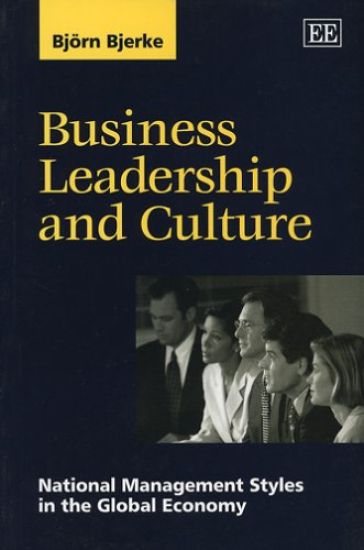
Business Leadership and Culture

Business Leadership and Culture

Björn Bjerke

Edward Elgar Publishing Ltd
2001
nidottu
How do business leaders think as a result of their national culture? This book provides a discussion and comparative analysis of five major cultures - American, Arab, Chinese, Japanese and Scandinavian - and how they reveal themselves in business practice. The author begins by introducing the concept of culture and why it is important, addressing issues such as values, beliefs and assumptions and the consequences of these. Bjorn Bjerke then goes on to address corporate culture and business strategy as well as some myths associated with national cultures. Looking at the five specific cultures he addresses cultural themes and presents a typified picture of the business leader in each of these. He concludes that there are five different capitalist systems governing these cultures, and that the business leader plays a different role in each. Extending this discussion, the author questions whether the culture-free business leader exists and, if so, what the characteristics of such a person might be. Business Leadership and Culture will enlighten students, scholars and business people about the consequences of culture for international business and management.
Business Leadership and Culture

Business Leadership and Culture

Björn Bjerke

Edward Elgar Publishing Ltd
1999
sidottu
How do business leaders think as a result of their national culture? This book provides a discussion and comparative analysis of five major cultures - American, Arab, Chinese, Japanese and Scandinavian - and how they reveal themselves in business practice. The author begins by introducing the concept of culture and why it is important, addressing issues such as values, beliefs and assumptions and the consequences of these. Bjorn Bjerke then goes on to address corporate culture and business strategy as well as some myths associated with national cultures. Looking at the five specific cultures he addresses cultural themes and presents a typified picture of the business leader in each of these. He concludes that there are five different capitalist systems governing these cultures, and that the business leader plays a different role in each. Extending this discussion, the author questions whether the culture-free business leader exists and, if so, what the characteristics of such a person might be. Business Leadership and Culture will enlighten students, scholars and business people about the consequences of culture for international business and management.