Kirjojen hintavertailu – 12 903 725 kirjaa ja 27 kauppaa

Kirjailija

Blaise Cendrars

Kirjat ja teokset yhdessä paikassa: 24 kirjaa, julkaisuja vuosilta 1993–2026, suosituimpiin kuuluu Ron. Vertaile teosten hintoja ja tarkista saatavuus suomalaisista kirjakaupoista.

24 kirjaa

Kirjojen julkaisuvuodet: 1993–2026.

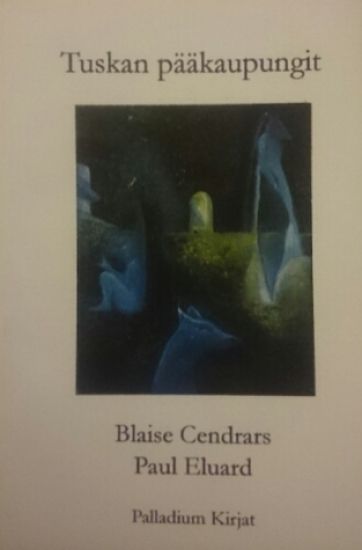
Tuskan pääkaupungit

Tuskan pääkaupungit

Blaise Cendrars; Paul Eluard

Palladium Kirjat
2001
nidottu
Kahden merkittävän surrealistisen arkkitehdin utopistinen, mutta elinvoimaiseksi osoittautunut pääkaupunkisuunnitelma, jossa on huomioitu yksityisliikenteen ja joukkoliikenteen välinen "yltyvän ja yllyttävän dialektiikan synnyttämä entropinen tyhjä tila" (Foucault), sekä erityisesti julkisissa odotustiloissa tapahtuva psykofyysinen kanssakäyminen - johon luetaan kaikenlainen keinuminen, hyväily, juominen ja parittelu. Pääkaupunkisuunnitelman joukkoliikenteeseen ja huolintaan keskittyy Blaise Cendrarsin "Transsiperialaista proosaa" (1913). Yhdyskuntasuunnittelun ja asumisen keskeisiä ongelmia käsittelee Paul Eluardin "Köyhien linna" (1948). Esikaupunkisuunnitelmasta vastaavat Blaise Cendrarsin osalta Henry Miller (1938) ja Jussi Kylätasku (1967), ja Paul Eluardin osalta Poul Borum (1967).
Hollywood

Hollywood

Blaise Cendrars

University of California Press
1995
sidottu
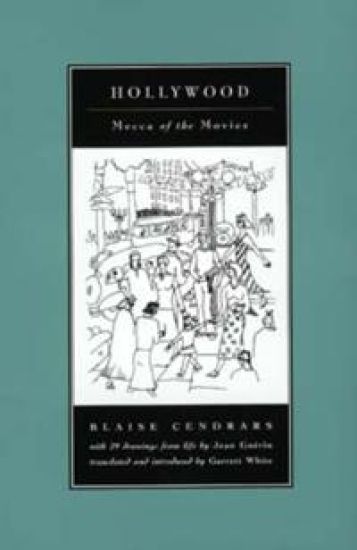
Blaise Cendrars, one of twentieth-century France's most gifted men of letters, came to Hollywood in 1936 for the newspaper "Paris-Soir". Already a well-known poet, Cendrars was a celebrity journalist whose perceptive dispatches from the American dream factory captivated millions. These articles were later published as "Hollywood: Mecca of the Movies", which has since appeared in many languages. Remarkably, this is its first translation into English. Hollywood in 1936 was crowded with stars, moguls, directors, scouts, and script girls. Though no stranger to filmmaking (he had worked with director Abel Gance), Cendrars was spurned by the industry greats with whom he sought to hobnob. His response was to invent a wildly funny Hollywood of his own, embellishing his adventures and mixing them with black humor, star anecdotes, and wry social commentary. Part diary, part tall tale, this book records Cendrars' experiences on Hollywood's streets and at its studios and hottest clubs. His impressions of the town's drifters, star-crazed sailors, and undiscovered talent are recounted in a personal, conversational style that anticipates the 'new journalism' of writers such as Tom Wolfe. Perfectly complemented by his friend Jean Guerin's witty drawings, and following the tradition of European travel writing, Cendrars' 'little book about Hollywood' offers an astute, entertaining look at 1930s America as reflected in its unique movie mecca.
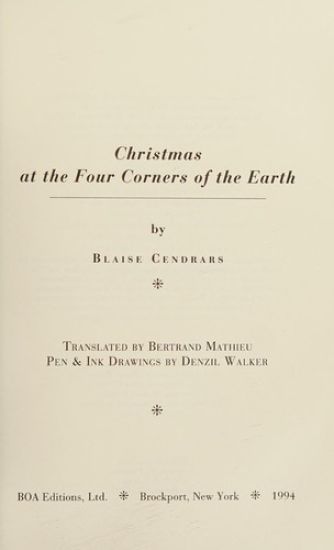
Christmas at the Four Corners of the Earth

Christmas at the Four Corners of the Earth

Blaise Cendrars

BOA Editions, Limited
1994
sidottu
The twelve trans-realist prose sketches in "Christmas at the Four Corners of the Earth" take the reader to Paris, Rio de Janeiro, Bahia, Rotterdam, China, New Mexico, New Zealand, the Ardennes Forest, and the south Atlantic ocean. Working together they are antithesis to sentimental Christmas stories.
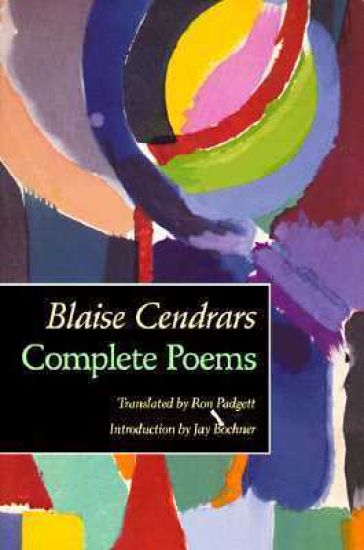
Complete Poems

Complete Poems

Blaise Cendrars

University of California Press
1993
pokkari
Blaise Cendrars was a pioneer of modernist literature. The full range of his poetry--from classical rhymed alexandrines to "cubist" modernism, and from feverish, even visionary, depression to airy good humor--offers a challenge no translator has accepted until now. Here, for the first time in English translation, is the complete poetry of a legendary twentieth-century French writer. Cendrars, born Frederick Louis Sauser in 1887, invented his life as well as his art. His adventures took him to Russia during the revolution of 1905 (where he traveled on the Trans-Siberian Railway), to New York in 1911, to the trenches of World War I (where he lost his right arm), to Brazil in the 1920s, to Hollywood in the 1930s, and back and forth across Europe. With Guillaume Apollinaire and Max Jacob he was a pioneer of modernist literature, working alongside artist friends such as Chagall, Delaunay, Modigliani, and Leger, composers Eric Satie and Darius Milhaud, and filmmaker Abel Gance. The range of Cendrars's poetry--from classical rhymed alexandrines to "cubist" modernism, and from feverish, even visionary, depression to airy good humor--offers a challenge no translator has accepted until now.