Kirjojen hintavertailu – 12 903 724 kirjaa ja 27 kauppaa

Kirjailija

Bob Milward

Kirjat ja teokset yhdessä paikassa: 6 kirjaa, julkaisuja vuosilta 1996–2021, suosituimpiin kuuluu Structural Adjustment. Vertaile teosten hintoja ja tarkista saatavuus suomalaisista kirjakaupoista.

6 kirjaa

Kirjojen julkaisuvuodet: 1996–2021.

International Trade and Sustainable Development
The contemporary orthodox view of world trade has centred, generally unchallenged, on the ideas of free trade, based on the theoretical construct of comparative advantage. This book will engage in a critique of the orthodox position based on the underlying theoretical economic construct, the historical development of the now developed economies and the morally unsustainable position of the free-trade regime. The author examines alternatives such as Most Favoured Nation and Preferential Trading Agreements before making the argument in favour of Asymmetric Trading, where the underdeveloped economies can develop behind tariff barriers and quotas, whilst the triadic nations maintain a lack of barriers to the exports of these economies. He outlines how such a trading regime would be mutually beneficial in the long term, in the sense that development through industrialisation takes place and the increase in GDP per capita would allow markets for exports to be sustainable, thus widening the market for the goods and services of the developed economies. However, the author demonstrates that free trade actually increases the development gap by maintaining the status quo in terms of the underdeveloped economies specialising in and exporting low value-added primary products and importing high value-added manufactures. The book analyses contemporary and historical data to illustrate how an alternative trading regime can be truly advantageous to both the developed and underdeveloped regions of the world: a global trading regime that is capable of increasing GDP in a sustainable manner without transferring a surplus from the poor to the rich nations and without a long-term commitment on the part of the developed nations to altruism.
International Trade and Sustainable Development
The contemporary orthodox view of world trade has centred, generally unchallenged, on the ideas of free trade, based on the theoretical construct of comparative advantage. This book will engage in a critique of the orthodox position based on the underlying theoretical economic construct, the historical development of the now developed economies and the morally unsustainable position of the free-trade regime. The author examines alternatives such as Most Favoured Nation and Preferential Trading Agreements before making the argument in favour of Asymmetric Trading, where the underdeveloped economies can develop behind tariff barriers and quotas, whilst the triadic nations maintain a lack of barriers to the exports of these economies. He outlines how such a trading regime would be mutually beneficial in the long term, in the sense that development through industrialisation takes place and the increase in GDP per capita would allow markets for exports to be sustainable, thus widening the market for the goods and services of the developed economies. However, the author demonstrates that free trade actually increases the development gap by maintaining the status quo in terms of the underdeveloped economies specialising in and exporting low value-added primary products and importing high value-added manufactures. The book analyses contemporary and historical data to illustrate how an alternative trading regime can be truly advantageous to both the developed and underdeveloped regions of the world: a global trading regime that is capable of increasing GDP in a sustainable manner without transferring a surplus from the poor to the rich nations and without a long-term commitment on the part of the developed nations to altruism.

Globalisation? Internationalisation and Monopoly Capitalism
This book acts as a welcome foil to current thinking on the concept of globalisation, which tends to be divided into two distinct camps: one which suggests that the neo-liberal model has triumphed and has no realistic alternative, and another which argues that globalisation, in its most extreme form, does not really exist, rather having evolved gradually from the very beginnings of industrialisation. Bob Milward presents an alternative view of globalisation and argues that indeed there has been a continuum in capitalist development, but that this has been forged by historical processes and the dynamism of the competitive forces of capitalism. He identifies the emergence of monopoly capitalism as an important shaping factor, and in so doing sheds light on issues of underdevelopment, multinational imperialism and crises in advanced capitalist economies. This radical, multidisciplinary account of the condition of the global economy, encompassing a critique of the neo-liberal foundations of orthodox global analysis, will appeal to an extensive audience. Students, researchers and academics in the fields of economics, heterodox economics, economic geography, politics, sociology, development studies, international relations and public policy will find Globalisation? Internationalisation and Monopoly Capitalism to be an engaging read.
Structural Adjustment

Structural Adjustment

Ed Brown; Bob Milward; Giles Mohan; Alfred B. Zack-Williams

Routledge
2000
sidottu
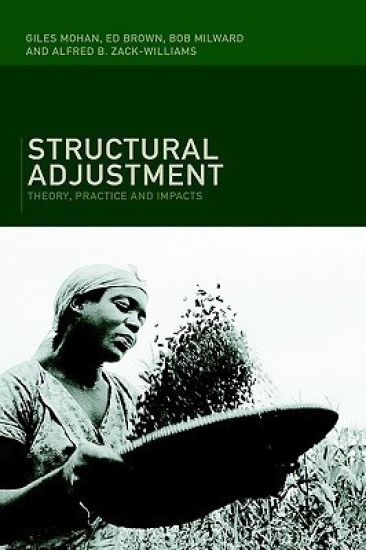
Structural Adjustment: Theory, Practice and Impacts examines the problems associated with Structural Adjustment Programmes (SAPs) and reveals the damaging impacts they can have. The book looks at how the debt crisis of the 1970's forced developing countries to seek external help and then reviews what constitutes as a standard adjustment programme, detailing the political, economic, social and environmental impacts of SAPs. The final section draws together theories and political responses and presents a case for alternatives to the programmes.
Structural Adjustment

Structural Adjustment

Ed Brown; Bob Milward; Giles Mohan; Alfred B. Zack-Williams

Routledge
2000
nidottu
Structural Adjustment Programmes (SAPs) are an important feature of contemporary development, yet they are often evaluated in the terms set out by lenders themselves, ignoring the wider implications of SAPs. Structural Adjustment attempts to situate SAPs in a wider development context featuring case material from the UK, USA, Ghana, Mexico, India, Jamaica, Turkey, Eastern Europe, Mali, Zimbabwe and Sierra Leone, the book addresses SAPs in the lenders' terms, before addressing macro-economic issues, the impacts on social groups, and the impact upon welfare policies such as education and health. Beyond economic analysis, the role of the state in the process, the impact of these programmes on services and the environment are also analysed.
Economic Policy

Economic Policy

Brian Atkinson; Bob Milward

Red Globe Press
1996
nidottu
This text provides comprehensive coverage of the core elements of economic policy, from both microeconomic and macroeconomic approaches. The authors have placed policy in its historical and political context so that readers can appreciate the theoretical roots. In particular, the effects of globalisation and membership of the European Union upon policy are considered. This book will be particularly appropriate for introductory courses on economic policy and economics courses with a particular policy emphasis.