Kirjojen hintavertailu – 12 859 819 kirjaa ja 27 kauppaa

Kirjailija

Booysen Susan

Kirjat ja teokset yhdessä paikassa: 5 kirjaa, julkaisuja vuosilta 2011–2016, suosituimpiin kuuluu Fees Must Fall. Vertaile teosten hintoja ja tarkista saatavuus suomalaisista kirjakaupoista.

5 kirjaa

Kirjojen julkaisuvuodet: 2011–2016.

Fees Must Fall

Fees Must Fall

Booysen Susan; Gillian Godsell; Rekgotsofetse Chikane; Sizwe Mpofu-Walsh; Omhle Ntshingila; Refiloe Lepere; Swankie Mofoko; Ayabonga Nase; Everatt David; Lynn Hewlett; Nomagugu Masuku-Mukadah; Horácio Lucas Zandamela; Koffi Kouakou; Gumede William; Bond Patrick; Satgar Vishwas; Fitzgerald Patrick; Oliver Seale; Pillay Pundy; Darlene Miller; Thad Metz

Wits University Press
2016
nidottu
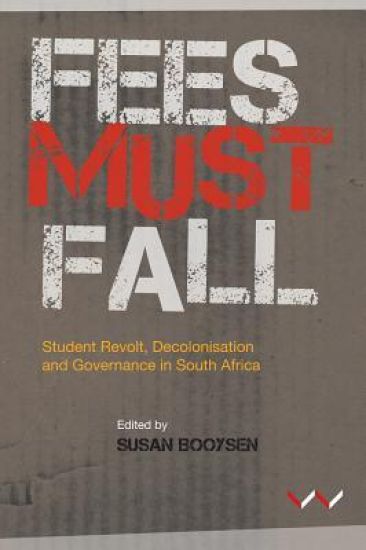
#FeesMustFall, the student revolt that began in October 2015, was an uprising against lack of access to, and financial exclusion from, higher education in South Africa. More broadly, it radically questioned the socio-political dispensation resulting from the 1994 social pact between big business, the ruling elite and the liberation movement. The 2015 revolt links to national and international youth struggles of the recent past and is informed by Black Consciousness politics and social movements of the international Left. Yet, its objectives are more complex than those of earlier struggles. The student movement has challenged the hierarchical, top-down leadership system of university management and it’s `double speak’ of professing to act in workers’ and students’ interests yet enforce a regressive system for control and governance. University managements, while one one level amenable to change, have also co-opted students into their ranks to create co-responsibility for the highly bureaucratised university fi nancial aid that stand in the way of their social revolution. This book maps the contours of student discontent a year after the start of the #FeesMustFall revolt. Student voices dissect coloniality, improper compromises by the founders of democratic South Africa, feminism, worker rights and meaningful education. In-depth assessments by prominent scholars refl ect on the complexities of student activism, its impact on national and university governance, and offer provocative analyses of the power of the revolt.
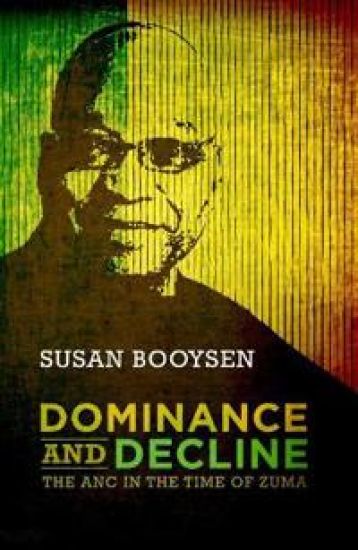
Dominance and Decline

Dominance and Decline

Booysen Susan

Wits University Press
2015
nidottu
Dominance and Decline takes stock of the Zuma-led administration and its impact on the African national Congress (AnC). Combining hard-hitting arguments with astute analysis Booysen shows how the ANC has become centered on the personage of Zuma, and how defense of his flawed leadership undermines the party’s capacity to govern competently and protect its long-term future. Following on from her first book, The African National Congress and the Regeneration of Power (2011), Booysen’s principle argument is that the state is failing as the president’s interests supersede those of party and state. Organisationally, the ANC has become a hegemon riven by faction, while the Zuma ANC oversees the implosion of the tripartite alliance and decimation of the youth, women’s and veterans’ leagues. Electorally, the ANC has been ceding ground to increasingly assertive opposition parties. The ANC falters on the policy front as it regurgitates old ideas and renews and implements these insufficiently. As Zuma’s replacements start competing and succession politics take shape, the book considers whether the ANC will be able to recover from the damage wrought under Zuma’s reign. Ultimately, Booysen asserts, the damage is irrevocable though the electorate may still reward the ANC for transcending the Zuma years. This is a must-have reference book on the development of the modern ANC. With rigour and incisive ness, Booysen persuasively analyses the cataclysmic period under Zuma and offers scholars and researchers a coherent framework for considering future patterns in the ANC.
New South African Review 3

New South African Review 3

Stephanie Allais; William Attwell; Booysen Susan; Cock Jacklyn; Daniel John; Fig David; Dick Forslund; Maylam Paul; Julia Moorman; Motala Shireen; Naidoo Prishani; Naidoo Vinothan; Naidu Sanusha; Nicol Martin; Pillay Devan; Marisha Ramdeen; Rispel Laetitia; Southall Roger; Ahmed Veriava; Louise Vincent

Wits University Press
2013
nidottu
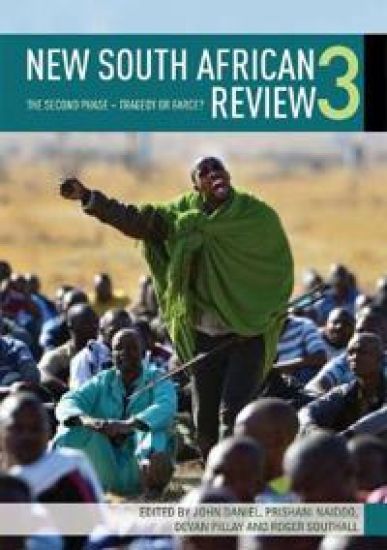
Hegel remarks somewhere that all great world-historic facts and personages appear, so to speak, twice. He forgot to add: the first time as tragedy, the second time as farce … (Karl Marx 1852) In the face of the continuing national tragedy of the inequality, poverty and unemployment which have triggered rising working- class discontent around the country, the ANC announced a `second phase’ of the `national democratic revolution’ to deal with the challenges. Ironically, the ANC post-Mangaung has resolved to preserve the core tenets of the minerals-energy-financial complex that defined racial capitalism – while at the same time ratcheting up the revolutionary rhetoric to keep the working class and marginalised onside. If the `first phase’ was a tragedy of the unmet expectations of the majority, is the `second phase’ likely to be a farce? The chapters in this volume are written by experts in their fields and address issues of politics, power and social class; economy, ecology and labour; public policy and social practice; and South Africa beyond its borders. They examine some of these challenges, and indicate that they are as much about the defective content of policies as their poor implementation. The third volume of the New South African Review continues the series by providing in-depth analyses of the key issues facing our country today.
One Hundred Years of the ANC

One Hundred Years of the ANC

Thozama April; Badsha Omar; Barchiesi Franco; Phil Bonner; Booysen Susan; Erlank Natasha; Etherington Norman; Gunner Liz; Lissoni Arianna; Macmillan Hugh; Netshitenzhe Joel; Nieftagodien Noor; Saul John; Shubin Vladimir; Soske Jon; Soudien Crain; Southall Roger; Ineke van Kessel

Wits University Press
2012
nidottu
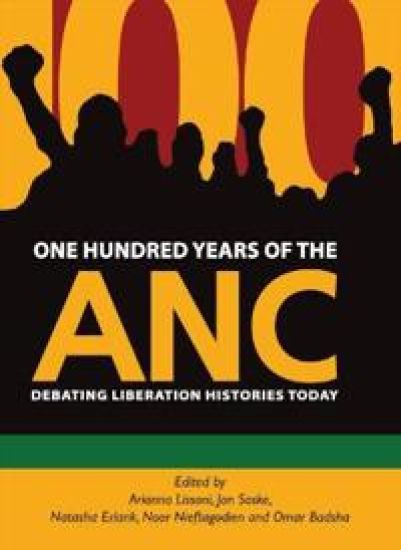
On 8 January 2012 the African National Congress (ANC) of South Africa, the oldest African nationalist organisation on the continent, celebrated its one hundredth anniversary. This historic event has generated significant public debate within both the ANC and South African society at large. There is no better time to critically reflect on the ANC’s historical trajectory and struggle against colonialism and apartheid than in its centennial year. One Hundred Years of the ANC is a collection of new work by renowned South African and international scholars. Covering a broad chronological and geographical spectrum and using a diverse range of sources, the contributors build upon but also extend the historiography of the ANC by tapping into marginal spaces in ANC history. By moving away from the celebratory mode that has characterised much of the contemporary discussions on the centenary, the contributors suggest that the relationship between the histories of earlier struggles and the present needs to be rethought in more complex terms. Collectively, the book chapters challenge hegemonic narratives that have become an established part of South Africa’s national discourse since 1994. By opening up debate around controversial or obscured aspects of the ANC’s century-long history, One hundred years of the ANC sets out an agenda for future research. The book is directed at a wide readership with an interest in understanding the historical roots of South Africa’s current politics will find this volume informative.
The African National Congress and the Regeneration of Political Power
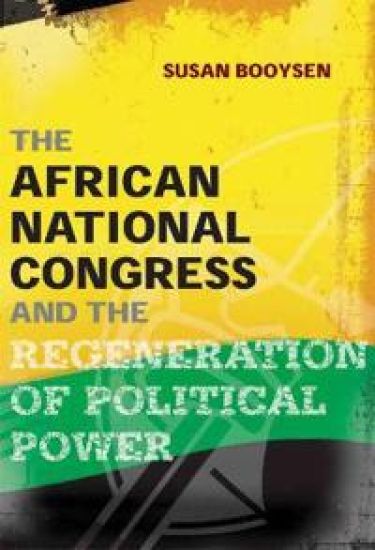
In the twenty years of transitional and democratic politics in South Africa, Susan Booysen constantly traversed two worlds, as direct observer and analyst-researcher. First, there is the world of the African National Congress (ANC), in which there is a sense of representation of the people in the contexts of elections and modern government. In ANC parlance, this is the time of the `national democratic revolution’ and there is continuous progress. The other world is that of critical observation and analysis. Here the observer-researcher negotiates the route between counter-truths, assessing how the ANC’s hegemonic power project of close to a century has materialised in the period of government power. It is a shifting target that is being analysed. The `answers’ are often at variance with the officially-projected ANC perspectives. The ANC and the Regeneration of Political Power straddles both worlds, but is unapologetically analytical. It builds on the empathy of understanding the struggles and achievements along with deferred dreams and frustrations. It moves to analyses of power, victories, strategy, engineering, manipulation, denials and corrections, obfuscation … and causes for celebration. Anchored in this world, the book focuses on discerning the bigger picture, which transcends the daily and monthly variances of who is in power and who in favour with those who are in power. Booysen has constructed the book around the framework of political power. Her analysis focuses on how the ANC, in twenty years of political power, has acted to continuously shape, maintain and regenerate power in relation to its internal structures and processes, opposition parties, people, government and the state. The chapters are all anchored in ongoing research and monitoring over this period, sometimes from the sidelines, but at other times with one foot in the political sphere. In 2011 the power configurations of and around the ANC are converging to deliver a present that holds vexing uncertainties. By dissecting contemporary power dimensions and comparing them with what has gone before, Booysen explores the construction of the political power `complex’ of the ANC. In so doing she offers insights into how South African politics, which is in many ways synonymous with the politics of the ANC, is likely to unfold in years, possibly decades, to come.