Kirjojen hintavertailu – 12 859 828 kirjaa ja 27 kauppaa

Kirjailija

Bradley Efron

Kirjat ja teokset yhdessä paikassa: 7 kirjaa, julkaisuja vuosilta 1982–2026, suosituimpiin kuuluu To Think Like a Statistician. Vertaile teosten hintoja ja tarkista saatavuus suomalaisista kirjakaupoista.

7 kirjaa

Kirjojen julkaisuvuodet: 1982–2026.

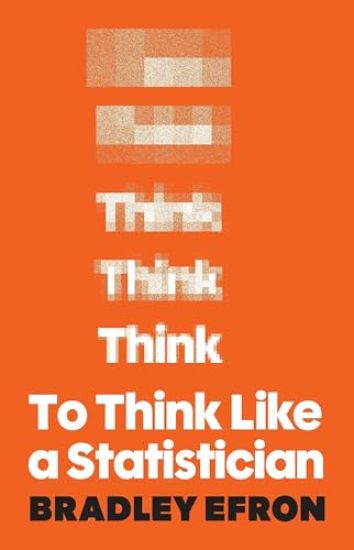
To Think Like a Statistician

To Think Like a Statistician

Bradley Efron

PRINCETON UNIVERSITY PRESS
2026
sidottu
Why you don’t need to be a statistician to think like one A fire hose of information bombards us every day, and some of it is even true. Is Bitcoin a good investment? Are hurricanes getting worse? Is the measles vaccine dangerous? Separating the wheat from the chaff is what statisticians do—and there’s lots of chaff. To Think Like a Statistician shares the skills statisticians use to sift through evidence, learn from experience, and extract meaning and knowledge from the random and the contradictory. Bradley Efron is one of the most renowned statisticians in the world and has shaped how data science and machine learning are practiced today. In this book, he draws on examples ranging from David Hume’s critique of miracles to counterfeit Basquiats, AI hallucinations, pandemics, competing political claims, government approvals of Alzheimer’s treatments, gambling, and misinformation. He describes how statisticians have tackled difficult topics—like correlation, causation, prediction, survival, and accuracy—and demystifies the disputes surrounding concepts like randomness, uncertainty, and subjectivity. Blending real-world insights with personal stories from a leading expert, To Think Like a Statistician equips readers with powerful ideas from the statistician’s toolbox and explains the tricks of the trade, enabling anyone to become a more sophisticated consumer of information in an increasingly noisy world.
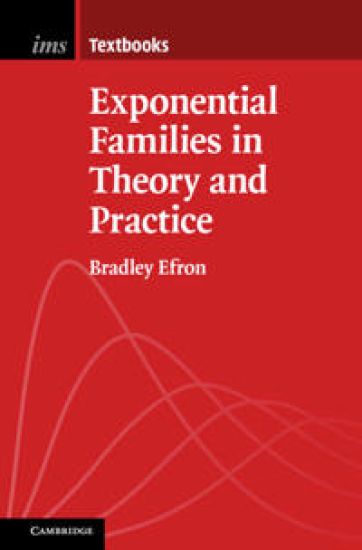
Exponential Families in Theory and Practice

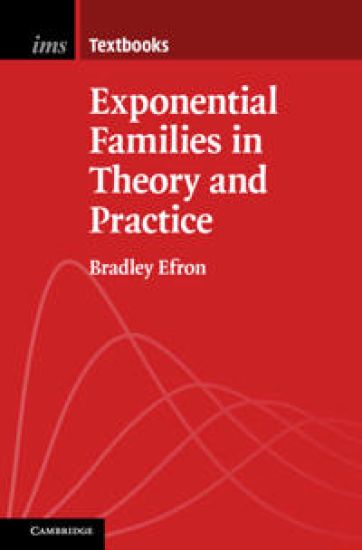
Exponential Families in Theory and Practice

Bradley Efron

Cambridge University Press
2022
pokkari
During the past half-century, exponential families have attained a position at the center of parametric statistical inference. Theoretical advances have been matched, and more than matched, in the world of applications, where logistic regression by itself has become the go-to methodology in medical statistics, computer-based prediction algorithms, and the social sciences. This book is based on a one-semester graduate course for first year Ph. D. and advanced master's students. After presenting the basic structure of univariate and multivariate exponential families, their application to generalized linear models including logistic and Poisson regression is described in detail, emphasizing geometrical ideas, computational practice, and the analogy with ordinary linear regression. Connections are made with a variety of current statistical methodologies: missing data, survival analysis and proportional hazards, false discovery rates, bootstrapping, and empirical Bayes analysis. The book connects exponential family theory with its applications in a way that doesn't require advanced mathematical preparation.
Exponential Families in Theory and Practice

Exponential Families in Theory and Practice

Bradley Efron

Cambridge University Press
2022
sidottu
During the past half-century, exponential families have attained a position at the center of parametric statistical inference. Theoretical advances have been matched, and more than matched, in the world of applications, where logistic regression by itself has become the go-to methodology in medical statistics, computer-based prediction algorithms, and the social sciences. This book is based on a one-semester graduate course for first year Ph. D. and advanced master's students. After presenting the basic structure of univariate and multivariate exponential families, their application to generalized linear models including logistic and Poisson regression is described in detail, emphasizing geometrical ideas, computational practice, and the analogy with ordinary linear regression. Connections are made with a variety of current statistical methodologies: missing data, survival analysis and proportional hazards, false discovery rates, bootstrapping, and empirical Bayes analysis. The book connects exponential family theory with its applications in a way that doesn't require advanced mathematical preparation.
Computer Age Statistical Inference, Student Edition

Computer Age Statistical Inference, Student Edition

Bradley Efron; Trevor Hastie

Cambridge University Press
2021
pokkari
The twenty-first century has seen a breathtaking expansion of statistical methodology, both in scope and influence. 'Data science' and 'machine learning' have become familiar terms in the news, as statistical methods are brought to bear upon the enormous data sets of modern science and commerce. How did we get here? And where are we going? How does it all fit together? Now in paperback and fortified with exercises, this book delivers a concentrated course in modern statistical thinking. Beginning with classical inferential theories - Bayesian, frequentist, Fisherian - individual chapters take up a series of influential topics: survival analysis, logistic regression, empirical Bayes, the jackknife and bootstrap, random forests, neural networks, Markov Chain Monte Carlo, inference after model selection, and dozens more. The distinctly modern approach integrates methodology and algorithms with statistical inference. Each chapter ends with class-tested exercises, and the book concludes with speculation on the future direction of statistics and data science.
Large-Scale Inference

Large-Scale Inference

Bradley Efron

Cambridge University Press
2012
pokkari
We live in a new age for statistical inference, where modern scientific technology such as microarrays and fMRI machines routinely produce thousands and sometimes millions of parallel data sets, each with its own estimation or testing problem. Doing thousands of problems at once is more than repeated application of classical methods. Taking an empirical Bayes approach, Bradley Efron, inventor of the bootstrap, shows how information accrues across problems in a way that combines Bayesian and frequentist ideas. Estimation, testing and prediction blend in this framework, producing opportunities for new methodologies of increased power. New difficulties also arise, easily leading to flawed inferences. This book takes a careful look at both the promise and pitfalls of large-scale statistical inference, with particular attention to false discovery rates, the most successful of the new statistical techniques. Emphasis is on the inferential ideas underlying technical developments, illustrated using a large number of real examples.
An Introduction to the Bootstrap

An Introduction to the Bootstrap

Bradley Efron; R.J. Tibshirani

Chapman Hall/CRC
1994
sidottu
Statistics is a subject of many uses and surprisingly few effective practitioners. The traditional road to statistical knowledge is blocked, for most, by a formidable wall of mathematics. The approach in An Introduction to the Bootstrap avoids that wall. It arms scientists and engineers, as well as statisticians, with the computational techniques they need to analyze and understand complicated data sets.
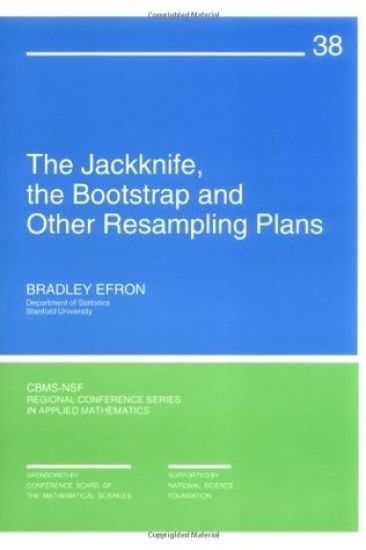
The Jackknife, the Bootstrap and Other Resampling Plans

The Jackknife, the Bootstrap and Other Resampling Plans

Bradley Efron

Society for Industrial Applied Mathematics,U.S.
1982
nidottu
The jackknife and the bootstrap are nonparametric methods for assessing the errors in a statistical estimation problem. They provide several advantages over the traditional parametric approach: the methods are easy to describe and they apply to arbitrarily complicated situations; distribution assumptions, such as normality, are never made. This monograph connects the jackknife, the bootstrap, and many other related ideas such as cross-validation, random subsampling, and balanced repeated replications into a unified exposition. The theoretical development is at an easy mathematical level and is supplemented by a large number of numerical examples. The methods described in this monograph form a useful set of tools for the applied statistician. They are particularly useful in problem areas where complicated data structures are common, for example, in censoring, missing data, and highly multivariate situations.