Kirjojen hintavertailu – 12 903 725 kirjaa ja 27 kauppaa

Kirjailija

Bradley Lewis

Kirjat ja teokset yhdessä paikassa: 19 kirjaa, julkaisuja vuosilta 2006–2025, suosituimpiin kuuluu Experiencing Epiphanies in Literature and Cinema. Vertaile teosten hintoja ja tarkista saatavuus suomalaisista kirjakaupoista.

19 kirjaa

Kirjojen julkaisuvuodet: 2006–2025.

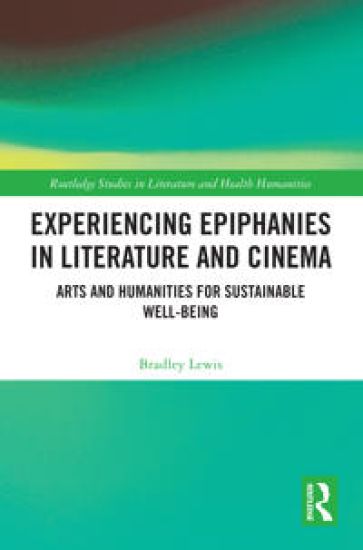
Experiencing Epiphanies in Literature and Cinema

Experiencing Epiphanies in Literature and Cinema

Bradley Lewis

TAYLOR FRANCIS LTD
2025
nidottu

Halvin toimitettuna 71,40 €

Experiencing Epiphanies in Literature and Cinema uses health humanities and psychological humanities to explore literary and cinematic epiphanies. James Joyce first adopted the term “epiphany” from its religious use to articulate momentsof luminous intensity or “sudden spiritual manifestation.” This study develops and extends Joyce’s use of epiphany through a range of literary and cinematic examples, from William Shakespeare to Ruth Ozeki and from Yasujiro Ozu to Jim Jarmusch. This wealth of epiphanies in the arts is important from a health humanities perspective in that they provide access to aesthetic and sustainable experiences of well-being, joy, and human flowering. They also provide antidotes to aesthetics of anti-epiphany—a showing forth of terror, horror, and panic. Experiencing Epiphanies is accordingly both critical and affirmative, diagnostic and therapeutic. It uses critique to understand the increasing need for well-being in contemporary times, and it uses affirmation to develop underutilized resources in the arts for transforming, configuring, and refiguring our everyday lives.

Experiencing Epiphanies in Literature and Cinema
Experiencing Epiphanies in Literature and Cinema uses health humanities and psychological humanities to explore literary and cinematic epiphanies. James Joyce first adopted the term “epiphany” from its religious use to articulate momentsof luminous intensity or “sudden spiritual manifestation.” This study develops and extends Joyce’s use of epiphany through a range of literary and cinematic examples, from William Shakespeare to Ruth Ozeki and from Yasujiro Ozu to Jim Jarmusch. This wealth of epiphanies in the arts is important from a health humanities perspective in that they provide access to aesthetic and sustainable experiences of well-being, joy, and human flowering. They also provide antidotes to aesthetics of anti-epiphany—a showing forth of terror, horror, and panic. Experiencing Epiphanies is accordingly both critical and affirmative, diagnostic and therapeutic. It uses critique to understand the increasing need for well-being in contemporary times, and it uses affirmation to develop underutilized resources in the arts for transforming, configuring, and refiguring our everyday lives.

One Big Chunk

One Big Chunk

Bradley Lewis; Louise Bradley

Createspace Independent Publishing Platform
2016
pokkari
At the age of - well, Dr. Louise Bradley wouldn't say - she woke up in the back of a hideous Hummer limo, the kind used for pornos, proms, weddings, and bar mitzvahs. She had lost her temporary veneers and drooled on her Dolce and Gabbana turquoise silk blouse. She had no idea where the limo was taking her. Was that her mother in the front seat? Dr. Bradley could not remember how she got there. Yes, she drank, took drugs, had sex with many men, and shopped incessantly, but she knew that she wasn't an addict. This is her account of her almost a week - maybe less - in a private rehab facility for the rich in Manhattan. Dr. Bradley's book combines her intimate memoir with adequate psychology, since she prefers the medication prescribed by her psychiatrist as opposed to any long-term therapy. Dr. Bradley tries to understand the difference between falling in love and just becoming addicted to sex. She speaks freely about her obsession and how her Mommy betrayed her. Rather than explore the causes of multiple addictions, Dr. Bradley shows us how to avoid overtreatment and instead moving on with our lives, while exposing the mental health scams along the way. She hits on the importance of knowing when things are transient, and tells a powerful story in the process. Dr. Bradley remembers - as much as she can with sharp dialogue - of the stories she has to endure. While fact-checking proved to be an inconvenience, she strives to get to the truth, at least allowing herself a chance to remember. One Big Chunk is a fast-moving, wild, sexy, and fiercely powerful parody of what passes for a memoir - a hilarious satire that will simultaneously shock while offering a poignant expos of our mental healthcare system, with a running commentary on the world of fashion.
Long Island Purgatory

Long Island Purgatory

Bradley Lewis

Createspace Independent Publishing Platform
2014
pokkari
Long Island Purgatory is a touching, funny, memoir with fictional elements that captures the voice of a soon-to-be thirteen-year-old, skeptical of approaching adulthood. Bennie-The-Brain, as some of his classmates and townspeople refer to him, is caught up in the aftermath of the shock waves from the JFK assassination. Perhaps intelligent beyond his years, Bennie is about to face something even more powerful than the death of his hero, something that he cannot fathom. This unusual but real treatment of racial upheaval and urban transformation in Laurelton, investigates the impact of blockbusting on the lives of Bennie, his family, and the rest of the mostly Jewish town. Blockbusting refers to a practice in which real estate agents sold a house on an all-white block to an African-American family. The panic among the remaining residents has often been referred to as "white flight". Lewis describes a widely forgotten phenomenon of recent social history, including his own real-life horrors and painful memories. Inside this strikingly candid, vividly written account of his experience, he takes us behind the scenes in 1963. We journey with him through both frank and poignant vignettes that convey the human cost of racism. Long Island Purgatory tells a powerful and deeply personal story that allows us an unprecedented look back at a sad piece of our history.
Depression

Depression

Bradley Lewis

Routledge
2011
nidottu
We live in an era of depression, a condition that causes extensive suffering for individuals and families and saps our collective productivity. Yet there remains considerable confusion about how to understand depression. Depression: Integrating Science, Culture, and Humanities looks at the varied and multiple models through which depression is understood. Highlighting how depression is increasingly seen through models of biomedicine—and through biomedical catch-alls such as "broken brains" and "chemical imbalances"—psychiatrist and cultural studies scholar Bradley Lewis shows how depression is also understood through a variety of other contemporary models. Furthermore, Lewis explores the different ways that depression has been categorized, described, and experienced across history and across cultures.
Depression

Depression

Bradley Lewis

Routledge
2011
sidottu
We live in an era of depression, a condition that causes extensive suffering for individuals and families and saps our collective productivity. Yet there remains considerable confusion about how to understand depression. Depression: Integrating Science, Culture, and Humanities looks at the varied and multiple models through which depression is understood. Highlighting how depression is increasingly seen through models of biomedicine—and through biomedical catch-alls such as "broken brains" and "chemical imbalances"—psychiatrist and cultural studies scholar Bradley Lewis shows how depression is also understood through a variety of other contemporary models. Furthermore, Lewis explores the different ways that depression has been categorized, described, and experienced across history and across cultures.
Narrative Psychiatry

Narrative Psychiatry

Bradley Lewis

Johns Hopkins University Press
2011
sidottu
Psychiatry has lagged behind many clinical specialties in recognizing the importance of narrative for understanding and effectively treating disease. With this book, Bradley Lewis makes the challenging and compelling case that psychiatrists need to promote the significance of narrative in their practice as well. Narrative already holds a prominent place in psychiatry. Patient stories are the foundation for diagnosis and the key to managing treatment and measuring its effectiveness. Even so, psychiatry has paid scant scholarly attention to the intrinsic value of patient stories. Fortunately, the study of narrative outside psychiatry has grown exponentially in recent years, and it is now possible for psychiatry to make considerable advances in its appreciation of clinical stories. Narrative Psychiatry picks up this intellectual opportunity and develops the tools of narrative for psychiatry. Lewis explores the rise of narrative medicine and looks closely at recent narrative approaches to psychotherapy. He uses philosophic and fictional writings, such as Anton Chekhov's play Ivanov, to develop key terms in narrative theory (plot, metaphor, character, point of view) and to understand the interpretive dimensions of clinical work. Finally, Lewis brings this material back to psychiatric practice, showing how narrative insights can be applied in psychiatric treatments-including the use of psychiatric medications. Nothing short of a call to rework the psychiatric profession, Narrative Psychiatry advocates taking the inherently narrative-centered patient-psychiatrist relationship to its logical conclusion: making the story a central aspect of treatment.
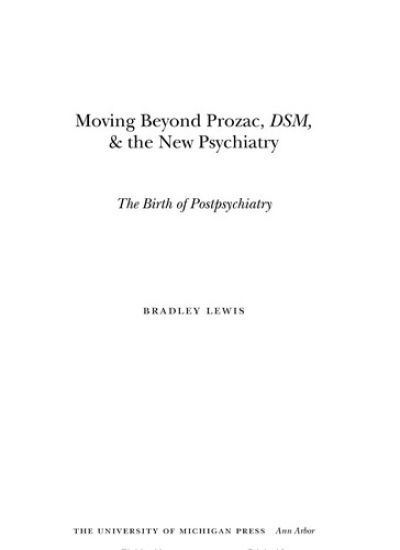
Moving Beyond Prozac, DSM, and the New Psychiatry

Moving Beyond Prozac, DSM, and the New Psychiatry

Bradley Lewis

The University of Michigan Press
2006
nidottu
"Interesting and fresh-represents an important and vigorous challenge to a discipline that at the moment is stuck in its own devices and needs a radical critique to begin to move ahead."--Paul McHugh, Johns Hopkins University School of Medicine"Remarkable in its breadth-an interesting and valuable contribution to the burgeoning literature of the philosophy of psychiatry."--Christian Perring, Dowling CollegeMoving Beyond Prozac, DSM, and the New Psychiatry looks at contemporary psychiatric practice from a variety of critical perspectives ranging from Michel Foucault to Donna Haraway. This contribution to the burgeoning field of medical humanities contends that psychiatry's move away from a theory-based model (one favoring psychoanalysis and other talk therapies) to a more scientific model (based on new breakthroughs in neuroscience and pharmacology) has been detrimental to both the profession and its clients. This shift toward a science-based model includes the codification of the Diagnostic and Statistical Manual of Mental Disorders to the status of standard scientific reference, enabling mental-health practitioners to assign a tidy classification for any mental disturbance or deviation. Psychiatrist and cultural studies scholar Bradley Lewis argues for "postpsychiatry," a new psychiatric practice informed by the insights of poststructuralist theory.