

Kirjojen hintavertailu – 12 859 819 kirjaa ja 27 kauppaa

Kirjailija

Brandon L. Wright

Kirjat ja teokset yhdessä paikassa: 3 kirjaa, julkaisuja vuosilta 2015–2016, suosituimpiin kuuluu Charter Schools at the Crossroads. Vertaile teosten hintoja ja tarkista saatavuus suomalaisista kirjakaupoista.

3 kirjaa

Kirjojen julkaisuvuodet: 2015–2016.

Charter Schools at the Crossroads

Charter Schools at the Crossroads

Chester E. Finn; Bruno V. Manno; Brandon L. Wright

Harvard Educational Publishing Group
2016
sidottu
Charter Schools at the Crossroads offers a frank and nuanced analysis of the successes and shortcomings of the charter movement, and outlines possible directions for the future. Few observers present at the creation of the first charter schools a quarter-century ago could have predicted how rapidly this movement would spread or how thoroughly it would come to dominate the education reform agenda. And few recent debates in education have been as highly charged as those over charter schools' roles, responsibilities, and results. Chester E. Finn, Jr., Bruno V. Manno, and Brandon L. Wright write that charters have been ""spectacularly uneven in many ways, succeeding wonderfully in some cases while faltering in others"". They counter the often-oversimplified narrative of the movement's origins, showing how multiple agendas and intentions led to a cacophony of results. The authors highlight some of the key accomplishments of charter schools in serving selected populations while acknowledging the mixed results of the sector as a whole, and identify critical challenges for strengthening the charter sector. The candor of the authors' analysis and the forthrightness of their concerns offer both allies and opponents valuable insight into the workings of a movement whose influence is indisputable and whose future is far from clear.

Charter Schools at the Crossroads

Charter Schools at the Crossroads

Chester E. Finn; Bruno V. Manno; Brandon L. Wright

Harvard Educational Publishing Group
2016
nidottu
Charter Schools at the Crossroads offers a frank and nuanced analysis of the successes and shortcomings of the charter movement, and outlines possible directions for the future. Few observers present at the creation of the first charter schools a quarter-century ago could have predicted how rapidly this movement would spread or how thoroughly it would come to dominate the education reform agenda. And few recent debates in education have been as highly charged as those over charter schools' roles, responsibilities, and results. Chester E. Finn, Jr., Bruno V. Manno, and Brandon L. Wright write that charters have been ""spectacularly uneven in many ways, succeeding wonderfully in some cases while faltering in others"". They counter the often-oversimplified narrative of the movement's origins, showing how multiple agendas and intentions led to a cacophony of results. The authors highlight some of the key accomplishments of charter schools in serving selected populations while acknowledging the mixed results of the sector as a whole, and identify critical challenges for strengthening the charter sector. The candor of the authors' analysis and the forthrightness of their concerns offer both allies and opponents valuable insight into the workings of a movement whose influence is indisputable and whose future is far from clear.
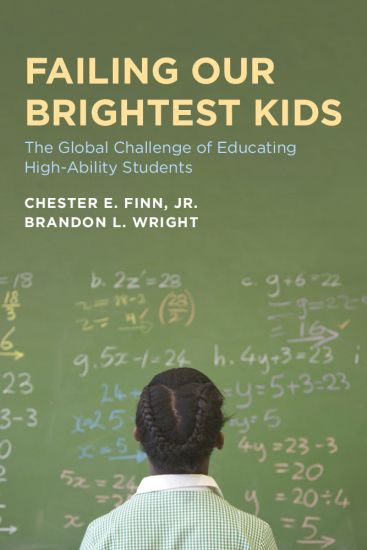
Failing Our Brightest Kids

Failing Our Brightest Kids

Chester E. Finn Jr; Brandon L. Wright

Harvard Educational Publishing Group
2015
nidottu
In this provocative volume, Chester E. Finn, Jr., and Brandon L. Wright argue that, for decades, the United States has done too little to focus on educating students to achieve at high levels. The authors identify two core problems: First, compared to other countries, the United States does not produce enough high achievers. Second, students from disadvantaged backgrounds are severely underrepresented among those high achievers. The authors describe educating students to high levels of achievement as an issue of both equity and human capital: talented students deserve appropriate resources and attention, and the nation needs to develop these students’ abilities to remain competitive in the international arena. The authors embark on a study of twelve countries and regions to address these issues, exploring the structures and practices that enable some countries to produce a higher proportion of high-achieving students than the United States and to more equitably represent disadvantaged students amongtheir top scorers. Based on this research, the authors present a series of ambitious but pragmatic points that they believe should inform US policy in this area. This candid and engaging book takes a topic that is largely discussed behind closed doors and puts it squarely on the table for public debate.