Kirjojen hintavertailu – 12 903 725 kirjaa ja 27 kauppaa

Kirjailija

Branka Vucetic

Kirjat ja teokset yhdessä paikassa: 4 kirjaa, julkaisuja vuosilta 1997–2012, suosituimpiin kuuluu Spread Spectrum CDMA Systems for Wireless Communications. Vertaile teosten hintoja ja tarkista saatavuus suomalaisista kirjakaupoista.

4 kirjaa

Kirjojen julkaisuvuodet: 1997–2012.

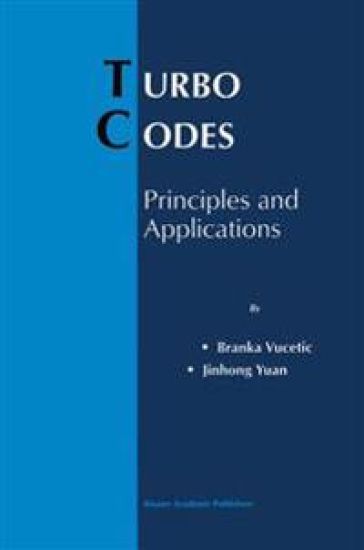
Turbo Codes

Turbo Codes

Branka Vucetic

Springer-Verlag New York Inc.
2012
nidottu
This book grew out of our research, industry consulting and con­ tinuing education courses. Turbo coding initially seemed to belong to a restricted research area, while now has become a part of the mainstream telecommu­ nication theory and practice. The turbo decoding principles have found widespread applications not only in error control, but in de­ tection, interference suppression and equalization. Intended for use by advanced students and professional engi­ neers, involved in coding and telecommunication research, the book includes both basic and advanced material. The chapters are se­ quenced so that the knowledge is acquired in a logical and progres­ sive way. The algorithm descriptions and analysis are supported by examples throughout the book. Performance evaluations of the presented algorithms are carried out both analytically and by sim­ ulations. Basic material included in the book has been taught to students and practicing professionals over the last four years in the form of senior undergraduate or graduate courses, lecture series and short continuing education courses.
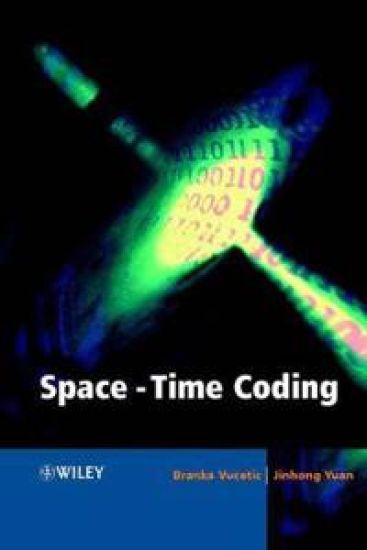
Space-Time Coding

Space-Time Coding

Branka Vucetic; Jinhong Yuan

John Wiley Sons Inc
2003
sidottu
Space–Time Coding provides an introduction to the subject and its application to wireless communication systems. With the integration of internet and multimedia applications in next generation wireless communications, the demand for wide-band high data rate communication services is growing. Space–time coding is based on introducing joint correlation in transmitted signals in both space and time domains. This volume provides an overview of design principles and major space–time coding techniques starting from MIMO system information theory capacity bounds and channel models, while endeavouring to pave the way towards complex areas such as applications of space–time codes and their performance evaluation in wide-band wireless channels. *Provides a working knowledge of Space–Time Coding. *Explains why Space–Time Codes have been included in the standards for the third generation wireless communication systems. *Offers illustrated examples, solutions and performance evaluation results throughout the volume. Written in a highly accessible format, Space–Time Coding is intended for postgraduate students, practicing engineers and researchers. The reader will have some familiarity with basic digital communications, matrix analysis and probability theory.
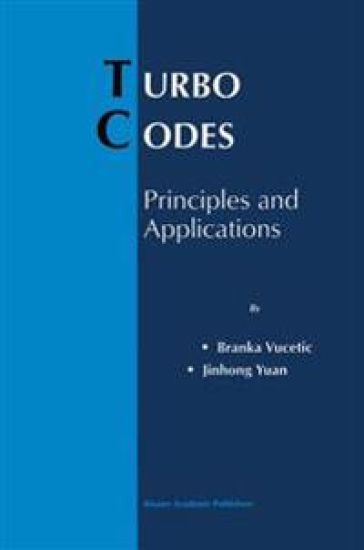
Turbo Codes

Turbo Codes

Branka Vucetic

Springer
2000
sidottu
This book grew out of our research, industry consulting and con­ tinuing education courses. Turbo coding initially seemed to belong to a restricted research area, while now has become a part of the mainstream telecommu­ nication theory and practice. The turbo decoding principles have found widespread applications not only in error control, but in de­ tection, interference suppression and equalization. Intended for use by advanced students and professional engi­ neers, involved in coding and telecommunication research, the book includes both basic and advanced material. The chapters are se­ quenced so that the knowledge is acquired in a logical and progres­ sive way. The algorithm descriptions and analysis are supported by examples throughout the book. Performance evaluations of the presented algorithms are carried out both analytically and by sim­ ulations. Basic material included in the book has been taught to students and practicing professionals over the last four years in the form of senior undergraduate or graduate courses, lecture series and short continuing education courses.
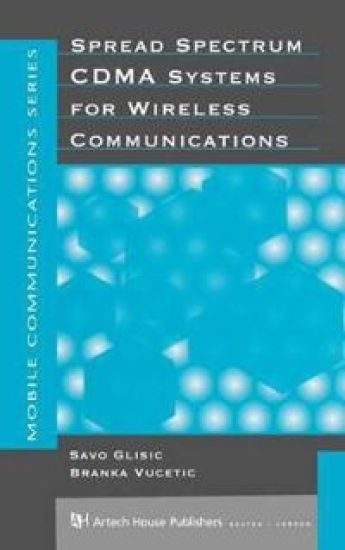
Spread Spectrum CDMA Systems for Wireless Communications

Spread Spectrum CDMA Systems for Wireless Communications

Savo G. Glisic; Branka Vucetic

Artech House
1997
sidottu
The spread-spectrum technique is becoming increasingly important in wireless communication systems. In this work, the main advantages of this techniques are outlined, describing its key elements, presenting important code acquisition strategies for direct sequences (DS) and frequency hopping (FH) systems, comparing various code tracking loop systems, and detailing receiver configurations based on CCD, SAW and DSP matched filters. The authors also examine system capacity issues related to the CDMA cellular network, and explain the CDMA overlay, packetized transmission in CDMA networks, and the problems of multiuser detection.