Kirjojen hintavertailu – 12 903 724 kirjaa ja 27 kauppaa

Kirjailija

Brian Galligan

Kirjat ja teokset yhdessä paikassa: 8 kirjaa, julkaisuja vuosilta 1995–2014, suosituimpiin kuuluu Citizens without Rights. Vertaile teosten hintoja ja tarkista saatavuus suomalaisista kirjakaupoista.

8 kirjaa

Kirjojen julkaisuvuodet: 1995–2014.

Becoming Australian

Becoming Australian

Brian Galligan; Martina Boese; Melissa Phillips

Academic Monographs
2014
sidottu
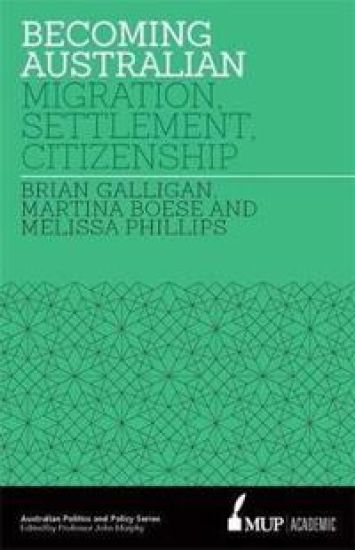
The year 2013 is the 40th anniversary of the end of the 'White Australia policy'. In these four decades Australia's immigration policy has shifted from a primary concern with cultural homogeneity or Britishness to a focus on demand-based skills through an increasingly fine-tuned system of points tests, occupation lists and employer-sponsored visas. Despite disproportionate politicisation of asylum seekers in recent public discourse, the intake of refugees and humanitarian entrants has remained relatively small. While Australia's contemporary migrant and refugee intake is truly multicultural, and governments continue to adhere to an official multicultural policy, integration into the Australian community and culture has been the dominant process, especially for second and third generation Australians. Australian identity and citizenship have changed in the last forty years, making Australia and its people more pluralistic and richly diverse. Becoming Australian focuses on the ways in which migrants and refugees meet the challenges of 'becoming Australian' and the transformative process for Australia and its people as they incorporate the continuing influx of multicultural peoples.
Becoming Australian

Becoming Australian

Brian Galligan; Martina Boese; Melissa Phillips

Academic Monographs
2014
pokkari
The year 2013 is the 40th anniversary of the end of the 'White Australia policy'. In these four decades Australia's immigration policy has shifted from a primary concern with cultural homogeneity or Britishness to a focus on demand-based skills through an increasingly fine-tuned system of points tests, occupation lists and employer-sponsored visas. Despite disproportionate politicisation of asylum seekers in recent public discourse, the intake of refugees and humanitarian entrants has remained relatively small. While Australia's contemporary migrant and refugee intake is truly multicultural, and governments continue to adhere to an official multicultural policy, integration into the Australian community and culture has been the dominant process, especially for second and third generation Australians. Australian identity and citizenship have changed in the last forty years, making Australia and its people more pluralistic and richly diverse. Becoming Australian focuses on the ways in which migrants and refugees meet the challenges of 'becoming Australian' and the transformative process for Australia and its people as they incorporate the continuing influx of multicultural peoples.
Australians and Globalisation

Australians and Globalisation

Brian Galligan; Winsome Roberts; Gabriella Trifiletti

Cambridge University Press
2001
pokkari
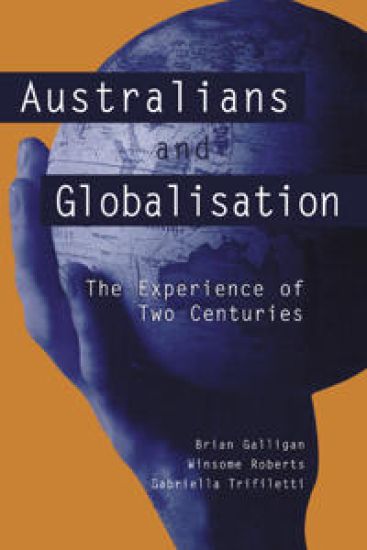
Is globalisation new? Are its effects inevitable? Are the concepts of national sovereignty and global markets incompatible? In this provocative book, the authors argue that Australia has always been a 'globalised' nation. In terms of its economy, political sovereignty and sense of national identity, the country and its citizens have had to create for themselves a complex position between dependence and irrelevance. Australians and Globalisation tells the tale of how governance and citizenship developed in response to global forces, starting with colonial societies and moving through the federation period and the twentieth century to the present day with its accelerated globalisation impact.
Citizens without Rights

Citizens without Rights

John Chesterman; Brian Galligan

Cambridge University Press
1997
pokkari
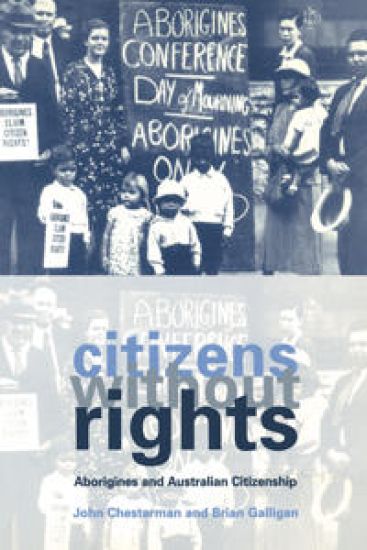
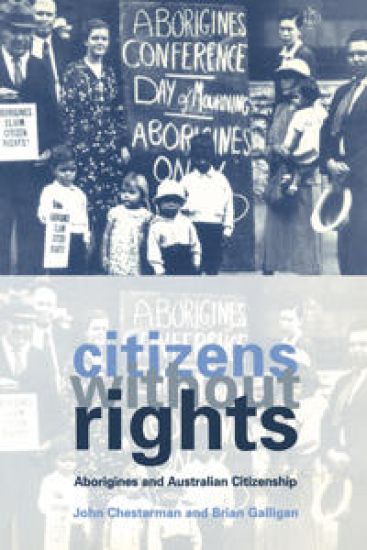
This is the first comprehensive study of the ways in which Aborigines and Torres Strait Islanders have been excluded from the rights of Australian citizenship over the past 100 years. Drawing extensively upon archival material, the authors look at how the colonies initiated a policy of exclusion that was then replicated by the Commonwealth and State governments following federation. The book includes careful examination of government policies and practice from the 1880s to the 1990s and argues that Aboriginal people have been central to notions of Australian citizenship by virtue of their exclusion from it. It overturns many assumptions and misunderstandings, arguing that there was never any constitutional reason why Aborigines could not be granted full citizenship. The authors show that citizenship was an empty term used to discriminate systematically against Aboriginal people.
Citizens without Rights

Citizens without Rights

John Chesterman; Brian Galligan

Cambridge University Press
1997
sidottu
This is the first comprehensive study of the ways in which Aborigines and Torres Strait Islanders have been excluded from the rights of Australian citizenship over the past 100 years. Drawing extensively upon archival material, the authors look at how the colonies initiated a policy of exclusion that was then replicated by the Commonwealth and State governments following federation. The book includes careful examination of government policies and practice from the 1880s to the 1990s and argues that Aboriginal people have been central to notions of Australian citizenship by virtue of their exclusion from it. It overturns many assumptions and misunderstandings, arguing that there was never any constitutional reason why Aborigines could not be granted full citizenship. The authors show that citizenship was an empty term used to discriminate systematically against Aboriginal people.
Federalism and the Environment

Federalism and the Environment

Brian Galligan; Kenneth M. Holland; F. Morton

Praeger Publishers Inc
1996
sidottu
This edited volume is a comprehensive examination of the legal framework in which environmental policy is fashioned in the major English-speaking federations—the United States, Canada, and Australia. The need for national solutions to environmental problems emerged long after the largest share of governmental power was allotted to states or provinces. This volume attempts to solve the paradox of how a country can have effective laws protecting the environment, vigorously enforced, when legislative and administrative powers are divided between two tiers of government. The contributors analyze environmental lawmaking along three dimensions. Part I describes the formal constitutional allocation of powers between states or provinces and the federal government, concluding that on paper environmental protection is essentially a local responsibility, although the reality is far different. In Part II the contributors explore the extent to which governments resort to informal negotiations among themselves to resolve environmental disputes. Part III is a thorough canvassing of the judiciary's role in making environmental policy and resolving disputes between levels and branches of government. In Australia and Canada, the courts play a relatively less important role in formulating policy than in the United States. In conclusion, the work shows that the level of environmental protection is relatively high in these three federations. Environmental politics, the work suggests, may be less divisive in federations than in unitary systems with comparable levels of development.
A Federal Republic

A Federal Republic

Brian Galligan

Cambridge University Press
1995
sidottu
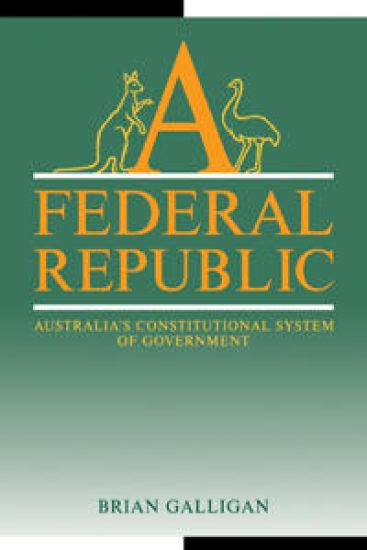
This provocative book, first published in 1995, argues that Australia is already a federal republic rather than a constitutional monarchy. It argues that by adopting a federal constitution in 1901 Australians ensured their status as a sovereign people. While the book does not deny the parliamentary and monarchic elements of the Australian system, it calls for a positive reassessment of the Constitution. Brian Galligan forcefully argues that the Australian Constitution has primacy over the other political institutions of the nation. The book considers fundamental issues that arise in discussion of the Constitution and federalism, including the role of the Senate, the possibility of a bill of rights, the way the High Court fits into the current system and the nature of governmental relations. This book will overturn the orthodoxies of much informed opinion and will challenge republicans and monarchists alike. Brian Galligan's unique perspective as a political scientist throws light on many aspects of federalism and will stimulate wide debate.
A Federal Republic

A Federal Republic

Brian Galligan

Cambridge University Press
1995
pokkari
This provocative book, first published in 1995, argues that Australia is already a federal republic rather than a constitutional monarchy. It argues that by adopting a federal constitution in 1901 Australians ensured their status as a sovereign people. While the book does not deny the parliamentary and monarchic elements of the Australian system, it calls for a positive reassessment of the Constitution. Brian Galligan forcefully argues that the Australian Constitution has primacy over the other political institutions of the nation. The book considers fundamental issues that arise in discussion of the Constitution and federalism, including the role of the Senate, the possibility of a bill of rights, the way the High Court fits into the current system and the nature of governmental relations. This book will overturn the orthodoxies of much informed opinion and will challenge republicans and monarchists alike. Brian Galligan's unique perspective as a political scientist throws light on many aspects of federalism and will stimulate wide debate.