

Kirjailija
Brian Inglis
Kirjat ja teokset yhdessä paikassa: 11 kirjaa, julkaisuja vuosilta 2011–2025, suosituimpiin kuuluu The Story Ireland. Vertaile teosten hintoja ja tarkista saatavuus suomalaisista kirjakaupoista.
11 kirjaa
Kirjojen julkaisuvuodet: 2011–2025.

Joan of Arc heard voices. Stravinsky and Mozart heard whole symphonies. Einstein solved problems without thinking. Archimedes solved his in the bath. Churchill felt protected by a guiding hand. What about you? Have you had an unknown Guest? Throughout the ages people have sensed the existence of a benevolent force intervening from time to time in their lives as if to offer them help and protection - or to chasten them. The good fairy of folklore and the guardian angel of Christian tradition belong in this category. Socrates said that he had heeded the voice of his 'daemon' all his life, and it had never let him down. Churchill sometimes had 'a strong feeling'; he told an audience of miners during the Second World War, 'that some guiding hand has interfered'. In The Unknown Guest Brian Inglis explores the historical and present-day evidence of the force. In perhaps its most familiar guise it operates as the 'muse' for writers and artists. And many of us have felt that chance and luck can't explain away hunches, premonitions, meaningful coincidences and extra-sensory perceptions. Brian Inglis concludes that we don't know enough to be sure about the source of these promptings but the evidence is impressive enough to be worth examining afresh.

Why do we dream? How have dreams helped inspire creative artists? How useful are they in daily problem solving? What evidence is there for second sight in dreaming? How much can dreams tell us about the future? In this wide ranging and immensely stimulating account, Brian Inglis first sifts the historical evidence and then describes recent scientific research, before proclaiming the empirical evidence both for a psychic element in dreams and for their frequently beneficial value in our day-to-day lives. He refers to the influences of 'visions of the night' on writers like Robert Louis Stevenson, Edgar Allen Poe, Sir Walter Scott, WB Yeats and Graham Greene. He quotes the testimony of scientists like Nils Bohr, Henri Fabre, and Frederick Kekul (who remarked: 'Let us learn to dream, gentlemen, and then perhaps we'll discover the truth'); and he cites instances of how specific dreams have served as 'memory joggers' or solved working problems in the case of inventors like Elias Howe (who invented the sewing machine) and sportsmen like Jack Nicklaus. The evidence for extra sensory communication in dreams is rich and enthralling - much of it derived from the contemporary archives of the Koestler Foundation. Precognition of dreams (as in 'disaster' or 'farewell' dreams), prophetic dreams, warning dreams and 'lucid' dreams are all indications that the mind in sleep can pick up useful information not ordinarily available to us when we are awake. 'To sleep, perchance to dream' the evolutionary potential of dreams has barely been tapped. Brian Inglis shows that it is we who can be the explorers now.
What exactly is psi? Why has the paranormal consistently been condemned by the scientific establishment? Why have its manifestations - ESP, psychokinesis, poltergeists and so on, which have been reported from every era, from every part of the world and all its walks of life - been so scathingly dismissed by supporters of scientism? Brian Inglis was bought up to regard science 'almost as a religion'. Such, he now fears, is precisely what it has become. Like other faiths, 'scientism' has developed dogmas which are founded, the faithful believe, on scientific facts, but which in reality are derived largely from the materialist assumptions of the Victorian physicists. Many of these assumptions, he argues, have now been revealed as fallacious, yet the scientific establishment clings to them tenuously. In this fascinating and remarkably clear study of attitudes, Inglis is concerned principally with the massive accumulation of evidence - historical, anecdotal and experimental - for the existence of action and communication at a distance of a kind which does not fit materialistic preconceptions. The force, all forces involved - for convenience labeled psi - can be observed in operation, at all biological levels, in the behaviour of plants, insects, animals and people, and Inglis has collected a striking body of evidence to illustrate the fact. He also examines how the force has been demonstrated in recent times - to the satisfaction of eminent quantum physicists. Yet, as the author shows, scientism's reaction has been either to ignore the evidence, pointing to some kind of extrasensory perception at work, or to explain it away with the help of far-fetched scientific theories which, however implausible, at least accord with prevailing scientific dogma. More alarming than this, Inglis reveals how some of the defenders of the faith have used their authority to stamp out heresy and discredit those, past and present, who have been courageous enough to explore this territory, in defiance of scientism's edicts. Heretics (and their works) may no longer be burned, but their academic prospects can be blighted and their reputations damaged. That the public should have been so misled by distorted versions of facts which would tend to support the case for psi is the most alarming disclosure to emerge from Inglis's investigation. The Hidden Poweris far from being merely a debunking of the debunkers. There has been no comparable survey of the psi evidence, including the flaws, to date, and none which so effectively removes the subject from its former murky associations. Bernard Levin said of Inglis's earlier book, Natural and Supernatural, 'I believe it to be an extraordinary important and valuable work, sensational in what it contains and even more so its implications ... he has piled up a mountain of evidence, searchingly examined and scrupulously evaluated. Arthur Koestler praised that work for being 'both scholarly and readable'. Now, in this book, Inglis points to a clear way forward in our understanding of the hidden power which is universally denied any useful application in everyday affairs.

In 1981 British Rail had a call from a woman who claimed to have had a vision of a fatal crash in which a freight train had been involved. So clear had it been, she said, that she not merely saw the blue diesel engine, but could read the number: 47 216. Two years later, an accident of the kind she predicted occurred, all the details matching - except one: the engine's number was 47 299. That would have been that, but a train spotter, Howard Johnston, happened to have noticed that 47 299 was not the engine's original number. It had been renumbered, a couple of years before, from 47 216. Diesels, he knew, were ordinarily renumbered only after major modifications, which this one had not undergone. When curiosity prompted him to ask why, he was told about the prediction. Apparently British Rail officials had been sufficiently impressed (they had checked with the local police, and found that the woman who had provided it had given them some useful information from her visions) to try to ward off fate by changing the number. The ruse had failed, and 'they had officially logged it all as an "amazing coincidence".'Life is full of coincidences, some are minor, but often, like the one above, they are extraordinary. Whether they are random events or meaningful cosmic moments which have a purpose, we don't know-it remains a mystery. But what is certain is, a lot of people have them, and they never cease to amaze us. In Coincidence: A Matter of Chance - or Synchronicity? Author and historian, Brian Inglis has compiled a collection of fascinating accounts that will uplift, confound, and leave the most committed sceptics scratching their heads.
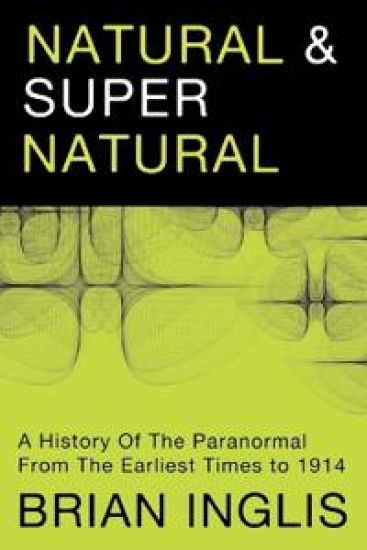
Did Moses turn rods into serpents? Does Uri Geller bend spoons? Did Socrates and Joan of Arc have spirit guides? Did Daniel Home levitate? The 1970's provided a striking revival of interest in the paranormal which has continued unabated into the twenty first century. Telepathy ESP, clairvoyance, premonitions, and psychokinesis - the action of mind upon matter - it was not long ago that orthodox opinion, both scientific and religious, rejected the possibility of such things out of hand. Today, their reality has been demonstrated and tested in laboratories all over the world and the results are published in serious scientific journals. Natural and Supernatural is the first full survey of the subject for over a century. With scrupulous thoroughness and a wealth of extraordinary detail, Brian Inglis presents his evidence, drawing on anthropological studies of primitive tribes and records of classical antiquity and taking his story to the outbreak of the First World War, when the first phase of scientific psychical research came to an end. He pays particular attention to the work of the mesmerists and of the early psychical researchers in the last century. He deals, too, with related aspects such as hauntings, poltergeist outbreaks:, scrying and dowsing. Contrary to popular belief, the evidence for psychic phenomena and non-locality, and the mass of material available to researchers is huge. Inglis meticulously sifted the genuine from the false., singling out such episodes as may reasonably be identified as historical and allowing the reader to make up his own mind, on the basis of the fullest and soundest knowledge, whether to accept paranormal phenomena or not. If they are accepted - and informed opinion is more and more moving that way- then a real revolution in our way of thinking is due to follow. For if mind can communicate with mind at distance, or move objects without contact, not merely will there have to be extensive revision of science textbooks. History, too, will need to be re-written, to allow for the possibility that reports which have long been dismissed as myth or illusion may have been accurate after all. The implications of the subject are great, and Inglis does them full justice. Praise for Natural and Supernatural.'I believe it to be an extraordinarily important and valuable work, sensational in what it contains and even more so in its implications...he has piled up a mountain of evidence, searchingly examined and scrupulously evaluated.' Bernard Levin, The Times 'It has the two basic qualities which make books on history endure: it is both scholarly and readable.' Arthur Koestler, the Guardian 'A tour de force...one of those works, like H. G. Wells Outline of History, that fires the imagination and leaves the reader feeling stunned, but excited.' Colin Wilson, Evening News 'Brian Inglis is eminently sensible and sane. In this massive survey, the evidence is presented in a sober and scholarly way... Natural and Supernatural is hard to fault.' the Economist Inglis bring to this book the same thoroughness and care that he shows in his other books...while I have not been converted, it has intensified mental conflict, and I admire and respect him for writing it.' Karl Sabbagh, New Scientist 'Cool, authoritative and highly readable - a service to science and society.' Ray Brown, Psychology Today

Emotional Stress And Your Health by Brian Inglis is a comprehensive guide that explores the relationship between emotional stress and physical health. The book is divided into several chapters, each of which focuses on a specific aspect of emotional stress and its impact on the body. The first chapter provides an overview of emotional stress, including its causes and symptoms. In subsequent chapters, the author delves deeper into the effects of stress on various bodily systems, including the cardiovascular system, immune system, and nervous system. He also discusses the role of stress in the development of chronic diseases such as cancer, diabetes, and autoimmune disorders. Throughout the book, Inglis provides practical tips and strategies for managing stress and reducing its impact on the body. He emphasizes the importance of self-care practices such as exercise, meditation, and social support, and provides guidance on how to incorporate these practices into daily life. Overall, Emotional Stress And Your Health is a valuable resource for anyone interested in understanding the complex relationship between emotional stress and physical health. The book is written in a clear and accessible style, making it easy to understand even for those without a background in medicine or psychology. This scarce antiquarian book is a facsimile reprint of the old original and may contain some imperfections such as library marks and notations. Because we believe this work is culturally important, we have made it available as part of our commitment for protecting, preserving, and promoting the world's literature in affordable, high quality, modern editions, that are true to their original work.