Kirjailija
Brian Reed
Kirjat ja teokset yhdessä paikassa: 34 kirjaa, julkaisuja vuosilta 2005–2026, suosituimpiin kuuluu Red Sonja: She-Devil with a Sword Volume 6. Vertaile teosten hintoja ja tarkista saatavuus suomalaisista kirjakaupoista.
34 kirjaa
Kirjojen julkaisuvuodet: 2005–2026.
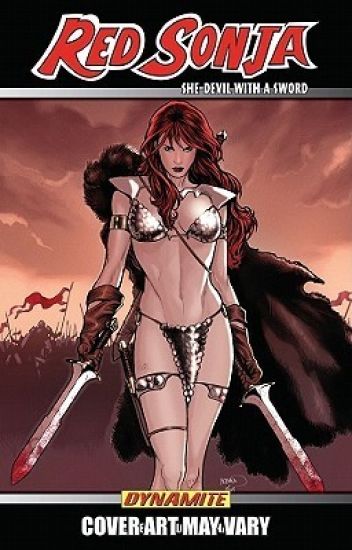
"Know also, 'O prince, that in the self-same days that the Cimmerian did stalk the Hyborian Kingdoms, one of the few swords worthy to cross with his was that of Red Sonja, warrior-woman out of majestic Hyrkania. Forced to flee her homeland because she spurned the advances of a king and slew him instead, she rode west across the Turanian Steppes and into the shadows mists of legendary." — The Nemedian Chronicles. This eighth volume in the epic saga of Red Sonja by writer Brian Reed and artist Walter Geovanni features a complete cover gallery.
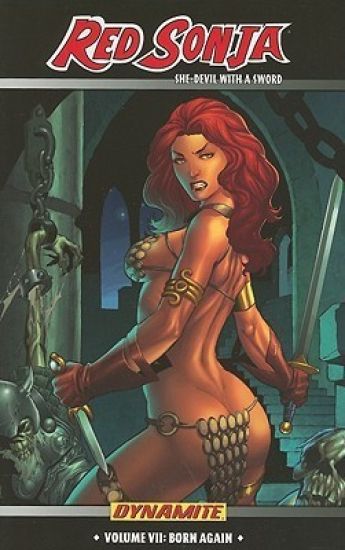
"Know also, 'o prince, that in the self-same days that the Cimmerian did stalk the Hyborian Kingdoms, one of the few swords worthy to cross with his was that of Red Sonja, warrior-woman out of majestic Hyrkania. Forced to flee her homeland because she spurned the advances of a king and slew him instead, she rode west across the Turanian Steppes and into the shadows mists of legendary." - The Nemedian ChroniclesThe seventh volume in Dynamite's hit Red Sonja series by Brian Reed and Walter Geovani.
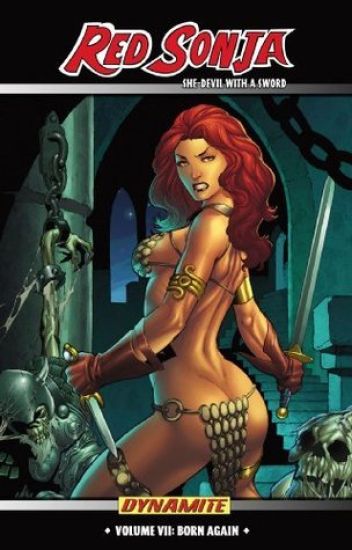
"Know also, 'o prince, that in the self-same days that the Cimmerian did stalk the Hyborian Kingdoms, one of the few swords worthy to cross with his was that of Red Sonja, warrior-woman out of majestic Hyrkania. Forced to flee her homeland because she spurned the advances of a king and slew him instead, she rode west across the Turanian Steppes and into the shadows mists of legendary." — The Nemedian ChroniclesThe seventh volume in Dynamite's hit Red Sonja series by Brian Reed and Walter Geovani.
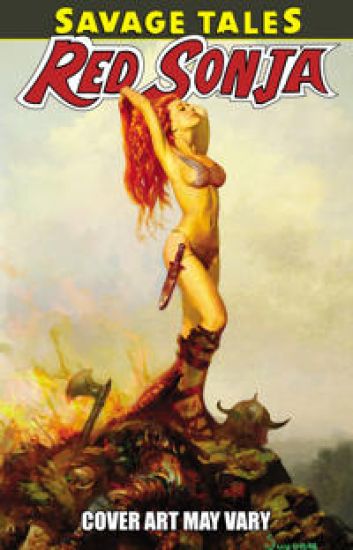
Savage Tales Of Red Sonja
Michael Avon Oeming; Christos Gage; J. T. Krul; Ron Marz; Joshua Ortega; Michael Leib; Brian Reed
Dynamic Forces Inc
2009
nidottu
The She-Devil With a Sword has had many Savage Tales, and now, Dynamite Entertainment presents them in this trade paperback collection featuring stories by Michael Avon Oeming, Ron Marz, Christos Gage, Joshua Ortega, Stephen Sadowski, Adriano Batsita, Pablo Marcos, and many more. This volume also includes a complete cover gallery.
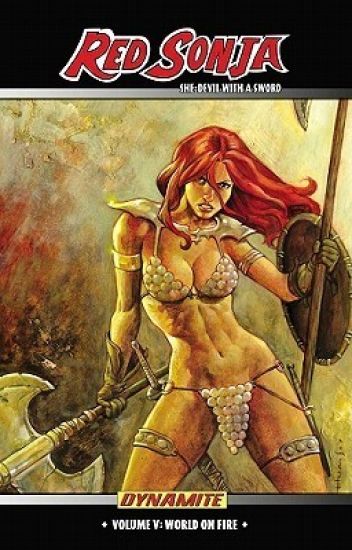
Red Sonja: She-Devil with a Sword Volume 5
Michael Avon Oeming; Brian Reed
Dynamite Entertainment
2008
nidottu
"Know also, 'o prince, that in the self-same days that the Cimmerian did stalk the Hyborian Kingdoms, one of the few swords worthy to cross with his was that of Red Sonja, warrior-woman out of majestic Hyrkania. Forced to flee her homeland because she spurned the advances of a king and slew him instead, she rode west across the Turanian Steppes and into the shadows mists of legendary." - The Nemedian ChroniclesThis fifth volume in the epic saga of Red Sonja contains issues #25-29 by writers Michael Avon Oeming, Brian Reed, and artist Homs, as the creative team presents the ultimate showdown with Kulan Gath.
Red Sonja: She Devil with a Sword Volume 5
Michael Avon Oeming; Brian Reed
Dynamite Entertainment
2008
sidottu
"Know also, 'o prince, that in the self-same days that the Cimmerian did stalk the Hyborian Kingdoms, one of the few swords worthy to cross with his was that of Red Sonja, warrior-woman out of majestic Hyrkania. Forced to flee her homeland because she spurned the advances of a king and slew him instead, she rode west across the Turanian Steppes and into the shadows mists of legendary." — The Nemedian ChroniclesThis fifth volume in the epic saga of Red Sonja contains issues #25-29 by writers Michael Avon Oeming, Brian Reed, and artist Homs, as the creative team presents the ultimate showdown with Kulan Gath.
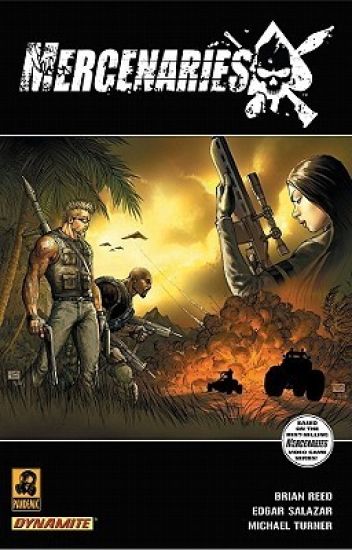
The best-selling video game from Pandemic Studios is the next new Dynamite Entertainment comic book event, collected here for the very first time! Get ready to join up with the Mercenaries! Mercenaries the game has revolutionized the world of 3rd-person action-shooters by putting players in the middle of real-world combat with the kind of freedom only a mercenary has. Featuring covers by red-hot artist Michael Turner, a stellar script from Mercenaries writer Brian (Ms. Marvel, Red Sonja) Reed, and art from Dynamite up-n-comer Edgar Salazar, The Mercenaries trade paperback puts you into the middle of the Mercenaries next adventure.



With his suicide in 1932, Hart Crane left behind a small body of work - ""White Buildings"" (1926) and ""The Bridge"" (1930). Yet, Crane's poetry was championed and debated publicly by many of the most eminent literary and cultural critics of his day, among them Van Wyck Brooks, Kenneth Burke, Robert Graves, Allen Tate, and Edmund Wilson. ""The Bridge"" appears in its entirety in the ""Norton Anthology of American Literature"" and Crane himself has been the subject of two recent biographies. In ""Hart Crane: After His Lights"", Brian Reed undertakes a study of Crane's poetic output that takes into account, but also questions, the post-structural and theoretical developments in humanities scholarship of the last decade that have largely approached Crane in a piecemeal way, or pigeonholed him as representative of his class, gender, or sexual orientation. Reed examines Crane's career from his juvenilia to his posthumous critical reception and his impact on practicing poets following World War II. The first part of the study tests common rubrics of literary theory - nationality, sexuality, period - against Crane's poetry, and finds that these labels, while enlightening, also obfuscate the origin and character of the poet's work. The second part examines Crane's poetry through the process of its composition, sources, and models, taking up questions of style, genealogy, and genre. The final section examines Crane's influence on subsequent generations of American poets, especially by avant-garde literary circles like the New American poets, the Black Mountain School, the New York School, and the Beats. The result is a study that complicates and enriches our understandings of Crane's poetry and contributes to the ongoing reassessment of literary modernism's origins, course, and legacy.

A critical reassessment of the life's work of a major American poet. With his suicide in 1932, Hart Crane left behind a small body of work - White Buildings (1926) and The Bridge (1930). Yet, Crane's poetry was championed and debated publicly by many of the most eminent literary and cultural critics of his day, among them Van Wyck Brooks, Kenneth Burke, Robert Graves, Allen Tate, and Edmund Wilson. The Bridge appears in its entirety in the Norton Anthology of American Literature, and Crane himself has been the subject two recent biographies. In Hart Crane: After His Lights, Brian Reed undertakes a study of Crane's poetic output that takes into account, but also questions, the post-structural and theoretical developments in humanities scholarship of the last decade that have largely approached Crane in a piecemeal way, or pigeonholed him as represen-tative of his class, gender, or sexual orientation. Reed examines Crane's career from his juvenilia to his posthumous critical reception and his impact on practicing poets following World War II. The first part of the study tests common rubrics of literary theory - nationality, sexuality, period - against Crane's poetry, and finds that these labels, while enlightening, also obfuscate the origin and character of the poet's work. The second part examines Crane's poetry through the process of its composition, sources, and models, taking up questions of style, genealogy, and genre. The final section examines Crane's influence on subsequent generations of American poets, especially by avant-garde literary circles like the New American poets, the Black Mountain School, the New York School, and the Beats. The result is a study that complicates and enriches our understandings of Crane's poetry and contributes to the ongoing reassessment of literary modernism's origins, course, and legacy.

Brian Reed's account is widely acknowledged as the definitive work on the once mighty Crewe Works, with an emphasis on the pre-1947 period it also includes information on the post-nationalisation period. It provides a wealth of authoritative detail on the development of the works, including illuminating biographies of Crewe's major engineers, and is illustrated with historic photographs and line illustrations, including layout diagrams