
Kirjojen hintavertailu – 12 859 819 kirjaa ja 27 kauppaa

Kirjailija

Bruce D. Chilton

Kirjat ja teokset yhdessä paikassa: 23 kirjaa, julkaisuja vuosilta 1994–2025, suosituimpiin kuuluu James the Just and Christian Origins. Vertaile teosten hintoja ja tarkista saatavuus suomalaisista kirjakaupoista.

Nimi esiintyy myös muodoissa: Bruce D Chilton

23 kirjaa

Kirjojen julkaisuvuodet: 1994–2025.

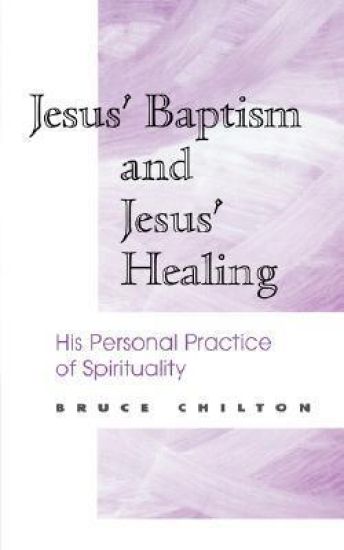
Jesus' Baptism and Jesus' Healing

Jesus' Baptism and Jesus' Healing

Bruce D. Chilton

Continuum International Publishing Group - Trinity
1998
pokkari
Within the environment of the Judaism of his day, Jesus practiced a unique understanding of purity grounded in his eschatological vision of how God was acting to gather his people. But Jesus practice was not only a matter of getting people to see God in the same way as he did. He also acted directly to put his own view of purity into effect, declaring clean what earlier had been considered unclean. This was already a concern in the ministry of John the baptizer, and it is apparent now that Jesus too was moved by the prospect of the purification of all Israel. The politics of Herod Antipas within Imperial Rome had made John s program appear seditious, and Jesus needed to be aware of this. In addition, John had conceived of God as preparing a pure people by means of immersion, but Jesus saw the people of his Galilee already pure and ready for the disclosure of a kingdom they could already celebrate. This is what caused Jesus to stop baptizing people as he had once done as John s disciple and to begin a dedicated ministry of healing based on his awareness of the Spirit within him, an awareness that emerges as a major concern of this book. A final portion of the book studies how baptism within the earliest church emerged as a celebration of the Spirit of God." An innovative perception of how a rite of purity might be understood when set over against its manifold historical contexts: religious, sociological, historical, political, and anthropological." -- Scot McKnight, North Park UniversityBruce Chilton, New Testament and Judaic scholar, is Bernard Iddings Bell Professor of Religion at Bard College, Annandale-on-Hudson, NY.>
The Body of Faith

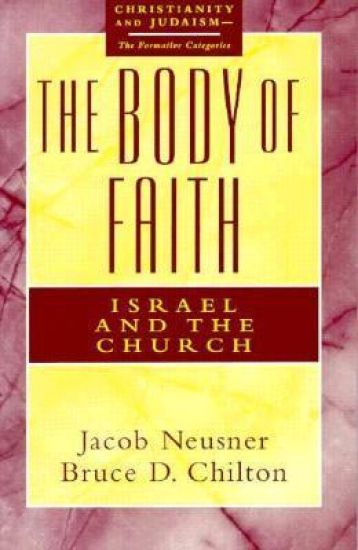
The Body of Faith

Jacob Neusner; Bruce D. Chilton

Continuum International Publishing Group - Trinity
1996
nidottu
Here is the second of three volumes (the first, Revelation: The Torah and the Bible, was published in 1995) whose purpose is to compare and contrast the paramount theological categories of Judaism and Christianity. The volumes provide the faithful of both Judaism and Christianity with informative, factual accounts of how Judaism and Christianity addressed the same issues and set forth their own distinctive program and set of propositions. While religions speak to individuals in the privacy of their hearts, they also define themselves through social entities such as church, holy people, nation of Islam, kingdom of God. In this book, Professors Neusner and Chilton bring reader to a consideration of Israel in Judaism and Christianity. When Jews call themselves Israel, their initial claim is that they constitute the Israel to whom God gave the Torah. All of those who inherit these Hebrew scriptures, specifically Christians, also claim to form an Israel because they receive these scriptures. Individual chapters in part one deal with Israel in the theology of Judaism, Israel as a kingdom of priests and holy nation, Israel as family, and Israel as (Christian) Rome. Part two examines Jesus and the absence of Israel; the Israel of James, the community of Q and Peter; and the church (ekklesia) in the Synoptic Gospels, Paul, Hebrews, and Revelation. The volumes in this series are excellent resources for all who wish to deepen their understanding of Judaism and Christianity and the relationship between these two great traditions. Jacob Neusner, leading scholar of the formative age and writings of Judaism, is Distinguished Research Professor of Religious Studies at the University of South Florida, Tampa. Bruce D. Chilton, New Testament and Judaic scholar, is Bernard Iddings Bell Professor of Religion at Bard College, Annandale-on-Hudson, NY.>
A Feast of Meanings

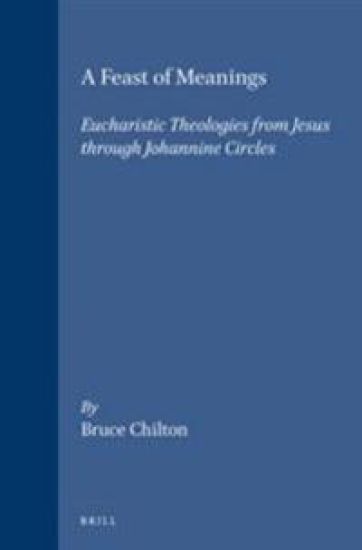
A Feast of Meanings

Bruce D. Chilton

Brill
1994
Erikoissidos
The monograph analyses eucharistic texts on the basis of the social practices which generated them. Six stages of ideology are identified. Jesus himself practised fellowship at meals as celebrations of Israel's purity (stage 1), and later insisted that a pure meal was a better sacrifice than an offering in the Temple (stage 2). The circle of Peter made such meals into covenantal celebrations; Jesus became a new Moses (stage 3). In order to militate against the full participation of non-Jews, the circle of James invented the full identifications with Passover (stage 4). Paul resisted any such limitations (stage 5). The Synoptic tradition accepted the Jacobean chronology, but joined Paul in developing the Hellenistic theme of Jesus as heroic martyr, and in explaining eucharist as a means of effecting solidarity with Jesus (stage 5). The Johannine ideologies transformed the idiom of eucharist by making Jesus into the paschal lamb which is consumed (stage 6). A conclusion relates the practices identified to the sources behind the Gospels; and shows how practice is key to the meanings of eucharistic texts.