Kirjojen hintavertailu – 12 859 824 kirjaa ja 27 kauppaa

Kirjailija

Bruce Fuller

Kirjat ja teokset yhdessä paikassa: 14 kirjaa, julkaisuja vuosilta 1992–2026, suosituimpiin kuuluu Debating Childhood and Preschool. Vertaile teosten hintoja ja tarkista saatavuus suomalaisista kirjakaupoista.

14 kirjaa

Kirjojen julkaisuvuodet: 1992–2026.

Debating Childhood and Preschool

Debating Childhood and Preschool

Bruce Fuller

OXFORD UNIVERSITY PRESS INC
2026
sidottu
Investments in young children--by caregivers, educators, and civic leaders--have grown enormously since the late twentieth century. Alongside this trend, deeply human questions have become hotly debated. How do we best nurture young children? Which adults and what settings best foster the early learning and social vitality of our youngest kids? Debating Childhood and Preschool tackles these essential issues, clarifying the philosophical divides and examining popular beliefs about child-rearing and early education. Bringing five decades of experience--as parent, teacher, and policy activist--Bruce Fuller unpacks the contested ideological roots of child-rearing and how they surface in preschool. He confronts guiding mythologies, such as "learning through play" and "free pre-K will narrow disparities," inviting parents and teachers to question their own assumptions about how we nurture and shape young children. By sharpening philosophical stances and deftly reviewing decades of empirical evidence, Fuller details how families, educators, and policy advocates can fine-tune their essential work in raising the next generation.

Debating Childhood and Preschool

Debating Childhood and Preschool

Bruce Fuller

OXFORD UNIVERSITY PRESS INC
2026
nidottu
Investments in young children--by caregivers, educators, and civic leaders--have grown enormously since the late twentieth century. Alongside this trend, deeply human questions have become hotly debated. How do we best nurture young children? Which adults and what settings best foster the early learning and social vitality of our youngest kids? Debating Childhood and Preschool tackles these essential issues, clarifying the philosophical divides and examining popular beliefs about child-rearing and early education. Bringing five decades of experience--as parent, teacher, and policy activist--Bruce Fuller unpacks the contested ideological roots of child-rearing and how they surface in preschool. He confronts guiding mythologies, such as "learning through play" and "free pre-K will narrow disparities," inviting parents and teachers to question their own assumptions about how we nurture and shape young children. By sharpening philosophical stances and deftly reviewing decades of empirical evidence, Fuller details how families, educators, and policy advocates can fine-tune their essential work in raising the next generation.
When Schools Work

When Schools Work

Bruce Fuller

Johns Hopkins University Press
2022
sidottu
How did a young generation of activists come together in 1990s Los Angeles to shake up the education system, creating lasting institutional change and lifting children and families across southern California? Critics claim that America's public schools remain feckless and hamstrung institutions, unable to improve even when nudged by accountability-minded politicians, market competition, or global pandemic. But if schools are so hopeless, then why did student learning climb in Los Angeles across the initial decades of the twenty-first century? In When Schools Work, Bruce Fuller details the rise of civic activists in L. A. as they emerged from the ashes of urban riots and failed efforts to desegregate schools. Based on the author's fifteen years of field work in L. A., the book reveals how this network of Latino and Black leaders, civil rights lawyers, ethnic nonprofits, and pedagogical progressives coalesced in the 1990s, staking out a third political ground and gaining distance from corporate neoliberals and staid labor chiefs. Fuller shows how these young activists—whom he terms "new pluralists"—proceeded to better fund central-city schools, win quality teachers, widen access to college prep courses, decriminalize student discipline, and even create a panoply of new school forms, from magnet schools to dual-language campuses, site-run small high schools, and social-justice focused classrooms. Moving beyond perennial hand-wringing over urban schools, this book offers empirical lessons on what reforms worked to lift achievement—and kids—across this vast and racially divided metropolis. More broadly, this study examines why these new pluralists emerged in this kaleidoscopic city and how they went about jolting an institution once given up for dead. Spotlighting the force of ethnic communities and humanist notions of children's growth, Fuller argues that diversifying forms of schooling also created unforeseen ways of stratifying both children and families. When Schools Work will inform the efforts of educators, activists, policy makers, and anyone else working to reshape public schools and achieve equitable results for all children.
Government Confronts Culture

Government Confronts Culture

Bruce Fuller

Routledge
2016
nidottu
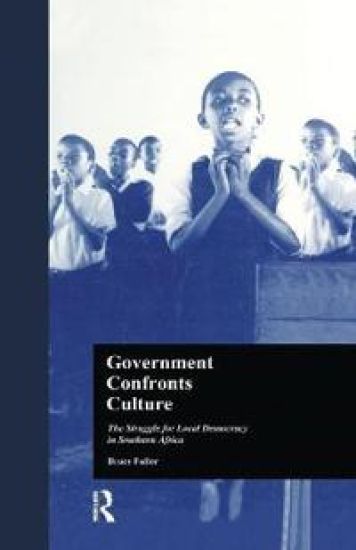
Transitional societies—struggling to build democratic institutions and new political traditions—are faced with a painful dilemma. How can Government become strong and effective, building a common good that unites disparate ethnic and class groups, while simultaneously nurturing democratic social rules at the grassroots? Professor Fuller brings this issue to light in the contentious, multicultural setting of Southern Africa. Post-apartheid states, like South Africa and Namibia, are pushing hard to raise school quality, reduce family poverty, and equalize gender relations inside villages and townships. But will democratic participation blossom at the grassroots as long as strong central states—so necessary for defining the common good—push universal policies onto diverse local communities? This book builds from a decade of family surveys and qualitative village studies led by Professor Fuller at Harvard University and African colleagues inside Botswana, Namibia, and South Africa.
Organizing Locally

Organizing Locally

Bruce Fuller

University of Chicago Press
2015
sidottu
We love the local. From the cherries we buy, to the grocer who sells them, to the school where our child unpacks them for lunch, we express resurgent faith in decentralizing the institutions and businesses that arrange our daily lives. But huge, bureaucratic organizations often still shape the character of our jobs, schools, the groceries where we shop - even the hospitals we entrust with our lives. So how, exactly, can we work small, when everything around us is so big? In Organizing Locally, Bruce Fuller shows us, taking stock of America's rekindled commitment to localism across an illuminating range of sectors, unearthing the crucial values and practices of decentralized firms that work. Traveling from a charter school in San Francisco to a veterans service network in Iowa, from a Pennsylvania health-care firm to the Manhattan branch of a Swedish bank, he explores how creative managers have turned local staff loose to craft inventive practices, untethered from central rules and plain-vanilla routines. By holding their successes and failures up to the same analytical light, he vividly reveals the key cornerstones of social organization on which effective decentralization depends. Ultimately, he brings order and evidence to the often strident debates about who has the power - and on what scale - to structure how we work and live locally.
Organizing Locally

Organizing Locally

Bruce Fuller

University of Chicago Press
2015
nidottu
We love the local. From the cherries we buy, to the grocer who sells them, to the school where our child unpacks them for lunch, we express resurgent faith in decentralizing the institutions and businesses that arrange our daily lives. But huge, bureaucratic organizations often still shape the character of our jobs, schools, the groceries where we shop-even the hospitals we entrust with our lives. So how, exactly, can we work small, when everything around us is so big? In Organizing Locally, Bruce Fuller shows us, taking stock of America's rekindled commitment to localism across an illuminating range of sectors, unearthing the crucial values and practices of decentralized firms that work. Traveling from a charter school in San Francisco to a veterans service network in Iowa, from a Pennsylvania health-care firm to the Manhattan branch of a Swedish bank, he explores how creative managers have turned local staff loose to craft inventive practices, untethered from central rules and plain-vanilla routines. By holding their successes and failures up to the same analytical light, he vividly reveals the key cornerstones of social organization on which effective decentralization depends. Ultimately, he brings order and evidence to the often strident debates about who has the power - and on what scale - to structure how we work and live locally.
Growing-Up Modern

Growing-Up Modern

Bruce Fuller

Routledge
2015
nidottu
The modern state – First and Third Worlds alike – pushes tirelessly to expand mass education and to deepen the schools’ effect upon children. First published in 1991, Growing-Up Modern explores why, how, and with what actual effects state actors so vehemently pursue this dual political agenda. Bruce Fuller first delves into the motivations held by politicians, education bureaucrats and civic elites as they earnestly seek to spread schooling to younger children, older adults and previously disenfranchised groups. Fuller argues that the school provides an institutional stage on which political actors signal their ideals and the coming of greater modernity; broadening membership in the polity, promising mass opportunity in the wage sector, intensifying modern (bureaucratic) forms of school management, and deepening a presumed commitment to the child’s individual development. Fuller advances a theory of the ‘fragile state’ where Western political expectations and organisations are placed within pluralistic Third World settings, using southern Africa as an example of the dilemmas faced by the central state.
Growing-Up Modern

Growing-Up Modern

Bruce Fuller

Routledge
2010
sidottu
The modern state – First and Third Worlds alike – pushes tirelessly to expand mass education and to deepen the schools’ effect upon children. First published in 1991, Growing-Up Modern explores why, how, and with what actual effects state actors so vehemently pursue this dual political agenda. Bruce Fuller first delves into the motivations held by politicians, education bureaucrats and civic elites as they earnestly seek to spread schooling to younger children, older adults and previously disenfranchised groups. Fuller argues that the school provides an institutional stage on which political actors signal their ideals and the coming of greater modernity; broadening membership in the polity, promising mass opportunity in the wage sector, intensifying modern (bureaucratic) forms of school management, and deepening a presumed commitment to the child’s individual development. Fuller advances a theory of the ‘fragile state’ where Western political expectations and organisations are placed within pluralistic Third World settings, using southern Africa as an example of the dilemmas faced by the central state.
Standardized Childhood

Standardized Childhood

Bruce Fuller

Stanford University Press
2008
pokkari
A array of childcare and preschool options blossomed in the 1970s as the feminist movement spurred mothers into careers and community organizations nurtured new programs. Now a small circle of activists aims to bring more order to childhood, seeking to create a more standard, state-run preschool system. For young children already facing the rigors of play dates and harried parents juggling the strains of work and family, government is moving in to standardize childhood. Sociologist Bruce Fuller traveled the country to understand the ideologies of childhood and the raw political forces at play. He details how progressives earnestly seek to extend the rigors of public schooling down into the lives of very young children. Fuller then illuminates the stiff resistance from those who hold less trust in government solutions and more faith in nonprofits and local groups in contributing to the upbringing of young children. The call for universal preschool is a new front in the culture wars, raising sharp questions about American families, cultural diversity, and the appropriate role of the state in the lives of our young children. Standardized Childhood shows why the universal preschool movement is attracting such robust support—and strident opposition—nationwide.
Standardized Childhood

Standardized Childhood

Bruce Fuller

Stanford University Press
2007
sidottu
A array of childcare and preschool options blossomed in the 1970s as the feminist movement spurred mothers into careers and community organizations nurtured new programs. Now a small circle of activists aims to bring more order to childhood, seeking to create a more standard, state-run preschool system. For young children already facing the rigors of play dates and harried parents juggling the strains of work and family, government is moving in to standardize childhood. Sociologist Bruce Fuller traveled the country to understand the ideologies of childhood and the raw political forces at play. He details how progressives earnestly seek to extend the rigors of public schooling down into the lives of very young children. Fuller then illuminates the stiff resistance from those who hold less trust in government solutions and more faith in nonprofits and local groups in contributing to the upbringing of young children. The call for universal preschool is a new front in the culture wars, raising sharp questions about American families, cultural diversity, and the appropriate role of the state in the lives of our young children. Standardized Childhood shows why the universal preschool movement is attracting such robust support—and strident opposition—nationwide.
Through My Own Eyes

Through My Own Eyes

Susan D. Holloway; Bruce Fuller; Marylee F. Rambaud; Costanza Eggers-Piérola

Harvard University Press
2001
nidottu
Shirl is a single mother who urges her son's baby-sitter to swat him when he misbehaves. Helena went back to work to get off welfare, then quit to be with her small daughter. Kathy was making good money but got into cocaine and had to give up her two-year-old son during her rehabilitation. Pundits, politicians, and social critics have plenty to say about such women and their behavior. But in this book, for the first time, we hear what these women have to say for themselves. An eye-opening--and heart-rending--account from the front lines of poverty, Through My Own Eyes offers a firsthand look at how single mothers with the slimmest of resources manage from day to day. We witness their struggles to balance work and motherhood and watch as they negotiate a bewildering maze of child-care and social agencies. For three years the authors followed the lives of fourteen women from poor Boston neighborhoods, all of whom had young children and had been receiving welfare intermittently. We learn how these women keep their families on firm footing and try--frequently in vain--to gain ground. We hear how they find child-care and what they expect from it, as well as what the childcare providers have to say about serving low-income families. Holloway and Fuller view these lives in the context of family policy issues touching on the disintegration of inner cities, welfare reform, early childhood and "pro-choice" poverty programs.
Government Confronts Culture

Government Confronts Culture

Bruce Fuller

CRC Press Inc
1999
sidottu
Transitional societies—struggling to build democratic institutions and new political traditions—are faced with a painful dilemma. How can Government become strong and effective, building a common good that unites disparate ethnic and class groups, while simultaneously nurturing democratic social rules at the grassroots? Professor Fuller brings this issue to light in the contentious, multicultural setting of Southern Africa. Post-apartheid states, like South Africa and Namibia, are pushing hard to raise school quality, reduce family poverty, and equalize gender relations inside villages and townships. But will democratic participation blossom at the grassroots as long as strong central states—so necessary for defining the common good—push universal policies onto diverse local communities? This book builds from a decade of family surveys and qualitative village studies led by Professor Fuller at Harvard University and African colleagues inside Botswana, Namibia, and South Africa.
The Political Construction of Education

The Political Construction of Education

Bruce Fuller; Richard Rubinson

Praeger Publishers Inc
1992
sidottu
Political actors within the modern state--in both the West and the Third World--argue that more schooling can provide remedies for a variety of economic and social ills. But what is the state's actual efficacy in sparking demands for, and constructing effective forms of, mass schooling? Is the state really an effective agent relative to educational demands originating from other institutions: competing economic interests, the family, and the school institution itself? Under what institutional conditions does school expansion spur economic growth and change? Since the 1960s, institutional and economic theorists have advanced responses to these important issues from three theoretical perspectives: functionalist human capital, class conflict, and world institution frameworks. This volume reviews historical work on these critical issues, conducted over the past two decades in the United States, Europe, and the Third World. Review chapters are complemented by reports of new findings--authored by a novel array of international economists, sociologists, and political analysts pulled together for this unusual initiative. Following a review chapter on the state's role in boosting mass schooling and economic change, Part 1 focuses on the historical origins of literacy and schooling. Part 2 reports original work on national economic effects of school expansion, drawing on experiences from both industrialized and developing economies. Part 3 turns to the issue of how central states attempt to craft the supply of, and manipulate popular demand for, schooling. Practical implications are discussed throughout. Top researchers have gathered an abundance of evidence, providing a rich reference volume for scholars and social policy makers alike.