
Kirjojen hintavertailu – 12 859 819 kirjaa ja 27 kauppaa

Kirjailija

Bruno S. Frey

Kirjat ja teokset yhdessä paikassa: 23 kirjaa, julkaisuja vuosilta 1988–2024, suosituimpiin kuuluu Overcoming Overtourism. Vertaile teosten hintoja ja tarkista saatavuus suomalaisista kirjakaupoista.

23 kirjaa

Kirjojen julkaisuvuodet: 1988–2024.

Not Just for the Money

Not Just for the Money

Bruno S. Frey

Edward Elgar Publishing Ltd
1998
nidottu
In Not Just for the Money Professor Frey challenges traditional economic theory and argues that people do not act in expectation of monetary gain alone, nor do they work solely because they are paid. Furthermore, the author claims that higher monetary compensation as well as regulations crowd-out motivation in important circumstances. Offering higher pay may make people less committed to their work and may reduce their performance. They thus behave in exactly the opposite way the fundamental price-effect of economics predicts. The first part of the book considers the Crowding-Out Effect and the Motivational Spill-Over Effect. The second part explores a large number of applications to constitutional questions, various policy issues and the organization of firms. The final part discusses the substantial consequences for policy making and economic theory. This path breaking book is bound to create controversy and debate. It will appeal not only to economists but to a wide range of social scientists who want to go beyond the traditional assumption of economic man.
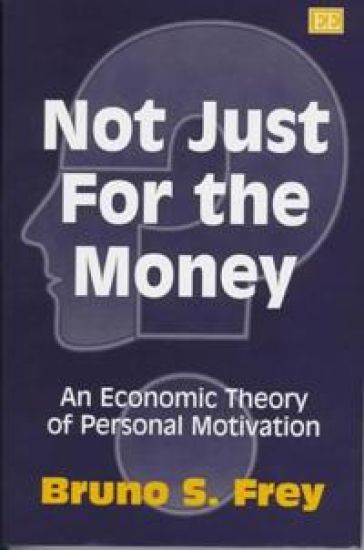
Not Just for the Money

Not Just for the Money

Bruno S. Frey

Edward Elgar Publishing Ltd
1997
sidottu
In Not Just for the Money Professor Frey challenges traditional economic theory and argues that people do not act in expectation of monetary gain alone, nor do they work solely because they are paid. Furthermore, the author claims that higher monetary compensation as well as regulations crowd-out motivation in important circumstances. Offering higher pay may make people less committed to their work and may reduce their performance. They thus behave in exactly the opposite way the fundamental price-effect of economics predicts. The first part of the book considers the Crowding-Out Effect and the Motivational Spill-Over Effect. The second part explores a large number of applications to constitutional questions, various policy issues and the organization of firms. The final part discusses the substantial consequences for policy making and economic theory. This path breaking book is bound to create controversy and debate. It will appeal not only to economists but to a wide range of social scientists who want to go beyond the traditional assumption of economic man.