Kirjojen hintavertailu – 12 903 724 kirjaa ja 27 kauppaa
Kirjailija
Bureau of Land Management
Kirjat ja teokset yhdessä paikassa: 40 kirjaa, julkaisuja vuosilta 2012–2016, suosituimpiin kuuluu Ecological Site Inventory. Vertaile teosten hintoja ja tarkista saatavuus suomalaisista kirjakaupoista.
Culture resource overviews such as this bring together much of the available information on prehistoric and historic peoples and present day Native American groups along with their associated environments. The purpose behind these studies is to provide background information for the management of and research into these prehistoric, historic, and contemporary resources. This overview is one of seven covering the southern California deserts undertaken as part of a comprehensive planning effort by the Bureau of Land Management for these deserts. Overviews aid in the day-to-day management of cultural resources and in the completion of environmental analyses and research projects. Its general value to the public in the fields of education and recreation-interpretation must also be stressed. Usually cultural overviews are completed prior to beginning the field assessments of prehistoric and historic remains and contemporary ethnic values. In this case, however, the nature of the planning effort was such that both field-work and literature search were completed at approximately the same time. The complementary field report by Gary Coombs (1979) in this series is titled "The Archaeology of the Western Mojave". Portions of the field report are discussed in this overview. The final report manuscript was submitted by Environmental Research Archaeologists in May of 1979 following contract initiation one year earlier. The authors are to be congratulated for their time-consuming efforts in bringing together relevant information on lands administered by the Bureau and considerable data concerning the surrounding private land. This work should prove popular with both the lay-reader and professional as it presents new ideas and interpretations of existing data which is sure to stimulate further interest and work. Its value to the management of cultural resources has already been realized in part and will no doubt continue
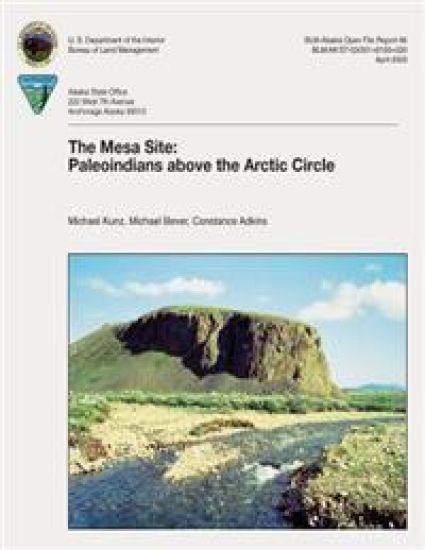
Between 1978 and 1999, excavations in arctic and western Alaska have revealed the presence of Paleoindians during terminal Pleistocene/early Holocene times, ca. 12,000 to 9500 years BP (Before Present). The Type Site for this cultural manifestation, the Mesa Site, is located on the northern flank of the central Brooks Range at N68 24.72 W155 48.02, amid rolling foothills that extend northward 40 miles to the Colville River. The site lies atop a mesa-like ridge that rises 180 feet above the floor of the Iteriak Creek valley, offering an unobstructed 360 view of the surrounding treeless countryside. Excavation at the site has produced the remains of more than 450 formal flaked stone tools and over 120,000 pieces of lithic debitage, which comprise an assemblage typical of the "classic" Paleoindian cultures of the North American High Plains. More than 150 of the artifacts are the complete or fragmentary remains of lanceolate projectile points, many of which have been recovered from within the charcoal/soil matrix of discrete hearths which are the central features of numerous activity areas. The age of the occupation is constrained by 44 uncalibrated AMS radiocarbon dates covering the interval 11,700 to 9700 years BP. The site lacks evidence of any widespread postdepositional disturbance and, except for a small, discrete manifestation in Locality A, contains no remains of more recent cultures. The composition of the Mesa artifact assemblage and its obvious technological relationship with the Paleoindian cultures of mid-continent North America mark it as distinctly different from other ancient arctic cultures. The presence of the Mesa Complex demonstrates a previously undocumented cultural diversity in Eastern Beringia at the Pleistocene/Holocene boundary. This is an interim report. The amount of data generated by the Mesa project is immense. Although we engaged in some analysis and compilation of data as we progressed through the field work, we are not in a position to present this information in its totality. Therefore, limits have necessarily been placed upon the scope of this report so that it can be completed in a reasonable amount of time. While some primary analysis has not been completed, we have enough information to present a report that is more descriptive and introspective than a raw data monograph. In this report, we address the scope of research, order and describe the data analyzed so far, and interpret and summarize the findings to date. This will be accomplished by discussing the following subjects: the culture history of the region and the place of the Mesa Complex within that culture history framework; the natural setting of the site region; the excavation and data collection methods; the description of the site including the natural and cultural stratigraphy, cultural features, localities and activity areas; the flaked stone industry including artifact typology, tool-stone variety, and tool use; the regional Pleistocene faunal assemblage; the regional Pleistocene climate and ecology; and site use.