Kirjojen hintavertailu – 12 903 725 kirjaa ja 27 kauppaa

Kirjailija

C. Suryanarayana

Kirjat ja teokset yhdessä paikassa: 7 kirjaa, julkaisuja vuosilta 1998–2020, suosituimpiin kuuluu Experimental Techniques in Materials and Mechanics. Vertaile teosten hintoja ja tarkista saatavuus suomalaisista kirjakaupoista.

Nimi esiintyy myös muodoissa: C Suryanarayana

7 kirjaa

Kirjojen julkaisuvuodet: 1998–2020.

Bulk Metallic Glasses

Bulk Metallic Glasses

C. Suryanarayana; A. Inoue

CRC Press
2020
nidottu
Reflecting the fast pace of research in the field, the Second Edition of Bulk Metallic Glasses has been thoroughly updated and remains essential reading on the subject. It incorporates major advances in glass forming ability, corrosion behavior, and mechanical properties. Several of the newly proposed criteria to predict the glass-forming ability of alloys have been discussed. All other areas covered in this book have been updated, with special emphasis on topics where significant advances have occurred. These include processing of hierarchical surface structures and synthesis of nanophase composites using the chemical behavior of bulk metallic glasses and the development of novel bulk metallic glasses with high-strength and high-ductility and superelastic behavior. New topics such as high-entropy bulk metallic glasses, nanoporous alloys, novel nanocrystalline alloys, and soft magnetic glassy alloys with high saturation magnetization have also been discussed. Novel applications, such as metallic glassy screw bolts, surface coatings, hyperthermia glasses, ultra-thin mirrors and pressure sensors, mobile phone casing, and degradable biomedical materials, are described. Authored by the world’s foremost experts on bulk metallic glasses, this new edition endures as an indispensable reference and continues to be a one-stop resource on all aspects of bulk metallic glasses.
Bulk Metallic Glasses

Bulk Metallic Glasses

C. Suryanarayana; A. Inoue

Productivity Press
2017
sidottu
Reflecting the fast pace of research in the field, the Second Edition of Bulk Metallic Glasses has been thoroughly updated and remains essential reading on the subject. It incorporates major advances in glass forming ability, corrosion behavior, and mechanical properties. Several of the newly proposed criteria to predict the glass-forming ability of alloys have been discussed. All other areas covered in this book have been updated, with special emphasis on topics where significant advances have occurred. These include processing of hierarchical surface structures and synthesis of nanophase composites using the chemical behavior of bulk metallic glasses and the development of novel bulk metallic glasses with high-strength and high-ductility and superelastic behavior. New topics such as high-entropy bulk metallic glasses, nanoporous alloys, novel nanocrystalline alloys, and soft magnetic glassy alloys with high saturation magnetization have also been discussed. Novel applications, such as metallic glassy screw bolts, surface coatings, hyperthermia glasses, ultra-thin mirrors and pressure sensors, mobile phone casing, and degradable biomedical materials, are described. Authored by the world’s foremost experts on bulk metallic glasses, this new edition endures as an indispensable reference and continues to be a one-stop resource on all aspects of bulk metallic glasses.
X-Ray Diffraction

X-Ray Diffraction

C. Suryanarayana; M. Grant Norton

Springer-Verlag New York Inc.
2013
nidottu
In this, the only book available to combine both theoretical and practical aspects of x-ray diffraction, the authors emphasize a "hands on" approach through experiments and examples based on actual laboratory data. Part I presents the basics of x-ray diffraction and explains its use in obtaining structural and chemical information. In Part II, eight experimental modules enable the students to gain an appreciation for what information can be obtained by x-ray diffraction and how to interpret it. Examples from all classes of materials -- metals, ceramics, semiconductors, and polymers -- are included. Diffraction patterns and Bragg angles are provided for students without diffractometers. 192 illustrations.
Rapidly Quenched Metals

Rapidly Quenched Metals

C Suryanarayana

Springer-Verlag New York Inc.
2012
nidottu
Professor Pol Duwez of the California Institute of Technology, Pasadena, USA, developed a method in 1960 to solidify metallic melts at cooling rates exceeding about 105 K/sec. It was shown that under these non-equilibrium conditions it was possible to obtain supersaturated solid solutions, metastable crystalline inter­ mediate phases and even amorphous phases under appropriate quench­ ing conditions and for suitable alloy compositions. Subsequently, several other techniques have also been developed to achieve these non-equilibrium effects. A common feature of all these rapid quench­ ing techniques ~ow collectively referred to as splat quenching, liquid quenching, melt quenching or liquisoi quenching) is that quenching is carried out from the liquid state at very high cooling rates. However, the shape and size of the quenched product may be different depending on the technique employed. The method of melt spinning- in which a continuous stream of liquid jet is impinged against a conducting wheel rotating at a high speed - has become the most popular since long and continuous ribbons of uniform cross section can be obtained. Although started only about 20 years ago, the rapid quenching technique has come to be established as a standard method to produce metastable effects. The activity in this area is now world-wide as evidenced by the organization of three international conferences devoted exclusively to this topic. The first one was held in Brela, Yugoslavia (1970), the second in Massachusetts, Cambridge, USA (1975) and the third at Sussex, UK (1978).
Experimental Techniques in Materials and Mechanics
Experimental Techniques in Materials and Mechanics provides a detailed yet easy-to-follow treatment of various techniques useful for characterizing the structure and mechanical properties of materials. With an emphasis on techniques most commonly used in laboratories, the book enables students to understand practical aspects of the methods and derive the maximum possible information from the experimental results obtained. The text focuses on crystal structure determination, optical and scanning electron microscopy, phase diagrams and heat treatment, and different types of mechanical testing methods. Each chapter follows a similar format: Discusses the importance of each technique Presents the necessary theoretical and background detailsClarifies concepts with numerous worked-out examples Provides a detailed description of the experiment to be conducted and how the data could be tabulated and interpretedIncludes a large number of illustrations, figures, and micrographs Contains a wealth of exercises and references for further reading Bridging the gap between lecture and lab, this text gives students hands-on experience using mechanical engineering and materials science/engineering techniques for determining the structure and properties of materials. After completing the book, students will be able to confidently perform experiments in the lab and extract valuable data from the experimental results.
Non-equilibrium Processing of Materials

Non-equilibrium Processing of Materials

C. Suryanarayana

Pergamon Press
1999
sidottu
The rapid technological developments during the later half of the 20th century have demanded materials that are stronger, capable of use at much higher temperatures, more corrosion-resistant, and much less expensive than those currently used. These demands become even more significant on the threshold of the new century and the millennium. Significant improvements in properties can only be achieved by processing the materials under far-from-equilibrium (or non-equilibrium) conditions. Several new processing technologies have been developed during the past few decades including, rapid solidification, spray forming, mechanical alloying, ion mixing, vapor deposition, laser processing and plasma processing. Remarkable advances have been made in recent years in the science and technology of these processes used to synthesize, characterize, and apply these materials processed under non-equilibrium conditions. Some of these techniques have evolved from laboratory curiosity to commercial-scale manufacturing in just a few years. In other cases, industrial necessity prompted development of the technology, and the science followed later. The chapters in this book have been written by people who are world-recognized experts in their respective fields. Each chapter describes the principles, processing techniques, special features of the materials produced, and their applications. An extensive list of references is provided at the end of each chapter that will facilitate location of additional information on specific aspects of any technique.
X-Ray Diffraction

X-Ray Diffraction

C. Suryanarayana; M. Grant Norton

Kluwer Academic/Plenum Publishers
1998
sidottu
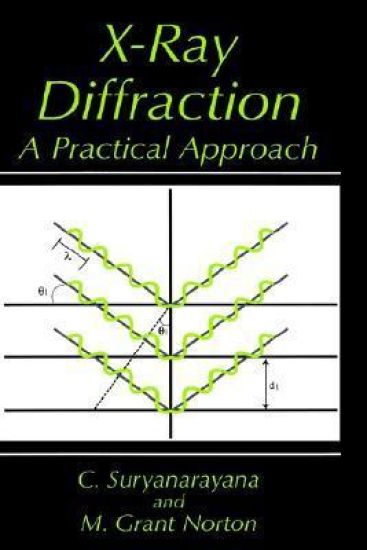
In this, the only book available to combine both theoretical and practical aspects of x-ray diffraction, the authors emphasize a "hands on" approach through experiments and examples based on actual laboratory data. Part I presents the basics of x-ray diffraction and explains its use in obtaining structural and chemical information. In Part II, eight experimental modules enable the students to gain an appreciation for what information can be obtained by x-ray diffraction and how to interpret it. Examples from all classes of materials -- metals, ceramics, semiconductors, and polymers -- are included. Diffraction patterns and Bragg angles are provided for students without diffractometers. 192 illustrations.