Kirjojen hintavertailu – 12 903 725 kirjaa ja 27 kauppaa
Kirjailija
Cameron Stark
Kirjat ja teokset yhdessä paikassa: 9 kirjaa, julkaisuja vuosilta 2017–2026, suosituimpiin kuuluu Quality Improvement and Audit in Dentistry. Vertaile teosten hintoja ja tarkista saatavuus suomalaisista kirjakaupoista.
This book is an introduction to quality improvement methods for dentists and other oral health professionals. It includes audit, which will be familiar to many dental professionals, and sets it in the wider context of quality improvement theory and practice. The book provides sufficient information to allow dental practices to undertake clinical audit and quality improvement using current best practice. The World Dental Federation has called for greater attention to quality in dentistry and has argued for the use of quality improvement methods. In the United Kingdom, the health services in Wales and Scotland have begun to produce materials to support dental quality improvement work. The Care Quality Commission in England has emphasized the requirement for audit in dental care. Dental Practices in Scotland are now required to undertake QI projects. In the USA, the American Dental Association now encourages audit and QI training guidance has been issued by the California Department of Public Health Office of Oral Health. While there has been a worldwide movement towards an increased focus on quality improvement in dental care, there are no supporting books to educate the market on this topic. One existing book discusses a case example of the use of Lean in dental care, but there are no generic quality improvement books that we have been able to identify. The courses developed in England, Scotland and California are in response to a need, but no book is available to support teaching with specifically dental examples.
There are international pressures on healthcare delivery because of increasing demand and rising costs. Maintaining quality while containing costs is a challenge in both privately and state funded services. If service quality decreases patients suffer and staff are often unhappy. Recruitment and retention become a challenge in services with perceived reduced quality. Continuous Value Management offers a method of managing the tensions between cost, quality, and staff engagement. This book describes a method of managing quality while containing costs. Value Management, developed by Brian Maskell and colleagues, links quality and finance and gives frontline staff greater control of quality and improved information on cost. The Institute of Healthcare Improvement (IHI) have developed this method for healthcare. A collaboration with NHS Scotland tested Continuous Value Management’s application in practice, and the system was then applied to other international healthcare settings including the Middle East, the USA, South American, and South-East Asia. Information on the system was previously available only through conferences, academic papers, and training from IHI. This volume makes the principles and application of Continuous Value Management available to a wider healthcare audience.
This book takes the reader through the process to plan, deliver, and follow-up a weeklong Lean Quality Improvement event, usually termed a ‘Rapid Improvement Event’ or ‘Rapid Process Improvement Workshop (RPIW).’ Drawing on the experience of conducting over 100 of these workshops, the book gives readers the information to plan and run their own event. It describes how RPIWs fit in to wider improvement processes and how the reader can maximize these processes in their own organization. These weeklong improvement events are popular in health and social care, but there are no textbooks available to support them. There are several books that describe the use of shorter Kaizen events in health care, but none that describe the process of delivering weeklong events. The events have a rhythm specific to the one-week format, and the book seeks to help people to make use of best practice and to avoid common problems. Based on the experiences of the authors, this book includes an introduction to Lean concepts linked to the relevant part of the process description; examples and templates of forms that can be used in workshops; and photographs of actual events.
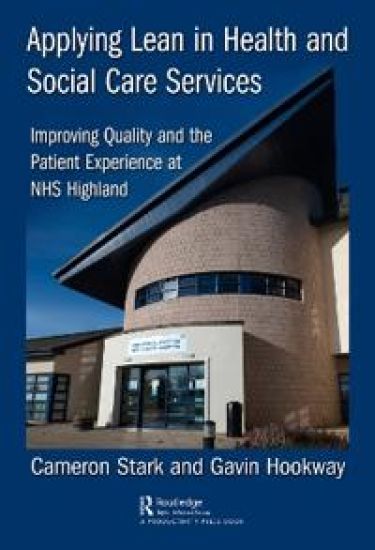
Organizations around the world are using Lean to redesign care and improve processes in a way that achieves and sustains meaningful results for patients, staff, physicians, and health systems. This book systematically describes how NHS Highland uses Lean principles and mindsets to improve safety, quality, access, and morale while reducing costs, and increasing capacity. Existing books often describe the gains obtained by using Lean methods, but often do not describe the underlying concepts and methods in details. Other books describe continuous improvement work, or specific techniques such as daily management in detail. This book seeks to occupy a middle space by providing an overview of the range of Lean ideas applicable to healthcare with sufficient examples and cases studies from NHS Highland and partner organizations so readers can see them in use and practice.
This is a book about practicing, learning, and sharing our experiences with the Lean methodology and the Toyota Production System. Doctors don't "implement medicine," they practice medicine. Lawyers don't "implement cases," they practice law. Shouldn't Lean facilitators, consultants, managers, and the like, also "practice Lean?" When most of us start with Lean, the practices and principles are new. We might struggle to make change happen. I know I did. Our initial clumsy efforts hopefully turn into proficiency and mastery over time. We shift from "doing Lean" to "being Lean" and teaching others how to be Lean. This book is a collection of honest and unvarnished first hand stories about learning, failing, and getting better at leading Lean transformation efforts. What mistakes have been made? What are the lessons learned? How do we "Plan, Do, Study, Adjust" our way to more effective Lean transformation models? Proceeds from the book will be donated to the non-profit Louise H. Batz Patient Safety Foundation. This project has raised $5,000 to date (as of 9/1/2020). Disclosure: Mark Graban is on the board of the Batz Foundation. We have a diverse set of contributors who come from various industries - manufacturing, healthcare, software, startups, etc. Authors include: Mark GrabanAuthor of the books Lean Hospitals and Healthcare Kaizen, blogger at LeanBlog.org Nick RuhmannDirector of Operational Excellence for Aon National Flood Services, Inc. Michael LombardChief Executive Officer of Cornerstone Critical Care Specialty Hospital of Southwest Louisiana Paul AkersPresident of FastCap, author of 2-Second Lean and Lean Health Jamie Parker15 years' experience in operations management / leadership in retail, service, and manufacturing Harry KenworthyExpert in Lean government after a long career in manufacturing Bob RushLean Manufacturing Group Leader for Tesla Motors Samuel SelayContinuous Improvement Manager for the Marine Corps at Camp Pendleton David HaighDavid works at Johnson & Johnson Canada, the largest consumer healthcare company in Canada Joe SwartzAdministrative Director, Business Transformation, Franciscan Alliance, co-author of Healthcare Kaizen Cameron StarkPhysician and Lean improvement leader in Scotland Harvey LeachPrincipal Consultant with The Consultancy Company based near Oxford, England Andy SheppardAuthor, The Incredible Transformation of Gregory Todd: a Novel about Leadership and Managing Change Mike LeighPresident and Founder of OpX Solutions, LLC and former Lean leader at General Electric Jamie FlinchbaughLean advisor, speaker, and author, who has advised over 300 companies on their Lean journey Lesa NicholsFounder, Lesa Nichols Consulting and former Toyota leader The book also contains relevant posts from Mark Graban's LeanBlog.org.