Kirjojen hintavertailu – 12 903 725 kirjaa ja 27 kauppaa

Kirjailija

Carl Abbott

Kirjat ja teokset yhdessä paikassa: 37 kirjaa, julkaisuja vuosilta 1981–2025, suosituimpiin kuuluu Planning a New West. Vertaile teosten hintoja ja tarkista saatavuus suomalaisista kirjakaupoista.

37 kirjaa

Kirjojen julkaisuvuodet: 1981–2025.

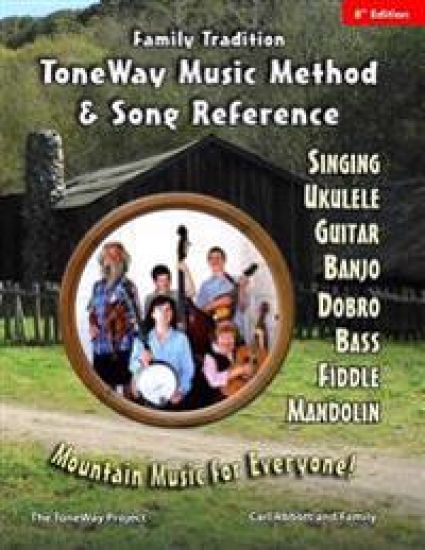
Family Tradition: ToneWay Music Method & Song Reference: Mountain Music for Everyone!

Family Tradition: ToneWay Music Method & Song Reference: Mountain Music for Everyone!

Luke Abbott; Carl Abbott

Createspace Independent Publishing Platform
2012
nidottu
Making Music Fun Again Long ago you mastered your native language intuitively. Now, you can master music in a similar way, and have fun doing it What's more, nothing is more simple or soul-satisfying than playing music with others, so come learn to play traditional mountain music - 'people music' - by ear, today Grab a ukulele, guitar, banjo, bass, Dobro, mandolin or fiddle and take our Free 2 hour "Get Started" Workshop Series at ToneWay.com. The ToneWay Music Method The ToneWay Music Method teaches you how to play string instruments in an easier and more musically fluent way... the playing by ear way applied to a handful of favorite mountain music song. Then you build on this as you learn an additional 32 beloved traditional songs in the Method section. Our ToneWay Picking Patterns, ToneWay Notation, and playing up-the-neck processes help launch you into a natural play-by-ear approach to music. This knowledge allows you to easily pick up and play any of the other string instruments as well. In short, the ToneWay Music Method reveals, in a practical way, how musicians intuitively play music it's a must-have for classroom or independent study. The Song Reference The Song Reference section offers a lifetime supply (365) of traditional songs. Their longevity is a testament to the joyful singing they arouse. Listen to short Song Clips of these at ToneWay.com. These teach melody and other qualities that give each song its 'soul'. Each song in the book is annotated with key-independent chord changes (a.k.a. Nashville number system), 'jammability', and tonal information useful for playing melody by ear and for singing lead and harmony. By the time you cover a bunch of these, you will have mastered the essentials you need to play most anything For more information, go to ToneWay.com
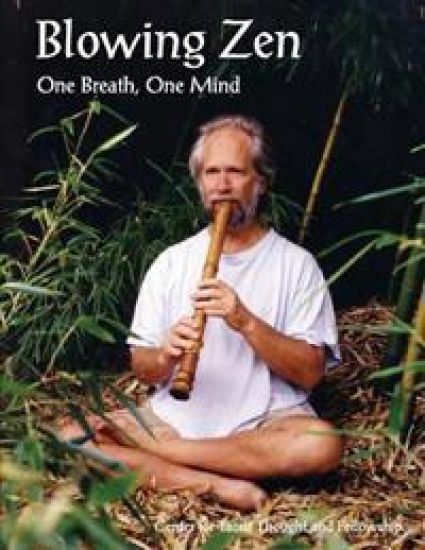
Blowing Zen: Expanded Edition: One Breath One Mind, Shakuhachi Flute Meditation

Blowing Zen: Expanded Edition: One Breath One Mind, Shakuhachi Flute Meditation

Carl Abbott

Createspace Independent Publishing Platform
2012
nidottu

Halvin toimitettuna 15,50 €

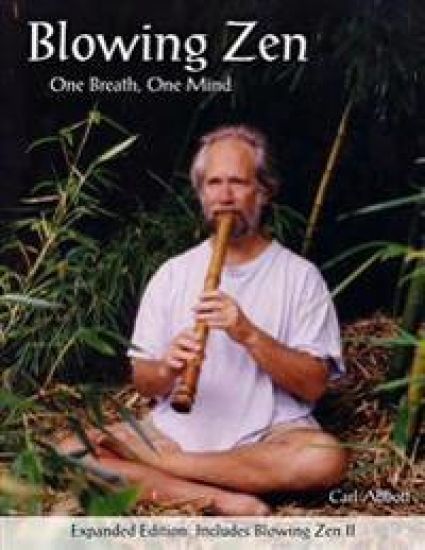
Note: The Blowing Zen recordings are available from Kunaki, Gumroad, and BlowingZen.org.http: //bit.ly/kunakiabbotthttps: //afm.gumroad.com/l/bzcdhttps: //blowingzen.org/learn/ The Shakuhachi is an ancient flute that captivates many who cross its path. Hidden in its simplicity is profound possibility. The windy, resonant sound of the Shakuhachi brings deep serenity to sympathetic ears. For the devoted player, it is also a spiritual tool for training the mind and breath. Most notably, Zen monks have using the Shakuhachi for centuries to train mind and breath through the practice of Sui Zen (blowing Zen) using Buddhist music composed specifically for the Shakuhachi. Blowing Zen: Expanded Edition is two books in one. The first is the original Blowing Zen (1992) which guides you step-by-step from producing sound to playing Buddhist Meditation music. Also included are detailed build-your-own shakuhachi instructions. The 'Expanded" section is Blowing Zen II, which contains sheet music for an additional 26 Hon Kyoku compositions (Zen Buddhist music), pitch graphs, more San Kyoku (Japanese Chamber music), and more Japanese folk music. The Blowing Zen Companion CD (available separately) contains the Japanese folk tunes, chamber music and Buddhist composition "Hi Fu Mi" taught in the first section of the book. It also includes examples of timing and standard Buddhist music phrases. Visit BlowingZen.com for FREE audio and video recordings of the material covered in the book.
Blowing Zen: One Breath, One Mind

Blowing Zen: One Breath, One Mind

Carl Abbott

Createspace Independent Publishing Platform
2012
nidottu
Note: The Blowing Zen recordings are available from Kunaki, Gumroad, and BlowingZen.org.http: //bit.ly/kunakiabbotthttps: //afm.gumroad.com/l/bzcdhttps: //blowingzen.org/learn/The Shakuhachi is an ancient flute that captivates many who cross its path. Hidden in its simplicity is profound possibility. The windy, resonant sound of the Shakuhachi brings deep serenity to sympathetic ears. For the devoted player, it is also a spiritual tool for training the mind and breath. Most notably, Zen monks have using the Shakuhachi for centuries to train mind and breath through the practice of Sui Zen (blowing Zen) using Buddhist music composed specifically for the Shakuhachi." Blowing Zen" guides you step-by-step from producing sound to playing Buddhist Meditation music. Also included are detailed build-your-own shakuhachi instructions. The Blowing Zen Companion CD (available separately) contains the Japanese folk tunes, chamber music and Buddhist composition "Hi Fu Mi" taught in the book. It also includes examples of timing and standard Buddhist music phrases. Visit BlowingZen.com for FREE audio and video recordings of the material covered in the book.
Mourning de Pachmann

Mourning de Pachmann

Carl Abbott

Hamilton Books
2011
nidottu
In January 1933, widowed Canadian psychiatrist Charles Flemming traveled to Rome to deliver a paper at an international psychiatric meeting and to further research the career of the eccentric Ukranian pianist, Vladimir de Pachmann, for a biography he has always wanted to write. En route, he learns of a young, virtually blind Polish pianist, Agnieszka Lipska, who will be giving several recitals in Rome. She has familial retinitis pigmentosa and her specialty is the music of Chopin. Charles and Agnieszka are introduced by Simon Williams, a music critic assigned to review the recitals. Her beauty and talent enraptures the heart of the lonely doctor and a romance develops. Shortly after arriving in Rome, Charles discovers that a manuscript containing aspects of de Pachmann’s life has been stolen from his hotel. This along with other complications, including a near-drowning in the Tiber River, ultimately involves the scrutiny of Mussolini’s fascist police. At her final recital, Agnieszka resists the restrictions of the government by playing the Polish National Anthem as an encore disguised as an anonymous Polish mazurka. However, a music critic recognizes the piece and the lovers are forced to flee Rome with the help of the Polish ambassador. They travel to Kraków, where Charles meets Agnieszka’s family. Before leaving there is concern over Agnieszka’s abdominal pain, which appears to require gynecologic surgery. On his ship back to Canada, Charles opens and reads a disturbing letter written by Agnieszka’s mother about her daughter’s past – a suppressed memory. The truth is revealed later on his return to Toronto. Written for a mature audience with interests in music, history and mystery, Mourning de Pachmann investigates the subtleties of love, guilt and forgiveness, ambition and ego, as well as the rewards of a personal adventure of a lonely, middle-aged man and a younger woman. In this historical novel the reader will learn much about the career of the real-life de Pachmann, who still mystifies musicologists and critics; life in fascist Italy where it is illegal to sell condoms and dangerous to deny the wishes of Il Duce, Benito Mussolini; and Europe on the verge of another world war.
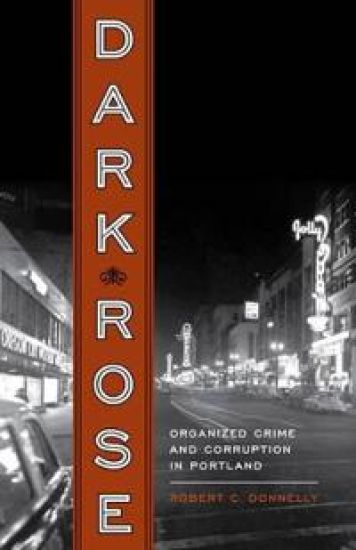
Dark Rose

Dark Rose

Robert C Donnelly; Carl Abbott

University of Washington Press
2011
pokkari
In April 1956, Portland Oregonian investigative reporters Wallace Turner and William Lambert exposed organized crime rackets and rampant corruption within Portland's law enforcement institutions. The biggest scandal involved Teamsters officials and the city's lucrative prostitution, gambling, and bootlegging operations. Turner and Lambert blew the cover on the Teamsters' scheme to take over alcohol sales and distribution and profit from these fringe enterprises. The Rose City was seething with vice and intrigue. The exposé and other reports of racketeering from around the country incited a national investigation into crime networks and union officials headed by the McClellan Committee, or officially, the U. S. Senate Select Committee on Improper Activities in the Labor or Management Field. The commission discovered evidence in Portland that helped prove Teamsters president Dave Beck's embezzlement of union funds and union vice president Jimmy Hoffa's connection to the mob. Dark Rose reveals the fascinating and sordid details of an important period in the history of what by the end of the century had become a great American city. It is a story of Portland's repeated and often failed efforts to flush out organized crime and municipal corruption - a familiar story for many mid-twentieth-century American cities that were attempting to clean up their police departments and municipal governments. Dark Rose also helps explain the heritage of Portland's reform politics and the creation of what is today one of the country's most progressive cities. Watch the book trailer: https://www.youtube.com/watch?v=Zkf6_dbIE8A
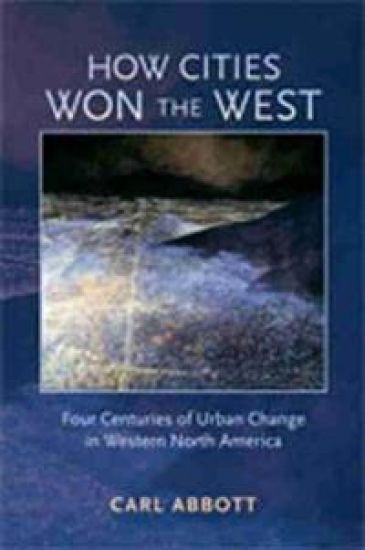
How Cities Won the West

How Cities Won the West

Carl Abbott

University of New Mexico Press
2010
nidottu
Cities rather than individual pioneers have been the driving force in the settlement and economic development of the western half of North America. Throughout the seventeenth, eighteenth, and nineteenth centuries, western urban centers served as starting points for conquest and settlement. As these frontier cities matured into metropolitan centers, they grew from imitators of eastern culture and outposts of eastern capital into independent sources of economic, cultural, and intellectual change. From the Gulf of Alaska to the Mississippi River and from the binational metropolis of San Diego-Tijuana to the Prairie Province capitals of Canada, Carl Abbott explores the complex urban history of western Canada and the United States. The evolution of western cities from stations for exploration and military occupation to contemporary entry points for migration and components of a global economy reminds us that it is cities that "won the West." And today, as cultural change increasingly moves from west to east, Abbott argues that the urban West represents a new center from which emerging patterns of behavior and changing customs will help to shape North America in the twenty-first century.
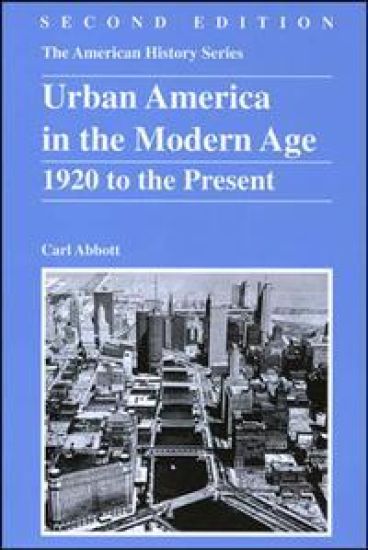
Urban America in the Modern Age

Urban America in the Modern Age

Carl Abbott

Harlan Davidson Inc
2006
nidottu
Since the appearance of "Urban America in the Modern Age" in 1987, the study of American cities has flourished. In this long-awaited second edition, Carl Abbott draws on the recent works of historians who have explored issues of urban growth, municipal politics, immigration and ethnicity, "suburbanization", and environmental change. The fascination with growth and change in the nation's metropolitan areas spans a wide range of scholarly fields, and the new edition also benefits from scholarship in disciplines closely related to urban history, including geography, political science, sociology, and urban planning. Featuring an entirely new chapter covering the years since 1980 and a bank of interesting photographs, the second edition of "Urban America in the Modern Age" further explores and fine-tunes the themes and topics central to its predecessor - the physical form of metropolitan areas, their sources of growth and mix of ethnic and racial groups, the shaping of and responses to public policy, and ideas of community planning.
Frontiers Past and Future

Frontiers Past and Future

Carl Abbott

University Press of Kansas
2006
sidottu
Will the settlement of Mars prove much different from the settlement of the West? Look to science fiction master Kim Stanley Robinson for fascinating ideas; then turn to historian Carl Abbott for further insights. Over the last half-century, science fiction has witnessed increasing complexity in its treatments of future homesteading, community building, mining, and other themes familiar to western historians. Considering these common threads, this is the first book to explore the ways that science fiction writers have drawn directly on narratives of the American West to frame their visions of the future. Abbott offers a fruitful new way to read science fiction, one that also greatly enriches our understanding of western history and its impact on our collective imagination. Detailing the overlap of science fiction and western fiction - especially relating to their mutual interest in and concerns about frontier expansionism - he reveals an unsuspected common ground that informs the writings of both camps. Reviewing the work of many Hugo and Nebula Award winners, as well as drawing upon popular film and television series (like the Buck Rogers serials), Abbott's study journeys across the far reaches of science fiction's universe. His cast of notables ranges from venerable masters like Robert Heinlein and Fritz Lieber to new-wave feminist Ursula Le Guin and cyberpunk pioneer William Gibson; their settings are as diverse as the near-future West of Octavia Butler and the entrancing extraterrestrial visions of Pamela Sargent, Jonathan Lethem, and C. J. Cherryh. Both enlightening and energizing, Abbott's study deftly shows us how the ways we remember the past greatly influence our ability to imagine multiple futures - in distant universes that appear very strange and yet utterly familiar. ""Frontiers Past and Future"" boldly goes where no historian has gone before and rewards us with new insights into our probable pasts and possible futures.
Two Centuries of Lewis and Clark

Two Centuries of Lewis and Clark

William L. Lang; Carl Abbott

Oregon Historical Society Press
2004
pokkari
The landscape encountered by the Corps of Discovery during their multi-year, cross- country trek to the Pacific was dramatically different from the one that greeted visitors attending Portland's Lewis and Clark Centennial Exposition in 1905 or the one that exists in the Pacific Northwest today. On the occasion of the bicentennial of the Lewis and Clark expedition and the centennial of the Lewis and Clark Centennial Exposition, the time is ripe for reconciling those earlier events with present-day activities. In Two Centuries of Lewis and Clark, William L. Lang and Carl Abbott have collaborated to address those issues. Lang scrutinizes the motivations for the Lewis and Clark expedition and the environmental ramifications of its discoveries on the people and the landscape of the Columbia River Basin. Abbott examines the ways in which the Lewis and Clark Exposition advanced President Jefferson's goal of developing the economic potential of the Pacific Northwest, particularly through the exploitation of the region's abundant natural resources.
The Great Extravaganza

The Great Extravaganza

Carl Abbott

Oregon Historical Society Press
2004
pokkari
The Great Extravaganza details the Lewis and Clark Exposition of 1905 from its planning stage, through the heady days of the fair, and into the decade of growth and prosperity that followed. Abbott captures the progressive sentiments that motivated early twentieth-century developers and politicians and the part the Exposition played in the development of Portland. Now in its third edition since its original publication in 1981, The Great Extravaganza includes a new introduction by Carl Abbott along with historic photographs that give readers a tour of the extensive fairgrounds, the grand exhibit halls, and the dozens of attractions that drew a million and a half people to Portland during the summer and early fall of 1905.
Greater Portland

Greater Portland

Carl Abbott

University of Pennsylvania Press
2001
pokkari
Selected by Choice magazine as an Outstanding Academic Title It has been called one of the nation's most livable regions, ranked among the best managed cities in America, hailed as a top spot to work, and favored as a great place to do business, enjoy the arts, pursue outdoor recreation, and make one's home. Indeed, years of cooperative urban planning between developers and those interested in ecology and habitability have transformed Portland from a provincial western city into an exemplary American metropolis. Its thriving downtown, its strong neighborhoods, and its pioneering efforts at local management have brought a steady procession of journalists, scholars, and civic leaders to investigate the "Portland style" that values dialogue and consensus, treats politics as a civic duty, and assumes that it is possible to work toward public good. Probing behind the press clippings, acclaimed urban historian Carl Abbott examines the character of contemporary Portland-its people, politics, and public life-and the region's history and geography in order to discover how Portland has achieved its reputation as one of the most progressive and livable cities in the United States and to determine whether typical pressures of urban growth are pushing Portland back toward the national norm. In Greater Portland, Abbott argues that the city cannot be understood without reference to its place. Its rivers, hills, and broader regional setting have shaped the economy and the cityscape. Portlanders are Oregonians, Northwesteners, Cascadians; they value their city as much for where it is as for what it is, and this powerful sense of place nurtures a distinctive civic culture. Tracing the ways in which Portlanders have talked and thought about their city, Abbott reveals the tensions between their diverse visions of the future and plans for development. Most citizens of Portland desire a balance between continuity and change, one that supports urban progress but actively monitors its effects on the region's expansive green space and on the community's culture. This strong civic participation in city planning and politics is what gives greater Portland its unique character, a positive setting for class integration, neighborhood revitalization, and civic values. The result, Abbott confirms, is a region whose unique initiatives remain a model of American urban planning.
Planning a New West

Planning a New West

Carl Abbott

Oregon State University
1997
sidottu
What happens when... a coveted landscape becomes a battleground for two legitimate and compelling visions of the American West? In examining the origins and implementations of the Columbia River Gorge National Scenic Area, Planning a New West reveals a vast experiment in mediating between the Old and New Wests.
The Metropolitan Frontier

The Metropolitan Frontier

Carl Abbott

University of Arizona Press
1995
nidottu
When the American West represented the country's frontier, many of its cities may have seemed little more than trading centers to serve the outlying populace. Now the nation's most open and empty region is also its most heavily urbanized, with 80 percent of Westerners living in its metropolitan areas. The process of urbanization that had already transformed the United States from a rural to an urban society between 1815 and 1930 has continued most clearly and completely in the modern West, where growth since 1940 spurred by mobilization for World War II has constituted a distinct era in which Western cities have become national and even international pacesetters. The Metropolitan Frontier places this last half-century of Western history in its urban context, making it the first comprehensive overview of urban growth in the region. Integrating the urban experience of all nineteen Western states, Carl Abbott ranges for evidence from Honolulu to Houston and from Fargo to Fairbanks to show how Western cities organize the region's vast spaces and connect them to the even larger sphere of the world economy. His survey moves from economic change to social and political response, examining the initial boom of the 1940s, the process of change in the following decades, and the ultimate impact of Western cities on their environments, on the Western regional character, and on national identity. Today, a steadily decreasing number of Western workers are engaged in rural industries, but Western cities continue to grow. As ecological and social crises begin to affect those cities, Abbott's study will prove required reading for historians, geographers, sociologists, urban planners, and all citizens concerned with America's future.
The New Urban America

The New Urban America

Carl Abbott

The University of North Carolina Press
1987
nidottu
The first comprehensive and comparative analysis of urban growth in the American South and West defines the historical growth of the Sunbelt. Abbott examines the economic base of southern and western cities, the process of suburbanization, and the effects of rapid growth on metropolitan politics. He details the growing conflict between central city and suburban government in the Sunbelt through the 1950s, 1960s, and 1970s. A UNC Press Enduring Edition -- UNC Press Enduring Editions use the latest in digital technology to make available again books from our distinguished backlist that were previously out of print. These editions are published unaltered from the original, and are presented in affordable paperback formats, bringing readers both historical and cultural value.