Kirjojen hintavertailu – 12 875 987 kirjaa ja 26 kauppaa

Kirjailija

Carl Dahlhaus

Kirjat ja teokset yhdessä paikassa: 11 kirjaa, julkaisuja vuosilta 1985–2020, suosituimpiin kuuluu Ludwig van Beethoven. Vertaile teosten hintoja ja tarkista saatavuus suomalaisista kirjakaupoista.

11 kirjaa

Kirjojen julkaisuvuodet: 1985–2020.

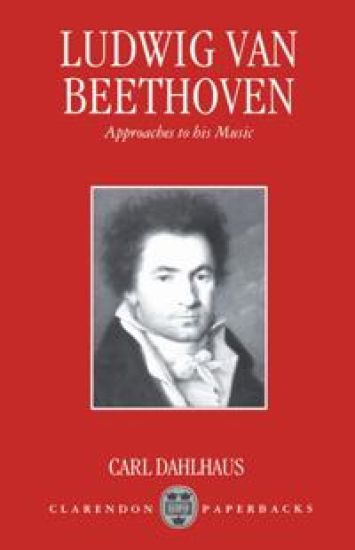
Ludwig van Beethoven

Ludwig van Beethoven

Carl Dahlhaus

Clarendon Press
1993
nidottu
Combines interpretations of individual works which go into issues of composition and musical history, instead of merely duplicating in words what can already be read in the scores, with excursions into the musical aesthetics of the period around 1800, a "classical" period in art history.
Studies on the Origin of Harmonic Tonality

Studies on the Origin of Harmonic Tonality

Carl Dahlhaus

Princeton University Press
2016
sidottu
Carl Dahlhaus was without doubt the premier musicologist of the postwar generation, a giant whose recent death was mourned the world over. Translated here for the first time, this fundamental work on the development of tonality shows his complete mastery of the theory of harmony. In it Dahlhaus explains the modern concepts of harmony and tonality, reviewing in the process the important theories of Rameau, Sechter, Ftis, Riemann, and Schenker. He contrasts the familiar premises of chordal composition with the lesser known precepts of intervallic composition, the basis for polyphonic music in the late Middle Ages and Renaissance. Numerous quotations from theoretical treatises document how early music was driven forward not by progressions of chords but by simple progressions of intervals. Exactly when did composers transform intervallic composition into chordal composition? Modality into tonality? Dahlhaus provides extensive analyses of motets by Josquin, frottole by Cara and Tromboncino, and madrigals by Monteverdi to demonstrate how, and to what degree, such questions can be answered. In his bold speculations, in his magisterial summaries, in his command of eight centuries of music and writings on music, and in his deep understanding of European history and culture, Carl Dahlhaus sets a standard that will seldom be equalled. Originally published in 1990. The Princeton Legacy Library uses the latest print-on-demand technology to again make available previously out-of-print books from the distinguished backlist of Princeton University Press. These editions preserve the original texts of these important books while presenting them in durable paperback and hardcover editions. The goal of the Princeton Legacy Library is to vastly increase access to the rich scholarly heritage found in the thousands of books published by Princeton University Press since its founding in 1905.
Studies on the Origin of Harmonic Tonality

Studies on the Origin of Harmonic Tonality

Carl Dahlhaus

Princeton University Press
2014
pokkari
Carl Dahlhaus was without doubt the premier musicologist of the postwar generation, a giant whose recent death was mourned the world over. Translated here for the first time, this fundamental work on the development of tonality shows his complete mastery of the theory of harmony. In it Dahlhaus explains the modern concepts of harmony and tonality, reviewing in the process the important theories of Rameau, Sechter, Ftis, Riemann, and Schenker. He contrasts the familiar premises of chordal composition with the lesser known precepts of intervallic composition, the basis for polyphonic music in the late Middle Ages and Renaissance. Numerous quotations from theoretical treatises document how early music was driven forward not by progressions of chords but by simple progressions of intervals. Exactly when did composers transform intervallic composition into chordal composition? Modality into tonality? Dahlhaus provides extensive analyses of motets by Josquin, frottole by Cara and Tromboncino, and madrigals by Monteverdi to demonstrate how, and to what degree, such questions can be answered. In his bold speculations, in his magisterial summaries, in his command of eight centuries of music and writings on music, and in his deep understanding of European history and culture, Carl Dahlhaus sets a standard that will seldom be equalled. Originally published in 1990. The Princeton Legacy Library uses the latest print-on-demand technology to again make available previously out-of-print books from the distinguished backlist of Princeton University Press. These editions preserve the original texts of these important books while presenting them in durable paperback and hardcover editions. The goal of the Princeton Legacy Library is to vastly increase access to the rich scholarly heritage found in the thousands of books published by Princeton University Press since its founding in 1905.
Nineteenth-Century Music

Nineteenth-Century Music

Carl Dahlhaus

University of California Press
1991
pokkari
This magnificent survey of the most popular period in music history is an extended essay embracing music, aesthetics, social history, and politics, by one of the keenest minds writing on music in the world today. Dahlhaus organizes his book around 'watershed' years - for example, 1830, the year of the July Revolution in France, and around which coalesce the 'demise of the age of art' proclaimed by Heine, the musical consequences of the deaths of Beethoven and Schubert, the simultaneous and dramatic appearance of Chopin and Liszt, Berlioz and Meyerbeer, and Schumann and Mendelssohn. But he keeps us constantly on guard against generalization and cliche. Cherished concepts like Romanticism, tradition, nationalism vs. universality, the musical culture of the bourgeoisie, are put to pointed re-evaluation. Always demonstrating the interest in socio-historical influences that is the hallmark of his work, Dahlhaus reminds us of the contradictions, interrelationships, psychological nuances, and riches of musical character and musical life. "Nineteenth-Century Music" contains 90 illustrations, the collected captions of which come close to providing a summary of the work and the author's methods. Technical language is kept to a minimum, but while remaining accessible, Dahlhaus challenges, braces, and excites. This is a landmark study that no one seriously interested in music and nineteenth-century European culture will be able to ignore.

Between Romanticism and Modernism

Between Romanticism and Modernism

Carl Dahlhaus

University of California Press
1989
pokkari
Carl Dahlhaus here treats Nietzsche's youthful analysis of the contradictions in Wagner's doctrine (and, more generally, in romantic musical aesthetics); the question of periodicization in romantic and neo-romantic music; the underlying kinship between Brahms' and Wagner's responses to the central musical problems of their time; and, the true significance of musical nationalism. Included in this volume is Walter Kauffman's translation of the previously unpublished fragment, "On Music and Words", by the young Nietzsche.
Richard Wagnerin musiikkidraamat

Richard Wagnerin musiikkidraamat

Carl Dahlhaus

Faros-kustannus
2016
nidottu
Carl Dahlhausin teos Richard Wagnerin musiikkidraamat (1971) on Wagner-kirjallisuuden klassikko, jonka teosanalyysit ovat yhä tutkijoiden ja musiikinystävien käytössä. Richard Wagnerin musiikkidraamat ilmestyy nyt ensi kertaa suomeksi. Teos julkaistaan yhteistyössä vuonna 1991 perustetun Suomen Wagner-seuran kanssa, sen 25-vuotisjuhlan kunniaksi. Suomennoksen esipuheen on kirjoittanut Carl Dahlhausin oppilas, professori Tomi Mäkelä. Teoksen on suomentanut Matti Lehtonen.
L'Esthetique de la Musique

L'Esthetique de la Musique

Carl Dahlhaus

Librarie Philosophique J. Vrin
2015
nidottu
Premier livre publie par Carl Dahlhaus, L'Esthetique de la musique tente d'accorder deux objectifs. Il s'agit d'abord de proposer une introduction historiquement informee au vaste champ de la philosophie de la musique, qui soit capable d'etre a la fois concise et raffinee. Mais ce Musikwissenschaftler qui n'est pas encore alors l'auteur de l'Histoire de la musique au XIXe siecle ou de l'Idee de la musique absolue livre egalement une premiere demonstration de sa methode de travail sur la musique. Elle frappera le lecteur par sa densite philosophique et son gout pour la lecture problematisee de textes issus de differentes traditions musicographiques. Dahlhaus revendiquait volontiers son souci d'ecrire l'histoire en respectant un pluralisme qu'il voulait issu de l'oeuvre de Fernand Braudel. Au lecteur de juger si cette premiere Esthetique de la musique, sous la plume d'un auteur qu'on a parfois dit plus philosophe que musicologue (J.-J. Nattiez) parvient a en poser le cadre. La force de ce texte fondateur pour la musicographie dahlhausienne demeure, et les tout recents developpements de la philosophie de la musique rendent sa lecture imperative.
The Idea of Absolute Music

The Idea of Absolute Music

Carl Dahlhaus

University of Chicago Press
1991
nidottu

Halvin toimitettuna 39,80 €

With a characteristically broad and provocative treatment, Dahlhaus examines a single music-aesthetical idea from various historical and philosophical viewpoints. "Essential reading for anyone interested in the larger intellectual framework in which Romantic music found its place, a framework that to a remarkable degree has continued to shape our image of music."--Robert P. Morgan, Yale University Carl Dahlhaus (1928-1989) is the author of a highly influential body of works on the foundations of music history and aesthetics.
Realism in Nineteenth-Century Music

Realism in Nineteenth-Century Music

Carl Dahlhaus

Cambridge University Press
1985
nidottu
The music of the nineteenth century was - and still is - thought of as a 'romantic' art, whereas the main current of the literature and fine arts of the age was 'realist' from about 1830. Yet some works are consistently described as 'realistic': Nusorgsky's Boris and Bizet's Carmen are only the most frequently cited examples. Professor Dahlhaus sets out the criteria of realism, with particular reference to French and German theorists and examines the extent to which they apply to music too. While his findings do not reverse the verdict that the music of the age was in general romantic, he demonstrates that musical realism consists in much more than imitation of natural sounds or tone-painting. The notes are revised here for the English-speaking reader.