Kirjojen hintavertailu – 12 859 829 kirjaa ja 27 kauppaa

Kirjailija

Carlo Fischione

Kirjat ja teokset yhdessä paikassa: 3 kirjaa, julkaisuja vuosilta 2012–2024, suosituimpiin kuuluu Weighted Sum-Rate Maximization in Wireless Networks. Vertaile teosten hintoja ja tarkista saatavuus suomalaisista kirjakaupoista.

3 kirjaa

Kirjojen julkaisuvuodet: 2012–2024.

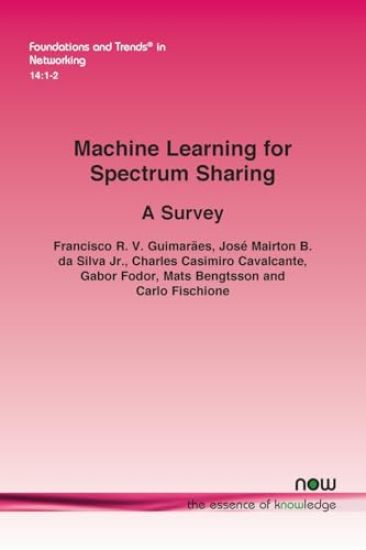
Machine Learning for Spectrum Sharing

Machine Learning for Spectrum Sharing

Francisco R. V. Guimarães; José Mairton B. da Silva; Charles Casimiro Cavalcante; Gabor Fodor; Mats Bengtsson; Carlo Fischione

Now Publishers Inc
2024
nidottu
The 5th generation (5G) of wireless systems is being deployed with the aim to provide many sets of wireless communication services, such as low data rates for a massive amount of devices, broadband, low latency, and industrial wireless access. Such an aim is even more complex in the next generation wireless systems (6G) where wireless connectivity is expected to serve any connected intelligent unit, such as software robots and humans interacting in the metaverse, autonomous vehicles, drones, trains, or smart sensors monitoring cities, buildings, and the environment. As the wireless devices will be orders of magnitude denser than in 5G cellular systems, and due to the complex quality of service requirements, the access to the wireless spectrum will have to be appropriately shared to avoid congestion, poor quality of service, or unsatisfactory communication delays. Spectrum sharing methods have been the objective of intense study through model-based approaches, such as optimization or game theories. However, these methods may fail when facing the complexity of the communication environments in 5G, 6G, and beyond. Recently, there has been significant interest in the application and development of data-driven methods, namely machine learning methods, to handle the complex operation of spectrum sharing. In this monograph, a complete overview of the state-of-the-art of machine learning for spectrum sharing is provided. First, the authors map the most prominent methods that are encountered in spectrum sharing. Then, it is shown how these machine learning methods are applied to the numerous dimensions and sub-problems of spectrum sharing, such as spectrum sensing, spectrum allocation, spectrum access, and spectrum handoff. Finally, several open questions and future trends are highlighted.
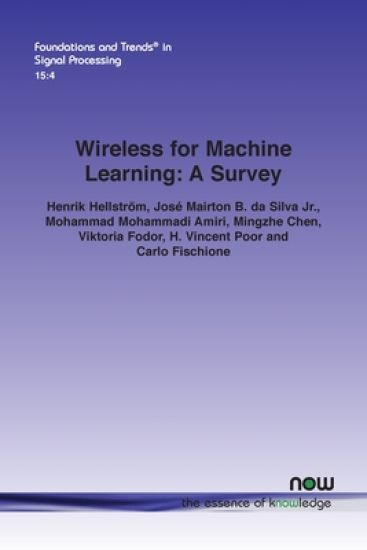
Wireless for Machine Learning

Wireless for Machine Learning

Henrik Hellström; José Mairton B. da Silva; Mohammad Mohammadi Amiri; Mingzhe Chen; Viktoria Fodor; H. Vincent Poor; Carlo Fischione

Now Publishers Inc
2022
nidottu
This monograph covers the topic of Wireless for Machine Learning (ML). Although the general intersection of ML and wireless communications is currently a prolific field of research that has already generated multiple publications, there is little review work on Wireless for ML. As data generation increasingly takes place on devices without a wired connection, ML related traffic will be ubiquitous in wireless networks. Research has shown that traditional wireless protocols are highly inefficient or unsustainable to support ML, which creates the need for new wireless communication methods. This monograph gives an exhaustive review of the state-of-the-art wireless methods that are specifically designed to support ML services over distributed datasets. Currently, there are two clear themes within the literature, analog over-the-air computation and digital radio resource management optimized for ML. A comprehensive introduction to these methods is presented, reviews are made of the most important works, open problems are highlighted and application scenarios are discussed.
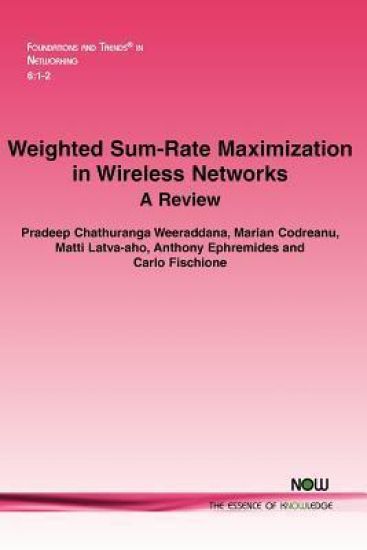
Weighted Sum-Rate Maximization in Wireless Networks

Weighted Sum-Rate Maximization in Wireless Networks

Pradeep Chathuranga Weeraddana; Marian Codreanu; Matti Latva-aho; Anthony Ephremides; Carlo Fischione

now publishers Inc
2012
nidottu
The weighted sum-rate maximization (WSRMax) problem plays a central role in many network control and optimization methods, such as power control, link scheduling, cross-layer control, network utility maximization. The problem is NP-hard in general. This is a cohesive discussion of the existing solution methods associated with the WSRMax problem, including global, fast local, as well as decentralized methods is presented. In addition, general optimization approaches, such as branch and bound methods, complementary geometric programming, and decomposition methods, are discussed in depth to address the problem. Through a number of numerical examples, the applicability of the resulting algorithms in various application domains is demonstrated. The presented algorithms and the associated numerical results can be very useful for network engineers or researchers with an interest in network design.