Kirjojen hintavertailu – 12 903 735 kirjaa ja 27 kauppaa

Kirjailija

Carlo Marchioro

Kirjat ja teokset yhdessä paikassa: 3 kirjaa, julkaisuja vuosilta 1993–2015, suosituimpiin kuuluu Mathematical Models of Viscous Friction. Vertaile teosten hintoja ja tarkista saatavuus suomalaisista kirjakaupoista.

3 kirjaa

Kirjojen julkaisuvuodet: 1993–2015.

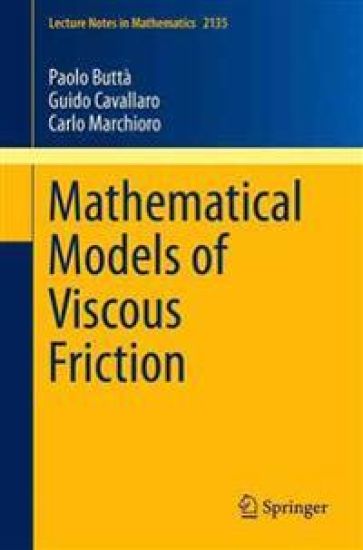
Mathematical Models of Viscous Friction

Mathematical Models of Viscous Friction

Paolo Buttà; Guido Cavallaro; Carlo Marchioro

Springer International Publishing AG
2015
nidottu
In this monograph we present a review of a number of recent results on the motion of a classical body immersed in an infinitely extended medium and subjected to the action of an external force. We investigate this topic in the framework of mathematical physics by focusing mainly on the class of purely Hamiltonian systems, for which very few results are available. We discuss two cases: when the medium is a gas and when it is a fluid. In the first case, the aim is to obtain microscopic models of viscous friction. In the second, we seek to underline some non-trivial features of the motion. Far from giving a general survey on the subject, which is very rich and complex from both a phenomenological and theoretical point of view, we focus on some fairly simple models that can be studied rigorously, thus providing a first step towards a mathematical description of viscous friction. In some cases, we restrict ourselves to studying the problem at a heuristic level, or we present themain ideas, discussing only some aspects of the proof if it is prohibitively technical. This book is principally addressed to researchers or PhD students who are interested in this or related fields of mathematical physics.
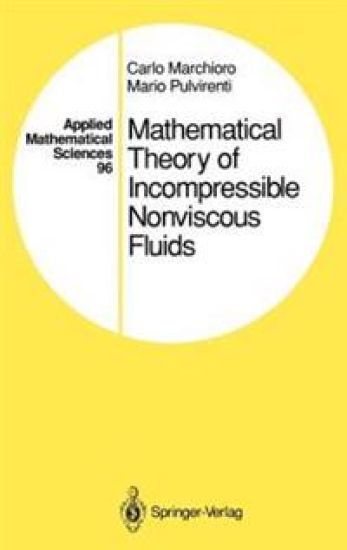
Mathematical Theory of Incompressible Nonviscous Fluids

Mathematical Theory of Incompressible Nonviscous Fluids

Carlo Marchioro; Mario Pulvirenti

Springer-Verlag New York Inc.
2011
nidottu
Fluid dynamics is an ancient science incredibly alive today. Modern technol­ ogy and new needs require a deeper knowledge of the behavior of real fluids, and new discoveries or steps forward pose, quite often, challenging and diffi­ cult new mathematical {::oblems. In this framework, a special role is played by incompressible nonviscous (sometimes called perfect) flows. This is a mathematical model consisting essentially of an evolution equation (the Euler equation) for the velocity field of fluids. Such an equation, which is nothing other than the Newton laws plus some additional structural hypo­ theses, was discovered by Euler in 1755, and although it is more than two centuries old, many fundamental questions concerning its solutions are still open. In particular, it is not known whether the solutions, for reasonably general initial conditions, develop singularities in a finite time, and very little is known about the long-term behavior of smooth solutions. These and other basic problems are still open, and this is one of the reasons why the mathe­ matical theory of perfect flows is far from being completed. Incompressible flows have been attached, by many distinguished mathe­ maticians, with a large variety of mathematical techniques so that, today, this field constitutes a very rich and stimulating part of applied mathematics.
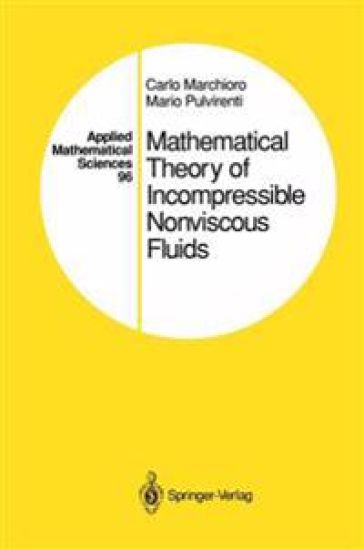
Mathematical Theory of Incompressible Nonviscous Fluids

Mathematical Theory of Incompressible Nonviscous Fluids

Carlo Marchioro; Mario Pulvirenti

Springer-Verlag New York Inc.
1993
sidottu
Fluid dynamics is an ancient science incredibly alive today. Modern technol­ ogy and new needs require a deeper knowledge of the behavior of real fluids, and new discoveries or steps forward pose, quite often, challenging and diffi­ cult new mathematical {::oblems. In this framework, a special role is played by incompressible nonviscous (sometimes called perfect) flows. This is a mathematical model consisting essentially of an evolution equation (the Euler equation) for the velocity field of fluids. Such an equation, which is nothing other than the Newton laws plus some additional structural hypo­ theses, was discovered by Euler in 1755, and although it is more than two centuries old, many fundamental questions concerning its solutions are still open. In particular, it is not known whether the solutions, for reasonably general initial conditions, develop singularities in a finite time, and very little is known about the long-term behavior of smooth solutions. These and other basic problems are still open, and this is one of the reasons why the mathe­ matical theory of perfect flows is far from being completed. Incompressible flows have been attached, by many distinguished mathe­ maticians, with a large variety of mathematical techniques so that, today, this field constitutes a very rich and stimulating part of applied mathematics.