Kirjojen hintavertailu – 12 859 824 kirjaa ja 27 kauppaa

Kirjailija

Carlos Eire

Kirjat ja teokset yhdessä paikassa: 8 kirjaa, julkaisuja vuosilta 2004–2025, suosituimpiin kuuluu Plough Quarterly No. 45 – The Supernatural. Vertaile teosten hintoja ja tarkista saatavuus suomalaisista kirjakaupoista.

8 kirjaa

Kirjojen julkaisuvuodet: 2004–2025.

Plough Quarterly No. 45 – The Supernatural

Plough Quarterly No. 45 – The Supernatural

Fleming Rutledge; Alison Milbank; Carlos Eire; James Wood

PLOUGH PUBLISHING HOUSE
2025
nidottu
Gone are the flat-earth days of scientific rationalism. Humans, it turns out, are naturally hungry for mystery, magic, faith. There have been laments about disenchantment and calls for re-enchantment. Many who forsake traditional religion are drawn to spiritualism and pagan beliefs and practices. Christians, meanwhile, have always affirmed that there is more than meets our eyes, that our world is teeming with angels and demons, powers and principalities, signs and wonders. The “supernatural” is real; in fact, it’s entirely natural. Whether you believe it or not, there are powers you should rightly fear, and one you should serve. On this theme: Joy Marie Clarkson debunks the idea that our world needs re-enchantment. Andrew Davison surveys the unseen world’s place in our cosmology. Alison Milbank considers the matter of angels as creatures like and unlike us. Carlos Eire talks about what drew him to accounts of flying saints. Fleming Rutledge says true preaching is letting the Holy Spirit speak through you. Rachel Pieh Jones recounts dreams of Jesus that changed two lives continents apart. Charles E. Moore tells a story of demon possession, revival, and miraculous healings that weren’t coincidental. Benjamin Crosby asks what “gifts of the spirit” should mark the follower of Jesus. Also in this issue: André Trocmé tells how his town offered sanctuary to thousands of Jews facing deportation. Anti-Nazi theologian Henri de Lubac has a message for today’s Christian nationalists. Mary Townsend gives up her smartphone and starts noticing things. Hannah Rose Thomas paints portraits of mothers who survived the Srebrenica massacre. The winning poems in Plough’s fifth annual Rhina Espaillat Poetry Award. Plough Quarterly features stories, ideas, and culture for people eager to apply their faith to the challenges we face. Each issue includes in-depth articles, interviews, poetry, book reviews, and art.
The Life of Saint Teresa of Avila

The Life of Saint Teresa of Avila

Carlos Eire

PRINCETON UNIVERSITY PRESS
2019
sidottu
The life and many afterlives of one of the most enduring mystical testaments ever writtenThe Life of Saint Teresa of Avila is among the most remarkable accounts ever written of the human encounter with the divine. The Life is not really an autobiography at all, but rather a confession written for inquisitors by a nun whose raptures and mystical claims had aroused suspicion. Despite its troubled origins, the book has had a profound impact on Christian spirituality for five centuries, attracting admiration from readers as diverse as mystics, philosophers, artists, psychoanalysts, and neurologists. How did a manuscript once kept under lock and key by the Spanish Inquisition become one of the most inspiring religious books of all time? National Book Award winner Carlos Eire tells the story of this incomparable spiritual masterpiece, examining its composition and reception in the sixteenth century, the various ways its mystical teachings have been interpreted and reinterpreted across time, and its enduring influence in our own secular age. The Life became an iconic text of the Counter-Reformation, was revered in Franco’s Spain, and has gone on to be read as a feminist manifesto, a literary work, and even as a secular text. But as Eire demonstrates in this vibrant and evocative book, Teresa’s confession is a cry from the heart to God and an audacious portrayal of mystical theology as a search for love. Here is the essential companion to the Life, one woman’s testimony to the reality of mystical experience and a timeless affirmation of the ultimate triumph of good over evil.
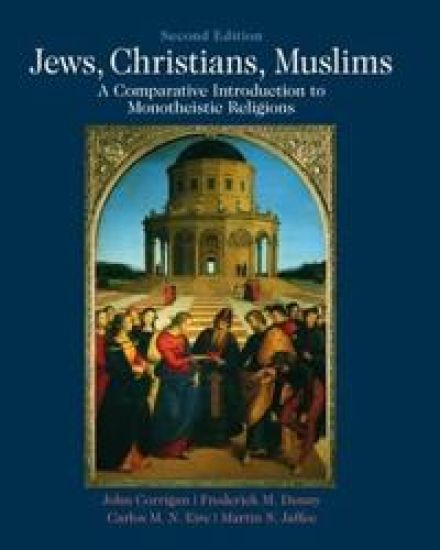
Jews, Christians, Muslims

Jews, Christians, Muslims

John Corrigan; Frederick Denny; Carlos Eire; Martin S Jaffee

Routledge
2017
sidottu
The second edition of Jews, Christians, Muslims: A Comparative Introduction to Monotheistic Religions, compares Judaism, Christianity, and Islam using seven common themes which are equally relevant to each tradition. Provoking critical thinking, this text addresses the cultural framework of religious meanings and explores the similarities and differences among Judaism, Christianity, and Islam as it explains the ongoing process of interpretation in each religion. The book is designed for courses in Western and World Religions.
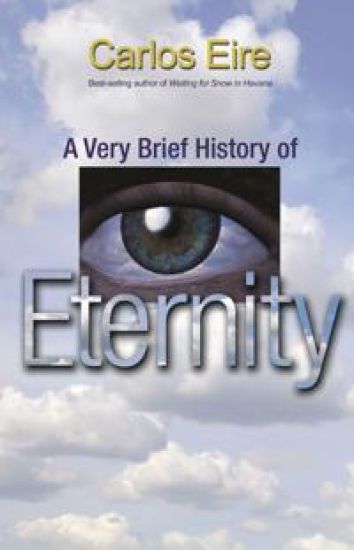
A Very Brief History of Eternity

A Very Brief History of Eternity

Carlos Eire

Princeton University Press
2011
pokkari
What is eternity? Is it anything other than a purely abstract concept, totally unrelated to our lives? A mere hope? A frightfully uncertain horizon? Or is it a certainty, shared by priest and scientist alike, and an essential element in all human relations? In A Very Brief History of Eternity, Carlos Eire, the historian and National Book Award-winning author of Waiting for Snow in Havana, has written a brilliant history of eternity in Western culture. Tracing the idea from ancient times to the present, Eire examines the rise and fall of five different conceptions of eternity, exploring how they developed and how they have helped shape individual and collective self-understanding. A book about lived beliefs and their relationship to social and political realities, A Very Brief History of Eternity is also about unbelief, and the tangled and often rancorous relation between faith and reason. Its subject is the largest subject of all, one that has taxed minds great and small for centuries, and will forever be of human interest, intellectually, spiritually, and viscerally.
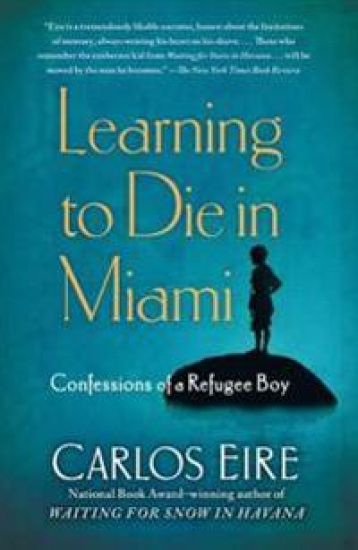
Learning to Die in Miami: Confessions of a Refugee Boy
Continuing the personal saga begun in the National Book Award-winning Waiting for Snow in Havana, the inspiring, sad, funny, bafflingly beautiful story of a boy uprooted by the Cuban Revolution and transplanted to Miami during the years of the Kennedy administration. In his 2003 National Book Award-winning memoir Waiting for Snow in Havana, Carlos Eire narrated his coming of age in Cuba just before and during the Castro revolution. That book literally ends in midair as eleven-year-old Carlos and his older brother leave Havana on an airplane--along with thousands of other children--to begin their new life in Miami in 1962. It would be years before he would see his mother again. He would never again see his beloved father. Learning to Die in Miami opens as the plane lands and Carlos faces, with trepidation and excitement, his new life. He quickly realizes that in order for his new American self to emerge, his Cuban self must "die." And so, with great enterprise and purpose, he begins his journey. We follow Carlos as he adjusts to life in his new home. Faced with learning English, attending American schools, and an uncertain future, young Carlos confronts the age-old immigrant's plight: being surrounded by American bounty, but not able to partake right away. The abundance America has to offer excites him and, regardless of how grim his living situation becomes, he eagerly forges ahead with his own personal assimilation program, shedding the vestiges of his old life almost immediately, even changing his name to Charles. Cuba becomes a remote and vague idea in the back of his mind, something he used to know well, but now it "had ceased to be part of the world." But as Carlos comes to grips with his strange surroundings, he must also struggle with everyday issues of growing up. His constant movement between foster homes and the eventual realization that his parents are far away in Cuba bring on an acute awareness that his life has irrevocably changed. Flashing back and forth between past and future, we watch as Carlos balances the divide between his past and present homes and finds his way in this strange new world, one that seems to hold the exhilarating promise of infinite possibilities and one that he will eventually claim as his own. An exorcism and an ode, Learning to Die in Miami is a celebration of renewal--of those times when we're certain we have died and then are somehow, miraculously, reborn.
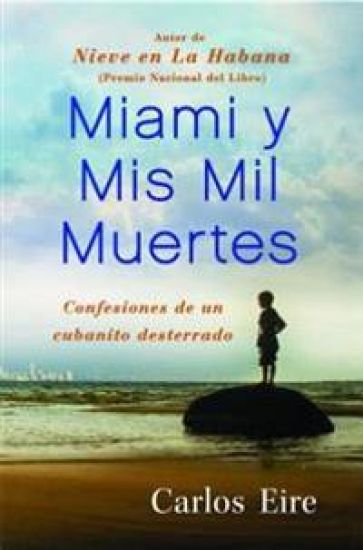
Miami Y MIS Mil Muertes: Confesiones de Un Cubanito Desterrado
En su libro de memorias Nieve en La Habana, el cual gan el Premio Nacional del Libro en 2003, Carlos Eire narra su ni ez en Cuba en la poca del triunfo de la revoluci n y la llegada al poder de Fidel Castro. Esa historia termina en 1962, en el avi n que lleva a Carlos y a su hermano desde La Habana a Miami para comenzar una nueva vida, como sucedi a miles de ni os cubanos. Pasar an a os antes de que Carlos volviera a ver a su madre. Y nunca m s volver a a ver a su padre, por quien sent a una verdadera devoci n. Miami y Mis Mil Muertes sigue el cuento en el momento en que aquel avi n aterriza y Carlos comienza una nueva vida impulsado por sus miedos y esperanzas. Enseguida se da cuenta de que para llegar a ser americano tendr que "morir" el Carlos cubano que hasta ahora ha sido. Se enfrenta al eterno dilema del inmigrante que debe aprender ingl s, ir a una escuela americana y descifrar un futuro incierto: est en el pa s de las oportunidades, pero a n no es capaz de aprovecharlas. A pesar de la dura realidad de los hogares adoptivos donde ha de vivir, el muchacho se abre paso, dejando atr s cualquier vestigio de su vida pasada hasta el punto de cambiar su nombre y convertirse en Charles. Miami y Mis Mil Muertes es un exorcismo y una oda a esa experiencia, es un homenaje a la renovaci n, a los momentos de la vida en que tenemos la certeza de haber muerto y, de alguna manera milagrosa, haber vuelto a nacer.
Nieve En La Habana: Confesiones de Un Cubanito / Waiting for Snow in Havana: Confessions of a Cuban Boy = Waiting for Snow in Havana
"Ten piedad de m , Se or, cubano soy". En 1962, Carlos Eire fue uno de los 14.841 ni os que fueron transportados fuera de Cuba en el puente a?reo conocido como la Operaci n Pedro Pan--exiliado de su familia, de su patria y de su propia ni ez por la Revoluci n. Los recuerdos de su vida en La Habana cobran vida en estas memorias evocativas e inolvidables. Nieve en La Habana es a su vez un exorcismo y una oda a un mundo perdido. La Cuba de la ni ez de Carlos, con sus lagartijas y su mar azul turquesa ba ado por un sol esplendoroso, se convierte en una isla maldita con la llegada al poder de un guerrillero llamado Fidel Castro. De pronto la m sica callejera se transforma en tiroteos, las pascuas navide as quedan prohibidas, la disidencia conlleva encarcelamiento y casi todos los amigos de Carlos deben irse de Cuba rumbo a un lugar tan lejano e inconcebible como los Estados Unidos. Carlos tambi n terminar en ese mismo exilio, y cumplir el deseo de su madre de convertirse en un hombre americano moderno --aun si su alma permanece en el pa s que lo vio nacer. Narrado con la urgencia de una confesi n, Nieve en La Habana es un elogio a una patria arruinada y un amoroso testimonio del esp ritu colectivo de todos los cubanos, dondequiera que est n.
Waiting for Snow in Havana: Confessions of a Cuban Boy
A memoir of the Cuban Revolution from the perspective of a Batista-era child describes his carefree early days, the harrowing legal changes that occurred with the ascension of Fidel Castro, his witness to the disappearance of numerous peers, and his eventual relocation to the United States during Operation Pedro Pan. Reprint. 25,000 first printing.