
Kirjojen hintavertailu – 12 859 827 kirjaa ja 27 kauppaa

Kirjailija

Carnoy Martin

Kirjat ja teokset yhdessä paikassa: 3 kirjaa, julkaisuja vuosilta 1985–1994, suosituimpiin kuuluu Faded Dreams. Vertaile teosten hintoja ja tarkista saatavuus suomalaisista kirjakaupoista.

3 kirjaa

Kirjojen julkaisuvuodet: 1985–1994.

Faded Dreams

Faded Dreams

Carnoy Martin

Cambridge University Press
1994
sidottu
Faded Dreams paints a new and challenging picture of why racial inequality changes in America. The author argues that blacks caught up with whites mainly when government policies, under political pressure by blacks and an important segment of the white community, pushed for greater racial equality. Similarly, the greatest obstacles to black gains in other periods have also been government policies. These policies usually assumed away the race problem or used it against blacks for political purposes. Faded Dreams shows that three dominant views of economic differences between blacks and whites - that blacks are individually responsible for not taking advantage of market opportunities, that the world economy has changed in ways that puts blacks at a tremendous disadvantage compared to whites, and that pervasive racism is holding blacks down - do not adequately explain why blacks made such large gains in the past and stopped making them in the 1980s and 1990s.
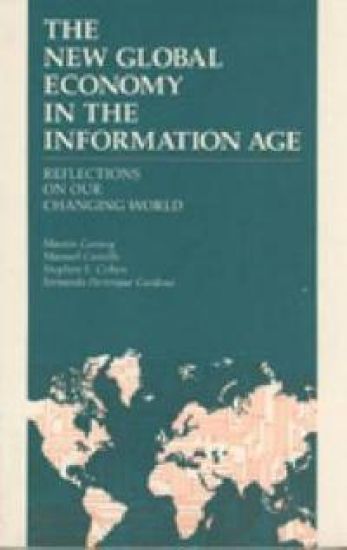
The New Global Economy in the Information Age

The New Global Economy in the Information Age

Carnoy Martin; Manuel Castells; Stephen Cohen; Fernando-Henrique Cardoso

Pennsylvania State University Press
1993
sidottu
Most studies of the world economy focus on highly developed countries and only on economic strategies. The New Global Economy in the Information Age is unique in integrating the political with the economic and in the truly global view it takes of the changes under way. It focuses on the effects of new computer and telecommunications technology in conditioning the policy choices of nation-states in both the less and more economically developed regions of the world. The authors analyze the new economic context in which nation-states operate, the main issues confronting them, and the way in which the politics of national development should change in the post-Cold War information age. They argue that the new world economy cannot be separated easily from the new world society, and that national and international politics is the cement binding the two.
Schooling and Work in the Democratic State

Schooling and Work in the Democratic State

Carnoy Martin

Stanford University Press
1985
sidottu
A new explanation of the relation between schooling and work in the democratic, advanced industrial state emerges from this study that rejects both traditional views and the more recent Marxian perspective. Traditional views consider schools as autonomous institutions that are able to pursue the goals of equality and social mobility irrespective of the inequalities of capitalist society; the Marxian perspective views schools as serving the role of producing wage-labor for capitalistic exploitation. The authors suggest that the shortcomings of both views are rooted in the fact that they do not recognize the true functions of the democratic, capitalist state. The state is seen as an arena for struggle between forces pushing for egalitarian, democratic reforms and those seeking to use the resources of the state for private capital accumulation. Depending on which side has primacy at the moment, schools will reflect one set of goals over the other. However, victory is never complete, and the tide of battle has shifted back and forth historically. The authors develop this theory through interpreting the dynamic relation between U. S. schools and the workplace. Based on this approach, they predict changes in both schooling and work as well as the forms that future conflicts between the contending forces are likely to take.