Kirjojen hintavertailu – 12 859 829 kirjaa ja 27 kauppaa

Kirjailija

Carol L. Graham

Kirjat ja teokset yhdessä paikassa: 6 kirjaa, julkaisuja vuosilta 1994–2012, suosituimpiin kuuluu The Other War. Vertaile teosten hintoja ja tarkista saatavuus suomalaisista kirjakaupoista.

6 kirjaa

Kirjojen julkaisuvuodet: 1994–2012.

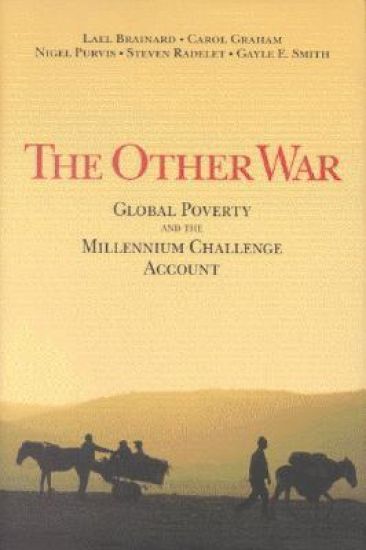
The Other War

The Other War

Lael Brainard; Carol L. Graham; Nigel Purvis

Brookings Institution
2003
nidottu
"The plight of the poorest around the world has been pushed to the forefront of America's international agenda for the first time in many years by the war on terrorism and the formidable challenges presented by the HIV/AIDS pandemic. In March 2002, President Bush announced the creation of the Millennium Challenge Account (MCA). This bilateral development fund represents an increase of $5 billion per year over current assistance levels and establishes of a new agency to promote growth in reform-oriented developing countries. Amounting to a doubling of U. S. bilateral development aid—the largest increase in decades -- the MCA offers a critical chance to deliberately shape the face that the United States presents to people in poor nations around the world. This book makes concrete recommendations on crafting a new blueprint for distributing and delivering aid to make the MCA an effective tool, not only in its own right, but also in transforming U. S. foreign aid and strengthening international aid cooperation more generally. The book tackles head on the tension between foreign policy and development goals that chronically afflicts U. S. foreign assistance; the danger of being dismissed as one more instance of the United States going it alone instead of buttressing international cooperation; and the risk of exacerbating confusion among the myriad overlapping U. S. policies, agencies, and programs targeted at developing nations, particularly USAID. In doing so, The Other War draws important lessons from new international development initiatives, such as the Global Fund to Fight AIDS, TB, and Malaria, the mixed record of previous U. S. aid efforts, trends in the U. S. budget for foreign assistance, the agencies currently involved in administering U. S. development policy, and the importance of the relationship between Congress and the executive branch in determining aid outcomes. The MCA holds the promise of substantially increasing U. S. development assistance and pioneering a new era in aid, but the authors caution against creating yet another example of wasted aid that could undermine political support for foreign assistance for decades to come. About the Authors Lael Brainard is director of the Brookings/CGD Project on the Millennium Challenge Account and holds the New Century Chair in Economic Studies and Foreign Policy Studies at the Brookings Institution. Carol Graham is Vice President and Director of the Governance Studies Program at the Brookings Institution, where she also directs the Global Poverty Reduction Initiative. Steven Radelet is a senior fellow at the Center for Global Development. Nigel Purvis is a senior scholar in Foreign Policy, Economic, and Governance Studies at the Brookings Institution. Gayle E. Smith is a guest scholar at the Brookings Institution and formerly was senior director for African affairs at the National Security Council."
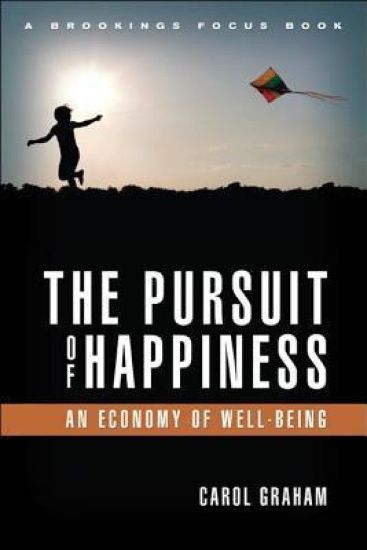
The Pursuit of Happiness

The Pursuit of Happiness

Carol L. Graham

Brookings Institution
2012
nidottu
In The Pursuit of Happiness , renowned economist Carol Graham explores what we know about the determinants of happiness and clearly presents both the promise and the potential pitfalls of injecting the ""economics of happiness"" into public policymaking. While the book spotlights the innovative contributions of happiness research to the dismal science, it also raises a cautionary note about the issues that still need to be addressed before policymakers can make best use of them.
Happiness and Hardship

Happiness and Hardship

Carol L. Graham; Stefano Pettinato

Brookings Institution
2001
nidottu
"Subjective well being, or happiness, has been analyzed in detail by psychologists for decades. Yet only recently has it become the subject of economic analysis. In Happiness and Hardship, Carol Graham and Stefano Pettinato provide a new conceptual framework for analyzing the relationship between subjective well being and the political sustainability of market-oriented economic growth in 17 Latin American countries and Russia. Several variables—such as marital status, employment, and inflation—are known to influence happiness. Graham and Pettinato have identified other variables that have important effects on how individuals perceive their well being: macroeconomic volatility, globalization of information, increasing income mobility, and inequality driven by technology-led growth. The authors begin by explaining data and measurement problems involved in studying mobility, and they summarize general trends in developing countries. Second, they provide new data on subjective well being for Latin America and Russia. They find that the socio-demographic determinants of ""happiness""—such as the effects of age and unemployment—are very similar to those in the U. S. and Europe. They also find that relative income differences have important effects on how individuals assess their well being. Those in the middle or lower middle of the income distribution are more likely to be dissatisfied than are the very poorest groups. Third, the authors find that volatility in income flows can have negative effects on perceived well being, even among upwardly mobile individuals. Finally, the authors explore the relationship between social capital and mobility. They distinguish between participation driven by economic necessity—such as soup kitchens—and voluntary participation in civic organizations. They find that different objectives underlying civic participation can result in different effects on individual mobility rates, on perceived well being, and on aggregate growth. An age-old puzzle is why some societies seem to tolerate significant degrees of economic hardship and yet retain political and social stability, while others break out into violent protest as a result of much smaller economic declines or shocks. Happiness and Hardship sheds new light on factors that can increase mobility and provide new opportunities for low-income people in developing economies, and possibly improve perceived, as well as actual, well being."
Private Markets for Public Goods

Private Markets for Public Goods

Carol L. Graham

Brookings Institution
1998
nidottu
"This book studies the effects of incorporating market incentives into the public goods arena. Carol Graham examines the effects of market-based strategies on the performance of public institutions, the political sustainability of market reforms, and equity. In so doing, she examines a variety of reform experiences in the realms of education, health, social security, and state- owned enterprises and across a range of country and income contexts, with case studies drawn from Latin America, Africa, and Eastern Europe. The studies show that the incorporation of new market incentives, such as vouchers in education and private social security systems, can have positive effects on the performance of public institutions. The effects on equity are less clear, however, and in many cases efficiency gains entail short-term equity losses. The poorest sectors are usually least equipped to take advantage of new incentives and may be marginalized from the reforms and lose access to essential services. Yet in the long-term, negative equity effects are usually counter-balanced by the benefits of enhancing the performance of public institutions. As this book makes clear, the issues explored have relevance for advanced industrial societies as well as for developing economies."
A Half Penny on the Federal Dollar

A Half Penny on the Federal Dollar

Michael E. O'Hanlon; Carol L. Graham

Brookings Institution
1997
nidottu
Spending on U. S. foreign affairs, which constitutes only about one percent of the federal budget, is being sharply reduced. Under the President's 1996 budget plan, it will decline by just as great a percentage as defense between 1990 and 2002?and by substantially more than defense over the 1980-2002 period. No other major category of federal spending will undergo a real cut over either time period. The shrinking budget, totaling about $19 billion in 1997, will still have to fund the State Department, international broadcasting and educational exchanges, trade subsidies and investment guarantees for U. S. business overseas; United Nations operations including peacekeeping, and all types of foreign assistance. In this book, O'Hanlon and Graham focus primarily on this last component of international spending. Specifically, they analyze U. S. official development assistance (ODA) to poor countries. The authors place U. S. ODA in a broad historical, international, and economic perspective. They then recommend an alternative approach to ODA for the United States as well as other donors. They favor continuing to provide humanitarian and grass-roots aid to most poor countries, but providing ODA to promote macroeconomic growth only to those countries that maintain coherent, market-oriented economic policy frameworks. The authors argue that to provide effective aid, as well as to maintain U. S. leadership in world affairs, net resources for ODA and the international account need to increase only modestly.
Safety Nets, Politics, and the Poor

Safety Nets, Politics, and the Poor

Carol L. Graham

Brookings Institution
1994
nidottu
Countries worldwide are attempting difficult transitions from state-planned to market economies. Most of these countries have fragile democratic regimes that are threatened by the high social and political costs of reform. Governments?and ultimately societies?have to make hard choices about allocating scarce public resources as they undergo these transitions. A central, often controversial, and most poignant question is how to protect vulnerable groups and the poor. What compensation, what ""safety net"" will be provided for them? Carol Graham argues that safety nets can provide an environment in which economic reform is more politically sustainable and poverty can be permanently reduced. However, these two objectives frequently involve trade-offs, as vocal and organized opponents of reform (for obvious political reasons) often concern governments far more than the poor. These organized and less vulnerable groups tend to place heavy demands on the scarce resources available to governments at times of economic crisis. Governments that fail to address the social costs of reform, meanwhile, often face popular opposition that jeopardizes or even derails the entire market transition-the results of the September 1993 elections in Poland are a case in point. The author examines these trade-offs in detail, with a particular focus on how political and institutional contexts affect the kinds of safety nets that are implemented. For example, reaching the poor and vulnerable with safety nets tends to be more difficult in closed-party systems, such as in Senegal, where entrenched interest groups have a monopoly on state benefits. In contrast, dramatic political change or rapid implementation of economic reform undermines the influence of such groups and therefore can provide unique political opportunities to redirect resources to the poor, as in the case of Bolivia and Zambia. Rather than focus their efforts on organized interest groups-such as public sector unions-which have a great deal to lose in the process of reform, governments might better concentrate their efforts on poor groups that have rarely, if ever, received benefits from the state. The poor, meanwhile, may gain a new stake in the ongoing process of economic and public sector reform through organizing to solicit the state for safety net benefits. This is the first book to provide a detailed and comparative analysis of compensation during economic reform. Graham offers specific examples of resource allocation in three regions: Latin America, Africa, and Eastern Europe. She features case studies from Chile, Bolivia, Peru, Senegal, Zambia, and Poland.