Kirjojen hintavertailu – 12 859 819 kirjaa ja 27 kauppaa

Kirjailija

Carol P Roth

Kirjat ja teokset yhdessä paikassa: 10 kirjaa, julkaisuja vuosilta 2015–2025, suosituimpiin kuuluu Behavioral Health Care in the Military Health System. Vertaile teosten hintoja ja tarkista saatavuus suomalaisista kirjakaupoista.

Nimi esiintyy myös muodoissa: Carol P. Roth

10 kirjaa

Kirjojen julkaisuvuodet: 2015–2025.

Assessing Readiness in Service Members Who Receive Private-Sector Behavioral Health Care

Assessing Readiness in Service Members Who Receive Private-Sector Behavioral Health Care

Jessica L. Sousa; Kimberly A. Hepner; Carol P. Roth

RAND Corporation
2025
nidottu
When the demand for behavioral health care outstrips supply at military treatment facilities (MTFs), service members are referred to private-sector providers. While readiness assessments are routinely included in clinical encounters at MTFs, it has been unclear how readiness assessments and command communication are being conducted for service members receiving private-sector care.

Virtual Behavioral Health for Army Soldiers

Virtual Behavioral Health for Army Soldiers

Kimberly A Hepner; Joshua Breslau; Jessica L Sousa; Carol P Roth; Teague Ruder; Isabelle González; Cheryl K Montemayor; Beth Ann Griffin

RAND Corporation
2023
pokkari
Delivery of high-quality behavioral health (BH) care is essential to the readiness of the U. S. armed forces and their families. Virtual behavioral health (VBH) care expanded during the COVID-19 pandemic and could support BH care delivery in the future. The authors examined trends in the use of VBH care for U. S. Army soldiers and their spouses from prior to the pandemic through March 2022 and surveyed soldiers about their perceptions of VBH care.
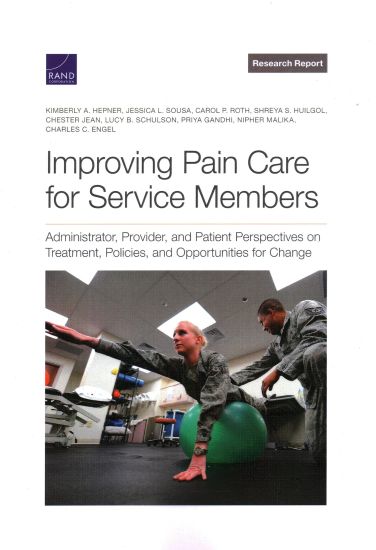
Improving Pain Care for Service Members

Improving Pain Care for Service Members

Kimberly A Hepner; Jessica L Sousa; Carol P Roth; Shreya S Huilgol; Chester Jean; Lucy B Schulson; Priya Gandhi; Nipher Malika; Charles C Engel

RAND Corporation
2023
pokkari
Acute and chronic pain are common among service members, with musculoskeletal pain and injuries being the leading cause of nondeployability among active-duty service members. Interviews with Military Health System (MHS) administrators, providers, and service member patients provide on-the-ground perspectives on MHS pain care policies, highlighting strengths and potential areas for improvement and innovation in pain care across the MHS.
Behavioral Health Care Delivery Following the Onset of the Covid-19 Pandemic

Behavioral Health Care Delivery Following the Onset of the Covid-19 Pandemic

Kimberly A Hepner; Carol P Roth; Jessica L Sousa; Teague Ruder; Ryan Andrew Brown; Layla Parast; Harold Alan Pincus

RAND Corporation
2023
pokkari
This report examines changes in behavioral health care delivered to service members by the Military Health System following the onset of the COVID-19 pandemic, including patterns of care, use of telehealth, and quality of care. The findings and recommendations are intended to inform improvements to behavioral health care in the Military Health System and provide insights into the implications of its ongoing integration of telehealth.
Readiness of Soldiers and Adult Family Members Who Receive Behavioral Health Care
Behavioral health (BH) conditions comprise the second most common medical reason for nondeployability in the U. S. Army. To inform the Army's efforts to monitor and improve outcomes, the authors aimed to identify promising metrics to assess readiness among soldiers and adult family members who receive BH care. Such metrics would expand the Army's outcome monitoring efforts beyond symptom improvement metrics for patients who received BH care.
Quality of Care for Ptsd and Depression in the Military Health System

Quality of Care for Ptsd and Depression in the Military Health System

Kimberly A Hepner; Carol P Roth; Elizabeth M Sloss

RAND
2021
nidottu
This report is a comprehensive assessment of the quality of care delivered by the Military Health System (MHS) in 2013-2014 for active-component service members with posttraumatic stress disorder (PTSD) or depression. The assessment includes performance on 30 quality measures, which draw on multiple data sources to evaluate the receipt of recommended assessments and treatments. The assessment identified strengths and areas for improvement.
Improving Behavioral Health Care for U.S. Army Personnel

Improving Behavioral Health Care for U.S. Army Personnel

Kimberly A Hepner; Carol P Roth; Eric R Pedersen

RAND
2020
nidottu
This report identifies factors associated with changes in outcomes for soldiers who received Army behavioral health specialty care and provides recommendations to improve care and outcomes for posttraumatic stress disorder, depression, and anxiety. Analyses of 141 patient and treatment variables indicated that two treatment factors-therapeutic alliance and receipt of benzodiazepines-were associated with outcomes.
Quality of Care for Ptsd and Depression in the Military Health System

Quality of Care for Ptsd and Depression in the Military Health System

Kimberly A. Hepner; Elizabeth M. Sloss; Carol P. Roth; Heather Krull; Susan M. Paddock; Shaela Moen; Martha J. Timmer; Harold Alan Pincus

RAND
2016
pokkari
Understanding the current quality of care for posttraumatic stress disorder (PTSD) and depression delivered to service members is an important step toward improving care across the Military Health System (MHS). This report describes the characteristics of active-component service members who received care for PTSD or depression through the MHS and assesses the quality of care received using quality measures derived from administrative data.
Measuring the Quality of Care for Psychological Health Conditions in the Military Health System

Measuring the Quality of Care for Psychological Health Conditions in the Military Health System

Kimberly A. Hepner; Carol P. Roth; Coreen Farris; Elizabeth M. Sloss; Grant R. Martsolf; Harold Alan Pincus; Katherine E. Watkins; Caroline Epley; Daniel Mandel; Susan D. Hosek; Carrie M. Farmer

RAND
2015
pokkari
To inform improvements to the quality of care delivered by the military health system for posttraumatic stress disorder and major depressive disorder, researchers developed a framework and identified, developed, and described a candidate set of measures for monitoring, assessing, and improving the quality of care. This document describes their research approach and the measure sets that they identified.