Kirjojen hintavertailu – 12 903 735 kirjaa ja 27 kauppaa

Kirjailija

Carolyn Gallaher

Kirjat ja teokset yhdessä paikassa: 8 kirjaa, julkaisuja vuosilta 2002–2025, suosituimpiin kuuluu Building a Green Wall. Vertaile teosten hintoja ja tarkista saatavuus suomalaisista kirjakaupoista.

8 kirjaa

Kirjojen julkaisuvuodet: 2002–2025.

Building a Green Wall

Building a Green Wall

Kimberly Cowell-Meyers; Carolyn Gallaher

Bristol University Press
2025
sidottu
In the aftermath of Britain’s 2016 decision to leave the EU, the Irish-American ethnic lobby remobilized to defend the Belfast/Good Friday Agreement from the threats posed by Brexit. Brexit deepened tensions in Northern Ireland and created rifts between Ireland and the UK. Drawing on interviews in Washington, Belfast, Dublin and London, the authors in this book explore how the lobby shaped US policy towards Brexit in order to prevent the reimposition of a hard border on the island of Ireland and preserve peace. The authors also consider the lobby’s approach to other contentious issues, including a united Ireland and Troubles-related investigations.
Building a Green Wall

Building a Green Wall

Kimberly Cowell-Meyers; Carolyn Gallaher

Bristol University Press
2025
nidottu
In the aftermath of Britain’s 2016 decision to leave the EU, the Irish-American ethnic lobby remobilized to defend the Belfast/Good Friday Agreement from the threats posed by Brexit. Brexit deepened tensions in Northern Ireland and created rifts between Ireland and the UK. Drawing on interviews in Washington, Belfast, Dublin and London, the authors in this book explore how the lobby shaped US policy towards Brexit in order to prevent the reimposition of a hard border on the island of Ireland and preserve peace. The authors also consider the lobby’s approach to other contentious issues, including a united Ireland and Troubles-related investigations.
The Politics of Staying Put

The Politics of Staying Put

Carolyn Gallaher

Temple University Press,U.S.
2016
pokkari
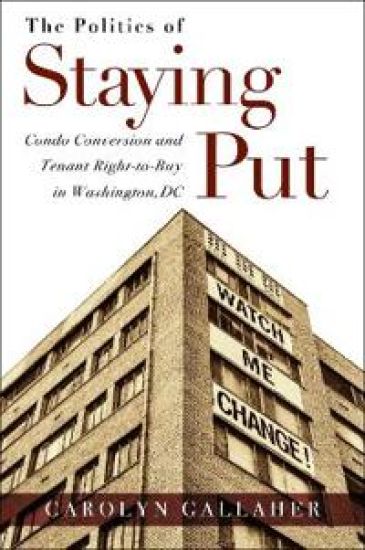
When cities gentrify, it can be hard for working-class and low-income residents to stay put. Rising rents and property taxes make buildings unaffordable, or landlords may sell buildings to investors interested in redeveloping them into luxury condos. In her engaging study The Politics of Staying Put, Carolyn Gallaher focuses on a formal, city-sponsored initiative-The Tenant Opportunity to Purchase Act (TOPA)-that helps people keep their homes. This law, unique to the District of Columbia, allows tenants in apartment buildings contracted for sale the right to refuse the sale and purchase the building instead. In the hands of tenants, a process that would usually hurt them-conversion to a condominium or cooperative-can instead help them. Taking a broad, city-wide assessment of TOPA, Gallaher follows seven buildings through the program’s process. She measures the law’s level of success and its constraints. Her findingshave relevance for debates in urban affairs about condo conversion, urban local autonomy, and displacement.
The Politics of Staying Put

The Politics of Staying Put

Carolyn Gallaher

Temple University Press,U.S.
2016
sidottu
When cities gentrify, it can be hard for working-class and low-income residents to stay put. Rising rents and property taxes make buildings unaffordable, or landlords may sell buildings to investors interested in redeveloping them into luxury condos. In her engaging study The Politics of Staying Put, Carolyn Gallaher focuses on a formal, city-sponsored initiative-The Tenant Opportunity to Purchase Act (TOPA)-that helps people keep their homes. This law, unique to the District of Columbia, allows tenants in apartment buildings contracted for sale the right to refuse the sale and purchase the building instead. In the hands of tenants, a process that would usually hurt them-conversion to a condominium or cooperative-can instead help them. Taking a broad, city-wide assessment of TOPA, Gallaher follows seven buildings through the program’s process. She measures the law’s level of success and its constraints. Her findingshave relevance for debates in urban affairs about condo conversion, urban local autonomy, and displacement.
Key Concepts in Political Geography

Key Concepts in Political Geography

Carolyn Gallaher; Carl T Dahlman; Mary Gilmartin; Alison Mountz; Peter Shirlow

SAGE Publications Inc
2009
nidottu
"A comprehensive reader for my political geography course. Good summaries at the end, and articles include effective case study examples." - Rachel Paul, Western Washington University "A very useful and comprehensive introduction to key concepts in political geography. This book provides useful context not just for 'traditional' political geography modules, but also those examining broader issues of power, resistance and social movements." - Gavin Brown, University of Leicester "Vital for introducing basic concepts and terminology in a clear and concise fashion. The short chapters are accessible and well supplemented with pertinent examples." - Daniel Hammett, Sheffield University "I found the book to be very useful in a supplemental capacity, full of information that would be useful for an undergraduate or early graduate student." - Jason Dittmer, University College London This textbook forms part of an innovative set of companion texts for the human geography subdisciplines. Organized around 20 short essays, Key Concepts in Political Geography provides a cutting-edge introduction to the central concepts that define contemporary research in the field. Involving detailed yet expansive discussions, the book includes: An introductory chapter providing a succinct overview of the recent developments in the fieldOver 20 key concept entries covering the expected staples of the sub-discipline, such as nationalism, territoriality, scale and political-economy, as well as relatively new arrivals to the field including the other, anti-statism, gender, and post-conflictA glossary, figures, diagrams and further reading. It is essential reading for undergraduate and postgraduate students of political geography.
Key Concepts in Political Geography

Key Concepts in Political Geography

Carolyn Gallaher; Carl T Dahlman; Mary Gilmartin; Alison Mountz; Peter Shirlow

SAGE Publications Inc
2009
sidottu
"A comprehensive reader for my political geography course. Good summaries at the end, and articles include effective case study examples." - Rachel Paul, Western Washington University "A very useful and comprehensive introduction to key concepts in political geography. This book provides useful context not just for 'traditional' political geography modules, but also those examining broader issues of power, resistance and social movements." - Gavin Brown, University of Leicester "Vital for introducing basic concepts and terminology in a clear and concise fashion. The short chapters are accessible and well supplemented with pertinent examples." - Daniel Hammett, Sheffield University "I found the book to be very useful in a supplemental capacity, full of information that would be useful for an undergraduate or early graduate student." - Jason Dittmer, University College London This textbook forms part of an innovative set of companion texts for the human geography subdisciplines. Organized around 20 short essays, Key Concepts in Political Geography provides a cutting-edge introduction to the central concepts that define contemporary research in the field. Involving detailed yet expansive discussions, the book includes: An introductory chapter providing a succinct overview of the recent developments in the fieldOver 20 key concept entries covering the expected staples of the sub-discipline, such as nationalism, territoriality, scale and political-economy, as well as relatively new arrivals to the field including the other, anti-statism, gender, and post-conflictA glossary, figures, diagrams and further reading. It is essential reading for undergraduate and postgraduate students of political geography.
After the Peace

After the Peace

Carolyn Gallaher

Cornell University Press
2007
pokkari
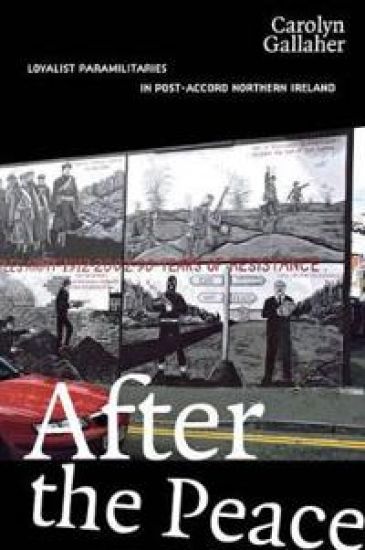
The 1998 Belfast Agreement promised to release citizens of Northern Ireland from the grip of paramilitarism. However, almost a decade later, Loyalist paramilitaries were still on the battlefield. After the Peace examines the delayed business of Loyalist demilitarization and explains why it included more fits than starts in the decade since formal peace and how Loyalist paramilitary recalcitrance has affected everyday Loyalists. Drawing on interviews with current and former Loyalist paramilitary men, community workers, and government officials, Carolyn Gallaher charts the trenchant divisions that emerged during the run-up to peace and thwart demilitarization today. After the Peace demonstrates that some Loyalist paramilitary men want to rebuild their communities and join the political process. They pledge a break with violence and the criminality that sustained their struggle. Others vow not to surrender and refuse to set aside their guns. These units operate under a Loyalist banner but increasingly resemble criminal fiefdoms. In the wake of this internecine power struggle, demilitarization has all but stalled. Gallaher documents the battle for the heart of Loyalism in varied settings, from the attempt to define Ulster Scots as a language to deadly feuds between UVF, UDA, and LVF contingents. After the Peace brings the story of Loyalist paramilitaries up to date and sheds light on the residual violence that persists in the post-accord era.
On the Fault Line

On the Fault Line

Carolyn Gallaher

Rowman Littlefield Publishers
2002
nidottu
Due to the economic globalization over the last twenty years, white workers have seen their racial dominance challenged and the security of their jobs assaulted, making them ripe for mobilization. On the Fault Line examines the American Patriot Movement—a broad, right-wing social movement that includes militias, Second Amendment activists, tax protestors, and individuals who drop out of the system. Carolyn Gallaher uncovers how the Patriot Movement addresses the conflicting social positions of its members—predominantly white, working class males. Arguing that discourses of patriotism obscure the class-based nature of their concerns, Gallaher asserts that these patriots buttress their racial anxieties through safe, acceptable nationalistic coding. While patriots have been mobilized by the right wing, this book presents potent reasons why the left could intervene, and to better effect. For all those interested in the fluctuating systems of power within the United States, Gallaher's work proves to be a fascinating and unique analysis.