Kirjojen hintavertailu – 12 903 725 kirjaa ja 27 kauppaa

Kirjailija

Catherine Gallagher

Kirjat ja teokset yhdessä paikassa: 6 kirjaa, julkaisuja vuosilta 1995–2018, suosituimpiin kuuluu Practicing New Historicism. Vertaile teosten hintoja ja tarkista saatavuus suomalaisista kirjakaupoista.

6 kirjaa

Kirjojen julkaisuvuodet: 1995–2018.

Telling It Like It Wasn't

Telling It Like It Wasn't

Catherine Gallagher

University of Chicago Press
2018
sidottu
Inventing counterfactual histories is a common pastime of modern day historians, both amateur and professional. We speculate about an America ruled by Jefferson Davis, a Europe that never threw off Hitler, or a second term for JFK. These narratives are often written off as politically inspired fantasy or as pop culture fodder, but in Telling It Like It Wasn't, Catherine Gallagher takes the history of counterfactual history seriously, pinning it down as an object of dispassionate study. She doesn't take a moral or normative stand on the practice, but focuses her attention on how it works and to what ends--a quest that takes readers on a fascinating tour of literary and historical criticism. Gallagher locates the origins of contemporary counterfactual history in eighteenth-century Europe, where the idea of other possible historical worlds first took hold in philosophical disputes about Providence before being repurposed by military theorists as a tool for improving the art of war. In the next century, counterfactualism became a legal device for deciding liability, and lengthy alternate-history fictions appeared, illustrating struggles for historical justice. These early motivations--for philosophical understanding, military improvement, and historical justice--are still evident today in our fondness for counterfactual tales featuring the Civil War and Nazis. Alternate histories of the Civil War and WWII abound, but here, Gallagher shows how the counterfactual habit of replaying the recent past often shaped the actual events themselves. The counterfactual mode lets us continue to envision our future by reconsidering the range of previous alternatives. Throughout this engaging and eye-opening book, Gallagher encourages readers to ask important questions about our obsession with counterfactual history and the roots of our tendency to ask "What if...?"
Telling It Like It Wasn't

Telling It Like It Wasn't

Catherine Gallagher

University of Chicago Press
2018
pokkari
Inventing counterfactual histories is a common pastime of modern day historians, both amateur and professional. We speculate about an America ruled by Jefferson Davis, a Europe that never threw off Hitler, or a second term for JFK. These narratives are often written off as politically inspired fantasy or as pop culture fodder, but in Telling It Like It Wasn't, Catherine Gallagher takes the history of counterfactual history seriously, pinning it down as an object of dispassionate study. She doesn't take a moral or normative stand on the practice, but focuses her attention on how it works and to what ends--a quest that takes readers on a fascinating tour of literary and historical criticism. Gallagher locates the origins of contemporary counterfactual history in eighteenth-century Europe, where the idea of other possible historical worlds first took hold in philosophical disputes about Providence before being repurposed by military theorists as a tool for improving the art of war. In the next century, counterfactualism became a legal device for deciding liability, and lengthy alternate-history fictions appeared, illustrating struggles for historical justice. These early motivations--"for philosophical understanding, military improvement, and historical justice--are still evident today in our fondness for counterfactual tales featuring the Civil War and Nazis. Alternate histories of the Civil War and WWII abound, but here, Gallagher shows how the counterfactual habit of replaying the recent past often shaped the actual events themselves. The counterfactual mode lets us continue to envision our future by reconsidering the range of previous alternatives. Throughout this engaging and eye-opening book, Gallagher encourages readers to ask important questions about our obsession with counterfactual history and the roots of our tendency to ask "What if...?"
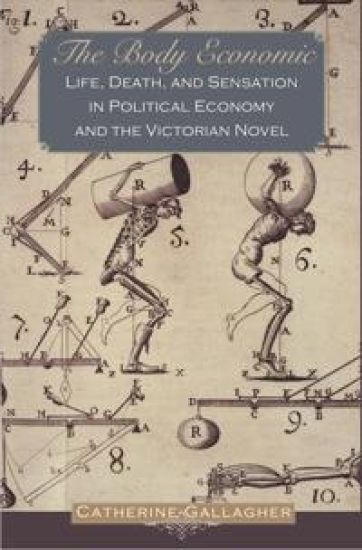
The Body Economic

The Body Economic

Catherine Gallagher

Princeton University Press
2008
pokkari
The Body Economic revises the intellectual history of nineteenth-century Britain by demonstrating that political economists and the writers who often presented themselves as their literary antagonists actually held most of their basic social assumptions in common. Catherine Gallagher demonstrates that political economists and their Romantic and early-Victorian critics jointly relocated the idea of value from the realm of transcendent spirituality to that of organic "life," making human sensations--especially pleasure and pain--the sources and signs of that value. Classical political economy, this book shows, was not a mechanical ideology but a form of nineteenth-century organicism, which put the body and its feelings at the center of its theories, and neoclassical economics built itself even more self-consciously on physiological premises. The Body Economic explains how these shared views of life, death, and sensation helped shape and were modified by the two most important Victorian novelists: Charles Dickens and George Eliot. It reveals how political economists interacted crucially with the life sciences of the nineteenth century--especially with psychophysiology and anthropology--producing the intellectual world that nurtured not only George Eliot's realism but also turn-of-the-century literary modernism.
Practicing New Historicism

Practicing New Historicism

Catherine Gallagher; Stephen Greenblatt

University of Chicago Press
2001
nidottu
For almost 20 years, new historicism has been a highly controversial and influential force in literary and cultural studies. In "Practicing New Historicism", two of its most distinguished practitioners reflect on its surprisingly disparate sources and far-reaching effects. In lucid and jargon-free prose, Catherine Gallagher and Stephen Greenblatt focus on five central aspects of new historicism: recurrent use of anecdotes, preoccupation with the nature of representations, fascination with the history of the body, sharp focus on neglected details, and skeptical analysis of ideology. Arguing that new historicism has always been more a passionately engaged practice of questioning and analysis than an abstract theory, Gallagher and Greenblatt demonstrate this practice in a series of characteristicaly dazzling readings of works ranging from paintings by Joos van Gent and Paolo Uccello to "Hamlet" and "Great Expectations". By juxtaposing analyses of Renaissance and 19th-century topics, the authors uncover a number of unexpected contrasts and connections between the two periods. Are aspects of the dispute over the Roman Catholic doctrine of the Eucharist detectable in British political economists' hostility to the potato? How does Pip's isolation in "Great Expectations" shed light on Hamlet's doubt?
Practicing New Historicism

Practicing New Historicism

Catherine Gallagher; Stephen Greenblatt

University of Chicago Press
2000
sidottu
For almost 20 years, new historicism has been a highly controversial and influential force in literary and cultural studies. In "Practicing New Historicism", two of its most distinguished practitioners reflect on its surprisingly disparate sources and far-reaching effects. In lucid and jargon-free prose, Catherine Gallagher and Stephen Greenblatt focus on five central aspects of new historicism: recurrent use of anecdotes, preoccupation with the nature of representations, fascination with the history of the body, sharp focus on neglected details, and skeptical analysis of ideology. Arguing that new historicism has always been more a passionately engaged practice of questioning and analysis than an abstract theory, Gallagher and Greenblatt demonstrate this practice in a series of characteristicaly dazzling readings of works ranging from paintings by Joos van Gent and Paolo Uccello to "Hamlet" and "Great Expectations". By juxtaposing analyses of Renaissance and 19th-century topics, the authors uncover a number of unexpected contrasts and connections between the two periods. Are aspects of the dispute over the Roman Catholic doctrine of the Eucharist detectable in British political economists' hostility to the potato? How does Pip's isolation in "Great Expectations" shed light on Hamlet's doubt? Offering not only an insider's view of new historicism, but also a lively dialogue between a Renaissance scholar and Victorianist, "Practising New Historicism" is an illuminating and unpredictable performance by two of America's most respected literary scholars.
Nobody's Story

Nobody's Story

Catherine Gallagher

University of California Press
1995
pokkari
Exploring the careers of five influential women writers of the Restoration and eighteenth century, Catherine Gallagher reveals the connections between the increasing prestige of female authorship, the economy of credit and debt, and the rise of the novel. The 'nobodies' of her title are not ignored, silenced, or anonymous women. Instead, they are literal nobodies: the abstractions of authorial personae, printed books, intellectual property rights, literary reputations, debts and obligations, and fictional characters. These are the exchangeable tokens of modern authorship that lent new cultural power to the increasing number of women writers through the eighteenth century. Women writers, Gallagher discovers, invented and popularized numerous ingenious similarities between their gender and their occupation. The terms 'woman', 'author', 'marketplace', and 'fiction' come to define each other reciprocally. Gallagher analyzes the provocative plays of Aphra Behn, the scandalous court chronicles of Delarivier Manley, the properly fictional nobodies of Charlotte Lennox and Frances Burney, and finally Maria Edgeworth's attempts in the late eighteenth century to reform the unruly genre of the novel.