Kirjojen hintavertailu – 12 867 616 kirjaa ja 27 kauppaa

Kirjailija

Catherine Perlès

Kirjat ja teokset yhdessä paikassa: 5 kirjaa, julkaisuja vuosilta 2001–2023, suosituimpiin kuuluu Ornaments and Other Ambiguous Artifacts from Franchthi. Vertaile teosten hintoja ja tarkista saatavuus suomalaisista kirjakaupoista.

5 kirjaa

Kirjojen julkaisuvuodet: 2001–2023.

Ornaments and Other Ambiguous Artifacts from Franchthi

Ornaments and Other Ambiguous Artifacts from Franchthi

Catherine Perlès

INDIANA UNIVERSITY PRESS
2023
pokkari
The famous Franchthi Cave excavations in Greece brought to light an exceptionally long sequence of ornaments, spanning from the earliest Upper Paleolithic to the end of the Neolithic. This volume focuses on the Neolithic, whose assemblages are far more diversified than those of earlier times. The introduction during the Neolithic of entirely artificial shapes, geometric and anthropomorphic, creates a marked departure from earlier periods and shows new directions in creativity by the bead makers. It also denotes a conceptual break in the treatment of shell, no longer solely a natural element barely modified by perforation, but now also a raw material rendered anonymous by workmanship. Due to the systematic sieving of the sediments and its location by the sea, the Franchthi cave and its outdoor settlement, the Paralia, yielded one of the richest collection of ornaments for Neolithic Greece.
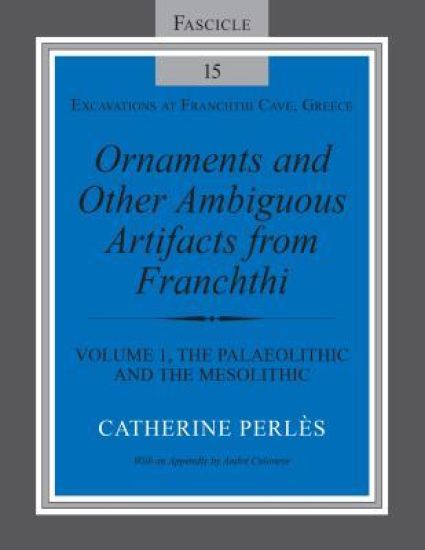
Ornaments and Other Ambiguous Artifacts from Franchthi

Ornaments and Other Ambiguous Artifacts from Franchthi

Catherine Perlès

Indiana University Press
2018
pokkari
The famous Franchthi Cave excavations in Greece brought to light an exceptionally long sequence of ornaments, spanning from the earliest Upper Palaeolithic to the end of the Neolithic. This volume focuses on the Palaeolithic and Mesolithic ornaments and ornamental species, which constitute one of the largest collections in Europe for these periods combined. Franchthi is one of the few identified production centers for ornaments, which are overwhelmingly dominated by marine molluscs. The detailed publication of these collections (Cyclope neritea, Antalis sp. and Columbella rustica) will be useful to all malacologists and specialists in ornaments working around the Mediterranean. These reference collections, coupled with the examination of manufacturing and wear traces on the archaeological specimens, allow a detailed reconstruction of the whole production cycle from procurement to discard. The systematic association of unworked, freshly worked and very worn shells suggests that the ornaments mostly served for the production or rejuvenation of embroidered garments. Despite the richness of the assemblages and varied local resources, the range of ornament types is surprisingly narrow and fundamentally stable through time. The ornaments from Franchthi Cave therefore paint a different portrait of the European Upper Palaeolithic and Mesolithic, one based on regional cultural continuity.
Settlement and Land Use on the Periphery

Settlement and Land Use on the Periphery

Jere M. Wickens; Susan I. Rotroff; Tracey Cullen; Lauren E. Talalay; Catherine Perlès

Archaeopress
2018
nidottu
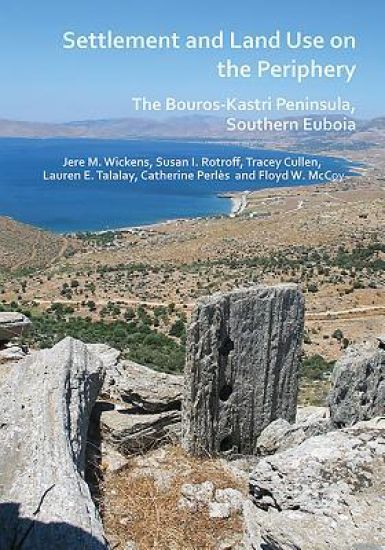
The Bouros-Kastri peninsula at the south-eastern tip of the Greek island of Euboia has previously been overlooked in the archaeological literature. This survey by the Southern Euboea Exploration Project, conducted under the aegis of the Canadian Institute in Greece, now provides a wealth of intriguing information about fluctuations in long-term use and habitation in this part of the Karystia. While the peninsula is agriculturally poor, its coast is blessed with several small coastal inlets and one important ancient port, Geraistos. These provide access to vital maritime routes and connect the peninsula to Athens and other Aegean ports. The survey revealed modest use of the peninsula during the Neolithic and Early Bronze Age; it was then virtually abandoned for the following two and a half millennia. Occupation resumed in the Late Archaic–Early Classical period, followed by near desertion in the 3rd century BC of all but some coastal sites, a resurgence of activity in the Late Roman period, and modest use in Byzantine and Ottoman times. The authors analyse the ways in which the peninsula's use was connected to that of the main urban centre at Karystos, and how the peninsula and the greater Karystia were integrated into the political, economic, and cultural spheres of Athens and the broader region.
The Early Neolithic in Greece

The Early Neolithic in Greece

Catherine Perlès

Cambridge University Press
2001
sidottu
Farmers made a sudden and dramatic appearance in Greece around 7000 BC, bringing with them new ceramics and crafts, and establishing settled villages. They were Europe's first farmers, and their settlements provide the link between the first agricultural communities in the Near East and the subsequent spread of the new technologies to the Balkans and on to Western Europe. In this 2001 book, Catherine Perlès argues that the stimulus for the spread of agriculture to Europe was a colonisation movement involving small groups of maritime peoples. Drawing evidence from a wide range of archaeological sources, including often neglected 'small finds', and introducing daring new perspectives on funerary rituals and the distribution of figurines, she constructs a complex and subtle picture of early Neolithic societies, overturning the traditional view that these societies were simple and self-sufficient.
The Early Neolithic in Greece

The Early Neolithic in Greece

Catherine Perlès

Cambridge University Press
2001
pokkari
Farmers made a sudden and dramatic appearance in Greece around 7000 BC, bringing with them new ceramics and crafts, and establishing settled villages. They were Europe's first farmers, and their settlements provide the link between the first agricultural communities in the Near East and the subsequent spread of the new technologies to the Balkans and on to Western Europe. In this 2001 book, Catherine Perlès argues that the stimulus for the spread of agriculture to Europe was a colonisation movement involving small groups of maritime peoples. Drawing evidence from a wide range of archaeological sources, including often neglected 'small finds', and introducing daring new perspectives on funerary rituals and the distribution of figurines, she constructs a complex and subtle picture of early Neolithic societies, overturning the traditional view that these societies were simple and self-sufficient.