
Kirjailija
Cathy O'Neil
Kirjat ja teokset yhdessä paikassa: 9 kirjaa, julkaisuja vuosilta 2017–2023, suosituimpiin kuuluu The Shame Machine. Vertaile teosten hintoja ja tarkista saatavuus suomalaisista kirjakaupoista.
9 kirjaa
Kirjojen julkaisuvuodet: 2017–2023.
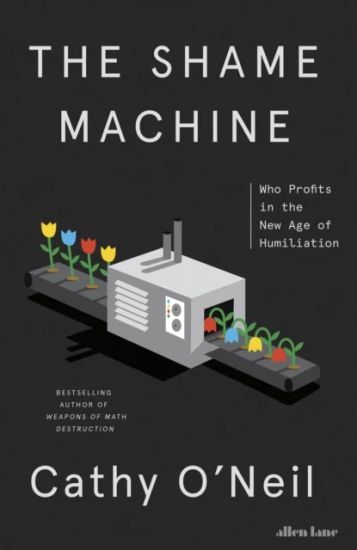
A TIMES BOOK OF THE YEAR Shame is being weaponized by governments and corporations to attack the most vulnerable. It's time to fight backShame is a powerful and sometimes useful tool. When we publicly shame corrupt politicians, abusive celebrities, or predatory corporations, we reinforce values of fairness and justice. But as best-selling author Cathy O'Neil argues in this revelatory book, shaming has taken a new and dangerous turn. It is increasingly being weaponized -- used as a way to shift responsibility for social problems from institutions to individuals. Shaming children for not being able to afford school lunches or adults for not being able to find work lets us off the hook as a society. After all, why pay higher taxes to fund programmes for people who are fundamentally unworthy? O'Neil explores the machinery behind all this shame, showing how governments, corporations and the healthcare system capitalize on it. There are damning stories of rehab clinics, reentry programs, drug and diet companies, and social media platforms -- all of which profit from 'punching down' on the vulnerable. Woven throughout The Shame Machine is the story of O'Neil's own struggle with body image and her recent weight-loss surgery, which awakened her to the systematic shaming of fat people seeking medical care. With clarity and nuance, O'Neil dissects the relationship between shame and power. Whom does the system serve? How do current incentive structures perpetuate the shaming cycle? And, most important, how can we all fight back?

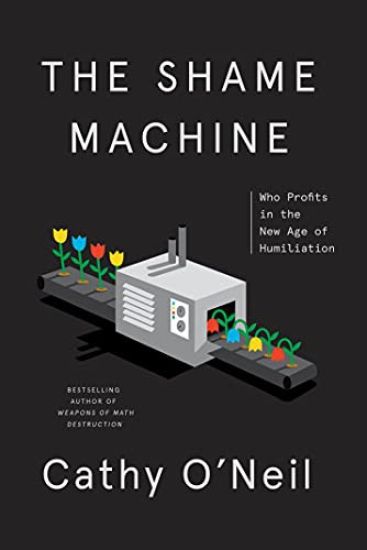
The Shame Machine: Who Profits in the New Age of Humiliation
Cathy O'Neil
Crown Publishing Group (NY)
2022
sidottu
NEW YORK TIMES EDITORS' CHOICE - A clear-eyed warning about the increasingly destructive influence of America's "shame industrial complex" in the age of social media and hyperpartisan politics--from the New York Times bestselling author of Weapons of Math Destruction "O'Neil reminds us that we must resist the urge to judge, belittle, and oversimplify, and instead allow always for complexity and lead always with empathy."--Dave Eggers, author of The Every ONE OF THE BEST BOOKS OF THE YEAR: The Times (UK) Shame is a powerful and sometimes useful tool: When we publicly shame corrupt politicians, abusive celebrities, or predatory corporations, we reinforce values of fairness and justice. But as Cathy O'Neil argues in this revelatory book, shaming has taken a new and dangerous turn. It is increasingly being weaponized--used as a way to shift responsibility for social problems from institutions to individuals. Shaming children for not being able to afford school lunches or adults for not being able to find work lets us off the hook as a society. After all, why pay higher taxes to fund programs for people who are fundamentally unworthy? O'Neil explores the machinery behind all this shame, showing how governments, corporations, and the healthcare system capitalize on it. There are damning stories of rehab clinics, reentry programs, drug and diet companies, and social media platforms--all of which profit from "punching down" on the vulnerable. Woven throughout The Shame Machine is the story of O'Neil's own struggle with body image and her recent weight-loss surgery, which awakened her to the systematic shaming of fat people seeking medical care. With clarity and nuance, O'Neil dissects the relationship between shame and power. Whom does the system serve? Is it counter-productive to call out racists, misogynists, and vaccine skeptics? If so, when should someone be "canceled"? How do current incentive structures perpetuate the shaming cycle? And, most important, how can we all fight back?
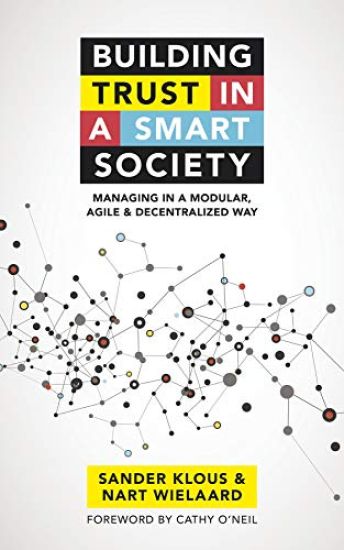
Building trust in a smart society
Sander Klous; Nart Wielaard; Cathy O'Neil
Infinite Ideas Limited
2018
nidottu
Building trust in a smart society asks one essential question: how can we manage complexity in a world where interactions become more data-rich and more global? The idea of an increasingly algorithm-based set of systems for running our lives provokes fear in a lot of people, and there certainly are ethical and technical dilemmas to contend with. We hear about the poorly controlled financial systems responsible for the stock market crash of 2008 and wonder if the system is now running us. The first self-replenishing fridge goes on sale and we start to think it can't be long until the machines take over - Terminator-like. And when even our landmark political decisions seem to be at the mercy of `bots' and the tweets they send out is it any wonder we despair of our technological future? So is there a positive side to this complex world? There are in fact huge possibilities here for those willing to evolve alongside the technology and learn to use it to their advantage. Technology will (some would say has to) continue to develop, so how might leaders and business owners work with it? At the heart of Building trust in a smart society is a MAD idea - that by throwing off traditional organizational systems and taking a modular, agile and decentralized approach, businesses can evolve and grow, while those unwilling to adapt are left behind. Complexity can become opportunity. Building trust in a smart society is essential reading for those willing to embrace the future and change the way they interact with the world.
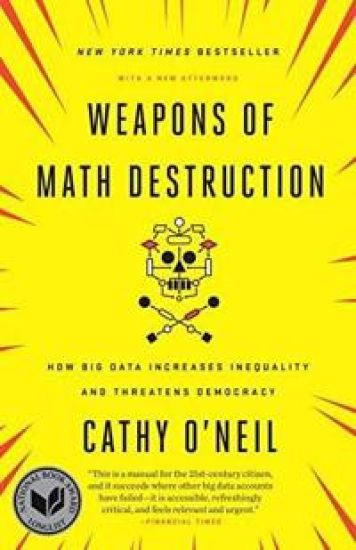
Weapons of Math Destruction: How Big Data Increases Inequality and Threatens Democracy
Cathy O'Neil
Crown Publishing Group (NY)
2017
nidottu
Halvin toimitettuna 20,30 €
A former Wall Street quant sounds an alarm on the mathematical models that pervade modern life and threaten to rip apart our social fabric We live in the age of the algorithm. Increasingly, the decisions that affect our lives where we go to school, whether we get a car loan, how much we pay for health insurance are being made not by humans, but by mathematical models. In theory, this should lead to greater fairness: Everyone is judged according to the same rules, and bias is eliminated. But as Cathy O Neil reveals in this urgent and necessary book, the opposite is true. The models being used today are opaque, unregulated, and uncontestable, even when they re wrong. Most troubling, they reinforce discrimination: If a poor student can t get a loan because a lending model deems him too risky (by virtue of his zip code), he s then cut off from the kind of education that could pull him out of poverty, and a vicious spiral ensues. Models are propping up the lucky and punishing the downtrodden, creating a toxic cocktail for democracy. Welcome to the dark side of Big Data. Tracing the arc of a person s life, from college to retirement, O Neil exposes the black box models that shape our future, both as individuals and as a society. These weapons of math destruction score teachers and students, sort resumes, grant (or deny) loans, evaluate workers, target voters, set parole, and monitor our health. O Neil calls on modelers to take more responsibility for their algorithms and on policy makers to regulate their use. But in the end, it s up to us to become more savvy about the models that govern our lives. This important book empowers us to ask the tough questions, uncover the truth, and demand change.

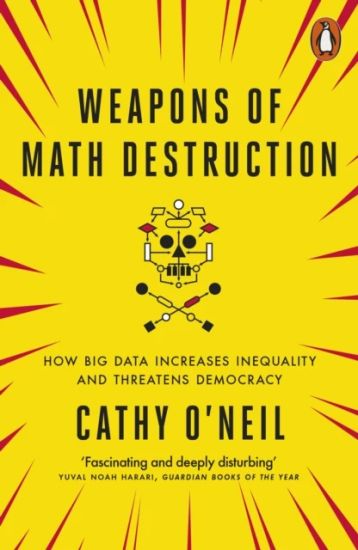
'A manual for the 21st-century citizen... accessible, refreshingly critical, relevant and urgent' - Financial Times 'Fascinating and deeply disturbing' - Yuval Noah Harari, Guardian Books of the Year In this New York Times bestseller, Cathy O'Neil, one of the first champions of algorithmic accountability, sounds an alarm on the mathematical models that pervade modern life -- and threaten to rip apart our social fabric. We live in the age of the algorithm. Increasingly, the decisions that affect our lives - where we go to school, whether we get a loan, how much we pay for insurance - are being made not by humans, but by mathematical models. In theory, this should lead to greater fairness: everyone is judged according to the same rules, and bias is eliminated. And yet, as Cathy O'Neil reveals in this urgent and necessary book, the opposite is true. The models being used today are opaque, unregulated, and incontestable, even when they're wrong. Most troubling, they reinforce discrimination. Tracing the arc of a person's life, O'Neil exposes the black box models that shape our future, both as individuals and as a society. These "weapons of math destruction" score teachers and students, sort CVs, grant or deny loans, evaluate workers, target voters, and monitor our health. O'Neil calls on modellers to take more responsibility for their algorithms and on policy makers to regulate their use. But in the end, it's up to us to become more savvy about the models that govern our lives. This important book empowers us to ask the tough questions, uncover the truth, and demand change.

Matemaatikko Cathy O'Neil on perehtynyt liike-elämän tapaan käyttää vapaaehtoisesti tai muuten antamaamme yksityis- ja henkilökohtaista aineistoamme myös meitä vastaan. Valtavien aineistojen keruu on mahdollistanut äärimmäisen henkilökohtaisen vaalimainonnon kohdistamisen, vakuutuksen myynnin riskien minimoinnin, korkeakoulujen maailmanlaajuisen luokittelun ja paljon muuta. On synytynyt laskenta algoritmeihin perustuvia matikkatuhoaseita ja niitä voidaan käyttää demokratiaa vastaan. Tulokset eivät ole kaikille myönteisiä.