Kirjojen hintavertailu – 12 859 829 kirjaa ja 27 kauppaa

Kirjailija

Celia Lury

Kirjat ja teokset yhdessä paikassa: 18 kirjaa, julkaisuja vuosilta 1993–2026, suosituimpiin kuuluu The Generic Person. Vertaile teosten hintoja ja tarkista saatavuus suomalaisista kirjakaupoista.

18 kirjaa

Kirjojen julkaisuvuodet: 1993–2026.

The Generic Person

The Generic Person

Sophie Day; Celia Lury; Helen Ward

BLOOMSBURY PUBLISHING PLC
2026
sidottu
We ask who—or what, and how—is the person of personalisation. Exploring practices across the domains of digital culture, healthcare and data science, this open-access book argues that they re-articulate relations between economy, politics and culture. Contemporary investment in big data, increasing computational power and ‘real-time’ analytics have made participation in a culture of personalisation almost impossible to avoid. We must declare, measure and share our personal data in order to carry out many activities. ‘People Like You’ are simultaneously one and many: a group, a category, or a generic emerging from the mapping of publics onto populations. Focusing in-depth on case studies in digital culture, health care and data science, this book identifies common features of personalising practices to evaluate their significance for conceptions of the person. We explore three features: the use of tracking techniques; the formation of relations of likeness, resemblance or similarity on the basis of practices of liking or preference; and new forms of contextualising persons in what Meta CEO Mark Zuckerberg referred to as the “default social.” This book explores the implications of these techniques for the stratification of populations, processes of inclusion, exclusion and belonging, and the assetisation of data, and how they combine to create to create new emphases on the individual, dividual and generic person. The eBook editions of this book are available open access under a CC BY-NC-ND 4.0 licence on bloomsburycollections.com. Open access was funded by The Wellcome Trust.

Problem Spaces

Problem Spaces

Celia Lury

Polity Press
2020
sidottu
In this innovative book, Celia Lury argues that the time has come for us to explore the world not only with new methods, but with a new approach to methodology itself. Fundamental changes are taking place in how we produce knowledge, how we communicate it and, indeed, what we consider to be knowledge. These changes demand innovative and creative responses to research questions. Lury's rethinking of the nature of social inquiry starts by reconceptualizing the 'problem space'. Problems are not static or a 'given'; rather, they are created and continually recomposed as part of the methodological process itself. Following the line of thought that methods are practices that articulate as much as capture a social problem, Lury further develops the notion of compositional methodology to think through its implications. With remarkable fluency, the book draws into conversation a range of hot-button issues, both longstanding and novel, from observation, reflexivity, recursive measurement and feminist methodologies, to participation, context, datafication and platformization. Always with an eye to the methodological potential of new trends, the book provides a strong challenge to much received wisdom and argues that a combination of techniques can contribute to better understanding of the problem spaces we all inhabit.
Problem Spaces

Problem Spaces

Celia Lury

Polity Press
2020
nidottu

Halvin toimitettuna 30,20 €

In this innovative book, Celia Lury argues that the time has come for us to explore the world not only with new methods, but with a new approach to methodology itself. Fundamental changes are taking place in how we produce knowledge, how we communicate it and, indeed, what we consider to be knowledge. These changes demand innovative and creative responses to research questions. Lury's rethinking of the nature of social inquiry starts by reconceptualizing the 'problem space'. Problems are not static or a 'given'; rather, they are created and continually recomposed as part of the methodological process itself. Following the line of thought that methods are practices that articulate as much as capture a social problem, Lury further develops the notion of compositional methodology to think through its implications. With remarkable fluency, the book draws into conversation a range of hot-button issues, both longstanding and novel, from observation, reflexivity, recursive measurement and feminist methodologies, to participation, context, datafication and platformization. Always with an eye to the methodological potential of new trends, the book provides a strong challenge to much received wisdom and argues that a combination of techniques can contribute to better understanding of the problem spaces we all inhabit.
Consumer Culture

Consumer Culture

Celia Lury

Rutgers University Press
2011
nidottu
The second edition of Consumer Culture explores the nature and role of consumption in modern societies. Celia Lury's up-to-date revision of this successful classic establishes the importance of new object-based studies for consumer culture, and incorporates new chapters on branding and the rise of ethical consumption. Drawing on a wide range of studies, and using contemporary illustrations from the media and popular culture, Lury examines the emergence of consumer culture and the changing relations between the production and consumption of cultural goods. She argues that consumer culture has become increasingly stylized and now provides an important context for everyday creativity. This new edition of Consumer Culture explores the way in which the position of individuals within social groups and their position in social groups structured by class, gender, race, and age affects the nature of their participation in consumer culture. The powerful role consumption plays in our lives is revealed and consumer culture is seen to provide new ways of creating social and political identities.
Consumer Culture

Consumer Culture

Celia Lury

Polity Press
2011
nidottu
The second edition of Consumer Culture brings this successful introductory textbook right up-to-date for students who are interested in the nature and role of consumption in modern societies. It introduces the importance of new object-based studies for consumer culture, as well as adding new chapters on branding and the rise of ethical consumption. Drawing on a wide range of studies, and using contemporary illustrations from the media and popular culture, the author examines the rise of consumer culture and the changing relations between the production and consumption of cultural goods. She argues that consumer culture has become increasingly stylized and now provides an important context for everyday creativity. The author explores the way an individual’s position in social groups structured by class, gender, race and age affects the nature of his or her participation in consumer culture. She also argues that this has contributed to changes in the way in which individuals belong to these social groups. The powerful role consumption plays in our lives is thus revealed as consumer culture is seen to provide new ways of creating social and political identities.
Consumer Culture

Consumer Culture

Celia Lury

Polity Press
2011
sidottu
The second edition of Consumer Culture brings this successful introductory textbook right up-to-date for students who are interested in the nature and role of consumption in modern societies. It introduces the importance of new object-based studies for consumer culture, as well as adding new chapters on branding and the rise of ethical consumption. Drawing on a wide range of studies, and using contemporary illustrations from the media and popular culture, the author examines the rise of consumer culture and the changing relations between the production and consumption of cultural goods. She argues that consumer culture has become increasingly stylized and now provides an important context for everyday creativity. The author explores the way an individual’s position in social groups structured by class, gender, race and age affects the nature of his or her participation in consumer culture. She also argues that this has contributed to changes in the way in which individuals belong to these social groups. The powerful role consumption plays in our lives is thus revealed as consumer culture is seen to provide new ways of creating social and political identities.
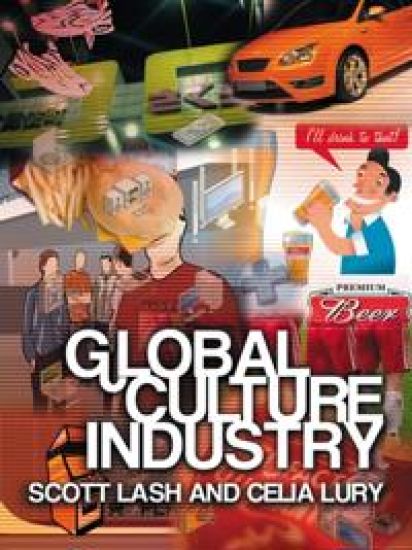
Global Culture Industry

Global Culture Industry

Scott Lash; Celia Lury

Polity Press
2007
nidottu
In the first half of the twentieth century, Theodor Adorno wrote about the 'culture industry'. For Adorno, culture too along with the products of factory labour was increasingly becoming a commodity. Now, in what they call the 'global culture industry', Scott Lash and Celia Lury argue that Adorno's worst nightmares have come true. Their new book tells the compelling story of how material objects such as watches and sportswear have become powerful cultural symbols, and how the production of symbols, in the form of globally recognized brands, has now become a central goal of capitalism. Global Culture Industry provides an empirically and theoretically rich examination of the ways in which these objects - from Nike shoes to Toy Story, from global football to conceptual art - metamorphose and move across national borders. This book is set to become a dialectic of enlightenment for the age of globalization. It will be essential reading for students and scholars across the social sciences.
Global Culture Industry

Global Culture Industry

Scott Lash; Celia Lury

Polity Press
2007
sidottu
In the first half of the twentieth century, Theodor Adorno wrote about the 'culture industry'. For Adorno, culture too along with the products of factory labour was increasingly becoming a commodity. Now, in what they call the 'global culture industry', Scott Lash and Celia Lury argue that Adorno's worst nightmares have come true. Their new book tells the compelling story of how material objects such as watches and sportswear have become powerful cultural symbols, and how the production of symbols, in the form of globally recognized brands, has now become a central goal of capitalism. Global Culture Industry provides an empirically and theoretically rich examination of the ways in which these objects - from Nike shoes to Toy Story, from global football to conceptual art - metamorphose and move across national borders. This book is set to become a dialectic of enlightenment for the age of globalization. It will be essential reading for students and scholars across the social sciences.
Brands

Brands

Celia Lury

Routledge
2004
nidottu
Brands are everywhere: in the air, on the high-street, in the kitchen, on television and, maybe even on your feet. But what are they? The brand, that point of connection between company and consumer, has become one of the key cultural forces of our time and one of the most important vehicles of globalization. This book offers a detailed and innovative analysis of the brand Illustrated with many examples, the book argues that brands: * mediate the supply and demand of products and services in a global economy * frame the activities of the market by functioning as an interface * communicate interactively, selectively promoting and inhibiting communication between producers and consumers * operate as a public currency while being legally protected as private property in law * introduce sensation, qualities and affect into the quantitative calculations of the market * organize the logics of global flows of products, people, images and events. This book will be essential reading for students of sociology, cultural studies and consumption.
Brands

Brands

Celia Lury

Routledge
2004
sidottu
Brands are everywhere: in the air, on the high-street, in the kitchen, on television and, maybe even on your feet. But what are they? The brand, that point of connection between company and consumer, has become one of the key cultural forces of our time and one of the most important vehicles of globalization. This book offers a detailed and innovative analysis of the brand Illustrated with many examples, the book argues that brands: * mediate the supply and demand of products and services in a global economy * frame the activities of the market by functioning as an interface * communicate interactively, selectively promoting and inhibiting communication between producers and consumers * operate as a public currency while being legally protected as private property in law * introduce sensation, qualities and affect into the quantitative calculations of the market * organize the logics of global flows of products, people, images and events. This book will be essential reading for students of sociology, cultural studies and consumption.
Feminism & Autobiography

Feminism & Autobiography

Tess Coslett; Celia Lury; Penny Summerfield

Routledge
2000
nidottu
Featuring essays by leading feminist scholars from a variety of disciplines, this key text explores the latest developments in autobiographical studies. The collection is structured around the inter-linked concepts of genre, inter-subjectivity and memory. Whilst exemplifying the very different levels of autobiographical activity going on in feminist studies, the contributions chart a movement from autobiography as genre to autobiography as cultural practice, and from the analysis of autobiographical texts to a preoccupation with autobiography as method.
Feminism & Autobiography

Feminism & Autobiography

Tess Coslett; Celia Lury; Penny Summerfield

Routledge
2000
sidottu
Featuring essays by leading feminist scholars from a variety of disciplines, this key text explores the latest developments in autobiographical studies. The collection is structured around the inter-linked concepts of genre, inter-subjectivity and memory. Whilst exemplifying the very different levels of autobiographical activity going on in feminist studies, the contributions chart a movement from autobiography as genre to autobiography as cultural practice, and from the analysis of autobiographical texts to a preoccupation with autobiography as method.
Global Nature, Global Culture

Global Nature, Global Culture

Sarah Franklin; Celia Lury; Jackie Stacey

SAGE Publications Inc
2000
sidottu
`An excellent book. The authors have the rare capacity to handle popular culture and case studies in a theoretically informed manner. Original and well researched' - Mike Featherstone, Nottingham Trent University Understandings of globalization have been little explored in relation to gender or related concerns such as identity, subjectivity and the body. This book contrasts `the natural' and `the global' as interpretive strategies, using approaches from feminist cultural theory. The book begins by introducing the central themes: ideas of the natural; questions of scale and context posed by globalization and their relation to forms of cultural production; the transformation of genealogy; and the emergence of interest in definitions of life and life forms. The authors explores these questions through a number of case studies including Benneton advertising, Jurassic Park, The Body Shop, British Airways, Monsanto and Dolly the Sheep. In order to respecify the `nature, culture and gender' concerns of two decades of feminist theory, this highly original book reflects, hypothesizes and develops new interpretive possibilities within established feminist analytical frames.
Global Nature, Global Culture

Global Nature, Global Culture

Sarah Franklin; Celia Lury; Jackie Stacey

SAGE Publications Inc
2000
nidottu
`An excellent book. The authors have the rare capacity to handle popular culture and case studies in a theoretically informed manner. Original and well researched' - Mike Featherstone, Nottingham Trent University Understandings of globalization have been little explored in relation to gender or related concerns such as identity, subjectivity and the body. This book contrasts `the natural' and `the global' as interpretive strategies, using approaches from feminist cultural theory. The book begins by introducing the central themes: ideas of the natural; questions of scale and context posed by globalization and their relation to forms of cultural production; the transformation of genealogy; and the emergence of interest in definitions of life and life forms. The authors explores these questions through a number of case studies including Benneton advertising, Jurassic Park, The Body Shop, British Airways, Monsanto and Dolly the Sheep. In order to respecify the `nature, culture and gender' concerns of two decades of feminist theory, this highly original book reflects, hypothesizes and develops new interpretive possibilities within established feminist analytical frames.
Prosthetic Culture

Prosthetic Culture

Celia Lury

Routledge
1997
nidottu
In a fascinating account of how technology is altering our consciousness, Celia Lury shows how the manipulation of photographic images and ways of seeing can so redefine the relation between consciousness, the body and memory as to create a 'prosthetic culture' whose capacities both extend and threaten our humanity. We live in a society in which some memories can be falsely implanted in the individual while others are stored in video archives of images, in which the powers of cartoon superheroes break through the limitations of time and space. Using the examples of photo-therapy, family albums, Benetton advertising campaigns, the phenomenon of false memory syndrome and the 'lives' of cartoon characters this book argues that the 'eyes' made available by contemporary visual technologies involve not simply specific ways of seeing, but also ways of life.
Prosthetic Culture

Prosthetic Culture

Celia Lury

Routledge
1997
sidottu
In a fascinating account of how technology is altering our consciousness, Celia Lury shows how the manipulation of photographic images and ways of seeing can so redefine the relation between consciousness, the body and memory as to create a 'prosthetic culture' whose capacities both extend and threaten our humanity. We live in a society in which some memories can be falsely implanted in the individual while others are stored in video archives of images, in which the powers of cartoon superheroes break through the limitations of time and space. Using the examples of photo-therapy, family albums, Benetton advertising campaigns, the phenomenon of false memory syndrome and the 'lives' of cartoon characters this book argues that the 'eyes' made available by contemporary visual technologies involve not simply specific ways of seeing, but also ways of life.
Cultural Rights

Cultural Rights

Celia Lury

Routledge
1993
sidottu
Cultural Rights aims to combine sociology of culture and cultural studies approaches to provide an innovative interpretation of contemporary culture. It develops Walter Benjamin's arguments on the effects of mechanical reproduction by seeing what has happened to originality and authenticity in postmodern culture. One aspect of this culture is that reproduction and simulation have become listless, so that distinguishing what is real from what is fabricated is a problem of daily life for everyone. Celia Lury establishes a clear framework for studying these matters by comparing a regime of cultural rights ordered by copyright, authorship and originality with one defined by trademark, branding and simulation. This move is illustrated through concise and accessible histories of three major cultural technologies - print, broadcasting and information technology - and the presentation of research into the contemporary culture industry. The gendered dimensions of this transformation are explored by looking at the significance of the category of women in the process of cultural reproduction.
Cultural Rights

Cultural Rights

Celia Lury

Routledge
1993
nidottu
Cultural Rights aims to combine sociology of culture and cultural studies approaches to provide an innovative interpretation of contemporary culture. It develops Walter Benjamin's arguments on the effects of mechanical reproduction by seeing what has happened to originality and authenticity in postmodern culture. One aspect of this culture is that reproduction and simulation have become listless, so that distinguishing what is real from what is fabricated is a problem of daily life for everyone. Celia Lury establishes a clear framework for studying these matters by comparing a regime of cultural rights ordered by copyright, authorship and originality with one defined by trademark, branding and simulation. This move is illustrated through concise and accessible histories of three major cultural technologies - print, broadcasting and information technology - and the presentation of research into the contemporary culture industry. The gendered dimensions of this transformation are explored by looking at the significance of the category of women in the process of cultural reproduction.