Kirjojen hintavertailu – 12 903 725 kirjaa ja 27 kauppaa
Kirjailija
Centers for Disease Cont And Prevention
Kirjat ja teokset yhdessä paikassa: 213 kirjaa, julkaisuja vuosilta 2012–2014, suosituimpiin kuuluu National Survey of the Mining Population: Part II: Mines. Vertaile teosten hintoja ja tarkista saatavuus suomalaisista kirjakaupoista.
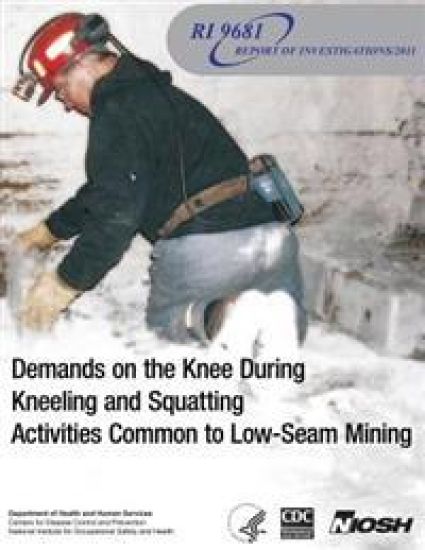
In 2009, the operating height of approximately one fourth of underground coal mines in the U. S. restricted mine workers to kneeling, crawling, and/or stooping posture to perform work MSHA 2009]. The large number of knee injuries to these workers is likely attributed to exposure to musculoskeletal disorder risk factors (prolonged kneeling, crawling, and twisting on one's knees). Therefore, the National Institute for Occupational Safety and Health has investigated three different biomechanical parameters (muscle activity of the knee flexors and extensors, pressure at the knee, and the net forces and moments at the knee) as subjects assumed postures common to low-seam mining, both with and without kneepads. The postures evaluated included: (1) kneeling near full flexion; (2) kneeling near 90 of knee flexion; (3) kneeling on one knee; and (4) squatting. The pressure and the net forces and moments at the knee were evaluated as subjects statically assumed these postures. However, negligible muscle activity existed for these static postures. Therefore, muscle activity of the knee flexors and extensors was evaluated for each posture while subjects performed a lateral lift that is common to low-seam mining where they lifted a 25-lb block from their right side, transferred it across their body, and placed it on the ground on their left side. The results indicated that, relative to the stresses posed by other kneeling postures, some postures had may have more detrimental effects than others. Considering the potential impact of the three biomechanical parameters, several key recommendations were made regarding when it may be most appropriate to use specific postures. Additional recommendations were also made regarding the design of kneepads. This study investigated three biomechanical parameters associated with knee loading that are potentially related to knee injury risk. In order to determine the effects that commonly used postures in low-seam mining and wearing or not wearing kneepads have on these parameters, three objectives were met for three kneepad conditions (no kneepad, articulated kneepad, and nonarticulated kneepad, both of which were reported by distributors to be very commonly used): 1. Examine the electromyographic (EMG) responses of knee flexors and extensors during a lateral lifting task in kneeling and squatting postures associated with low-seam mining (Note: Static trials were excluded from this analysis because only minimal activity was observed in these trials). It was hypothesized that changes in posture would result in altered muscular demands required to accomplish the lifting task, and would be reflected by changes in the magnitudes and patterns of EMG activity of the knee flexors and extensors. 2. For static postures associated with low-seam mining, determine the pressures applied to the landmarks of the knee identified during pilot testing as being responsible for transmitting the majority of load to the knee (patella, patellar tendon, and tibial tubercle). It was hypothesized that the pressure and pressure distribution at the knee would be significantly affected by wearing a kneepad and by the simulated posture. It was further hypothesized that the type of kneepad worn would significantly affect the pressure and pressure distribution at the knee. 3. For postures associated with low-seam mining, investigate the net externally applied forces and moments at the knee and resulting joint kinematics. It was hypothesized that significant differences will be detected in the loading profiles between kneeling and squatting, as well as between the low-flexion (kneeling on one knee and kneeling near 90 flexion) and higher-flexion (squatting and kneeling near full flexion) postures.
Young workers warrant special consideration to foster a safe and healthful entr e to the world of work. While there is consistent evidence that young workers are at increased risk for injury in the workplace, largely due to inexperience, the solutions and path forward are not straight-forward. Efforts to facilitate opportunities for youth to gain meaningful job experiences that foster development of marketable job skills for their future need to be balanced with efforts to protect them from work-related injury and illness. Additionally, work is just one component of youths' lives and their transitions into adulthood. Family and social relationships and education are other important components of young workers' lives that have complex relationships with work that need to be considered. Research on the impacts of youth work is conducted in multiple disciplines, with little interaction between them. These include the fields of business, law, psychology, public health, sociology, and youth development. NIOSH co-funded, with the Ontario Neurotrauma Foundation, a project that convened a unique series of symposia between 2007 and 2010 that brought together scholars from multiple disciplines, practitioners and business representatives from the U. S. and Canada to consider the implications of youth employment, and to make recommendations for moving forward, considering the complex relationships of work with other components of youth development. These Proceedings compile white papers (or subsequently published articles) that were developed to foster discussions at this series of symposia, along with an ambitious research and policy agenda that was spawned from these interdisciplinary discussions. White papers and articles were authored by business scholars, epidemiologists, health communicators, physicians, psychologists, and sociologists. These Proceedings serve as a foundation for fostering interdisciplinary attention to the complex issues surrounding young worker safety and health, and serve to inform the many stakeholders who did not attend the invitational series of symposia. These Proceedings will be useful to scholars from multiple disciplines, practitioners (e.g. safety professionals, unions, business leaders and educators), and policy makers interested in expanding their knowledge about young worker safety and health.