Kirjojen hintavertailu – 12 903 725 kirjaa ja 27 kauppaa
Kirjailija
Changhe Li
Kirjat ja teokset yhdessä paikassa: 7 kirjaa, julkaisuja vuosilta 2019–2025, suosituimpiin kuuluu Heat Transfer Mechanism and Temperature Field Model of MQL Micro-Grinding Biomedical Materials. Vertaile teosten hintoja ja tarkista saatavuus suomalaisista kirjakaupoista.
This book explores the machinability mechanism of hard-to-machining materials under hybrid energy field, with a particular emphasis on the development and modification of green lubricants, the integration of multi-energy field assistance, and the intelligent machining equipment.
This book discusses the thermodynamic mechanism of MQL grinding with nano-biological lubricant from the force, heat, surface integrity, and micro-morphology. It makes up the fatal defect of the lack of heat transfer capability of traditional MQL grinding. The machining accuracy, surface quality, especially surface integrity of the workpiece, are significantly improved; at the same time, the service life of the grinding wheel is increased and the working environment is improved. The general scope of the book’s content is the effects of MQL grinding with nano-bio-lubricant on grinding force, thermal mechanism, and surface. It provides a new method of sustainable green grinding for environment-friendly, resource-saving, and energy-efficient utilization and solves the technical bottleneck of the insufficient capacity in MQL heat transfer.
This textbook comprehensively explores the foundational principles, algorithms, and applications of intelligent optimization, making it an ideal resource for both undergraduate and postgraduate artificial intelligence courses. It remains equally valuable for active researchers and individuals engaged in self-study. Serving as a significant reference, it delves into advanced topics within the evolutionary computation field, including multi-objective optimization, dynamic optimization, constrained optimization, robust optimization, expensive optimization, and other pivotal scientific studies related to optimization. Designed to be approachable and inclusive, this textbook equips readers with the essential mathematical background necessary for understanding intelligent optimization. It employs an accessible writing style, complemented by extensive pseudo-code and diagrams that vividly illustrate the mechanisms, principles, and algorithms of optimization. With a focus on practicality, this textbook provides diverse real-world application examples spanning engineering, games, logistics, and other domains, enabling readers to confidently apply intelligent techniques to actual optimization problems. Recognizing the importance of hands-on experience, the textbook introduces the Open-source Framework for Evolutionary Computation platform (OFEC) as a user-friendly tool. This platform serves as a comprehensive toolkit for implementing, evaluating, visualizing, and benchmarking various optimization algorithms. The book guides readers on maximizing the utility of OFEC for conducting experiments and analyses in the field of evolutionary computation, facilitating a deeper understanding of intelligent optimization through practical application.
This book discusses the thermodynamic mechanism of MQL grinding with nano-biological lubricant from the force, heat, surface integrity, and micro-morphology. It makes up the fatal defect of the lack of heat transfer capability of traditional MQL grinding. The machining accuracy, surface quality, especially surface integrity of the workpiece, are significantly improved; at the same time, the service life of the grinding wheel is increased and the working environment is improved. The general scope of the book’s content is the effects of MQL grinding with nano-bio-lubricant on grinding force, thermal mechanism, and surface. It provides a new method of sustainable green grinding for environment-friendly, resource-saving, and energy-efficient utilization and solves the technical bottleneck of the insufficient capacity in MQL heat transfer.
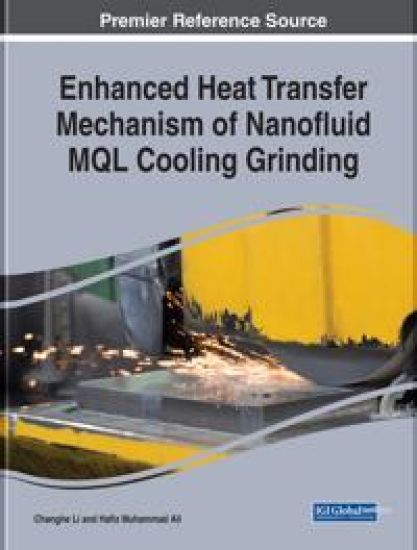
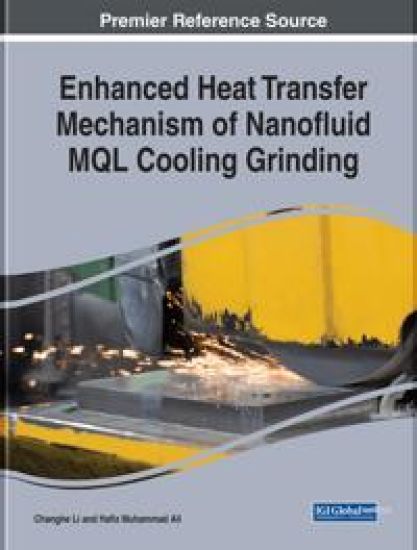
In today's modern world, the manufacturing industry is embracing an energy-efficient initiative and adopting green techniques. One aspect that has failed to adopt this scheme is flood grinding. Current flood grinding methods increase the treatment cost of grinding fluid and waste large quantities. In order to remain sustainable and efficient, in-depth research is necessary to study green grinding technologies that can ensure machining precision and surface quality of workpiece and reduce grinding fluid-induced environmental pollution. Enhanced Heat Transfer Mechanism of Nanofluid MQL Cooling Grinding: Emerging Research and Opportunities provides emerging research exploring the theoretical and practical aspects of nanofluid lubrication and its application within grinding flow and green manufacturing. Featuring coverage on a broad range of topics such as airflow distribution, morphology analysis, and lubrication performance, this book is ideally designed for mechanical professionals, engineers, manufacturers, researchers, scientists, academicians, and students seeking current research on clean and low-carbon precision machining methods.
In today's modern world, the manufacturing industry is embracing an energy-efficient initiative and adopting green techniques. One aspect that has failed to adopt this scheme is flood grinding. Current flood grinding methods increase the treatment cost of grinding fluid and waste large quantities. In order to remain sustainable and efficient, in-depth research is necessary to study green grinding technologies that can ensure machining precision and surface quality of workpiece and reduce grinding fluid-induced environmental pollution. Enhanced Heat Transfer Mechanism of Nanofluid MQL Cooling Grinding provides emerging research exploring the theoretical and practical aspects of nanofluid lubrication and its application within grinding flow and green manufacturing. Featuring coverage on a broad range of topics such as airflow distribution, morphology analysis, and lubrication performance, this book is ideally designed for mechanical professionals, engineers, manufacturers, researchers, scientists, academicians, and students seeking current research on clean and low-carbon precision machining methods.