Kirjojen hintavertailu – 12 903 724 kirjaa ja 27 kauppaa

Kirjailija

Chao Chen

Kirjat ja teokset yhdessä paikassa: 12 kirjaa, julkaisuja vuosilta 2018–2026, suosituimpiin kuuluu Enabling Smart Urban Services with GPS Trajectory Data. Vertaile teosten hintoja ja tarkista saatavuus suomalaisista kirjakaupoista.

12 kirjaa

Kirjojen julkaisuvuodet: 2018–2026.

Enabling Smart Urban Services with GPS Trajectory Data

Enabling Smart Urban Services with GPS Trajectory Data

Chao Chen; Daqing Zhang; Yasha Wang; Hongyu Huang

SPRINGER VERLAG, SINGAPORE
2022
nidottu
With the proliferation of GPS devices in daily life, trajectory data that records where and when people move is now readily available on a large scale. As one of the most typical representatives, it has now become widely recognized that taxi trajectory data provides rich opportunities to enable promising smart urban services. Yet, a considerable gap still exists between the raw data available, and the extraction of actionable intelligence. This gap poses fundamental challenges on how we can achieve such intelligence. These challenges include inaccuracy issues, large data volumes to process, and sparse GPS data, to name but a few. Moreover, the movements of taxis and the leaving trajectory data are the result of a complex interplay between several parties, including drivers, passengers, travellers, urban planners, etc. In this book, we present our latest findings on mining taxi GPS trajectory data to enable a number of smart urban services, and to bring us one step closer tothe vision of smart mobility. Firstly, we focus on some fundamental issues in trajectory data mining and analytics, including data map-matching, data compression, and data protection. Secondly, driven by the real needs and the most common concerns of each party involved, we formulate each problem mathematically and propose novel data mining or machine learning methods to solve it. Extensive evaluations with real-world datasets are also provided, to demonstrate the effectiveness and efficiency of using trajectory data. Unlike other books, which deal with people and goods transportation separately, this book also extends smart urban services to goods transportation by introducing the idea of crowdshipping, i.e., recruiting taxis to make package deliveries on the basis of real-time information. Since people and goods are two essential components of smart cities, we feel this extension is bot logical and essential. Lastly, we discuss the most important scientific problems and openissues in mining GPS trajectory data.
Smart Metro Station Systems

Smart Metro Station Systems

Hui Liu; Chao Chen; Yanfei Li; Zhu Duan; Ye Li

Elsevier - Health Sciences Division
2022
nidottu
Smart Metro Station Systems: Data Science and Engineering introduces key technologies in data science and engineering for smart metro station systems. The book consists of three main parts, focusing on the environment, people and energy. Each chapter includes practical applications, along with information on metro traffic flow monitoring and passenger guidance, methods for behavior analysis and trajectory projection, clustering and anomaly detection in crowd hotspots, monitoring and prediction for station humidity, monitoring and spatial prediction for air pollutants, time series feature extraction and analysis of metro load, characteristic and correlation analysis of metro load, and prediction and intelligent ventilation control. This volume offers a key reference on the emerging area of smart metro stations and will be useful to those working on smart railways, data science, engineering, artificial intelligence and aligned fields.
Enabling Smart Urban Services with GPS Trajectory Data

Enabling Smart Urban Services with GPS Trajectory Data

Chao Chen; Daqing Zhang; Yasha Wang; Hongyu Huang

Springer Verlag, Singapore
2021
sidottu
With the proliferation of GPS devices in daily life, trajectory data that records where and when people move is now readily available on a large scale. As one of the most typical representatives, it has now become widely recognized that taxi trajectory data provides rich opportunities to enable promising smart urban services. Yet, a considerable gap still exists between the raw data available, and the extraction of actionable intelligence. This gap poses fundamental challenges on how we can achieve such intelligence. These challenges include inaccuracy issues, large data volumes to process, and sparse GPS data, to name but a few. Moreover, the movements of taxis and the leaving trajectory data are the result of a complex interplay between several parties, including drivers, passengers, travellers, urban planners, etc. In this book, we present our latest findings on mining taxi GPS trajectory data to enable a number of smart urban services, and to bring us one step closer tothe vision of smart mobility. Firstly, we focus on some fundamental issues in trajectory data mining and analytics, including data map-matching, data compression, and data protection. Secondly, driven by the real needs and the most common concerns of each party involved, we formulate each problem mathematically and propose novel data mining or machine learning methods to solve it. Extensive evaluations with real-world datasets are also provided, to demonstrate the effectiveness and efficiency of using trajectory data. Unlike other books, which deal with people and goods transportation separately, this book also extends smart urban services to goods transportation by introducing the idea of crowdshipping, i.e., recruiting taxis to make package deliveries on the basis of real-time information. Since people and goods are two essential components of smart cities, we feel this extension is bot logical and essential. Lastly, we discuss the most important scientific problems and openissues in mining GPS trajectory data.
Robotics

Robotics

Chao Chen; Wesley Au; Shao Liu

TAYLOR FRANCIS LTD
2025
nidottu
This textbook covers the fundamental theorems and analysis of robotic manipulators and their state-of-the-art applications that have revolutionised their respective industries. This book is split into three parts, covering Fundamental, Advanced, and Research and Case Study topics of robotics. Fundamental topics cover minimally-required knowledge to study and analyse robots, i.e., planar kinematic analysis, trajectory generation, and basic control, preparing readers with zero or minimum background knowledge for a more comprehensive study of robotics fundamentals. Advanced topics cover classical analysis with state-of-the-art algorithms that make modern robotics intelligent, covering kinematic analysis, force-domain study, and path planning. The robotic manipulator of interest also extends beyond conventional rigid-link robots to address soft and under-actuated robots. Research and Case Study topics establish the link between the fundamental theorems of robotics, with their successful robotic applications that have revolutionised the medical, manufacturing, and agricultural industries. These state-of-the-art topics and case studies provide context for all earlier topics introduced in the textbook, which brings the student to the leading edge of robotics research and applications in the industry. Each aspect of robotics is introduced in a way that is easy for students of all levels to grasp and master, guiding the reader through the classical theorems, mathematical methods, and analytical tools necessary to analyse the designs of well-known robotic manipulators. Each chapter includes worked examples, many with realistic applications that establish the link between the fundamental theorems of robotics, with their successful robotic applications. This book can be used by undergraduate and postgraduate students in engineering, particularly in robotics and mechatronics, mechanical, and relevant. Engineers and researchers (non-university) can also refer to this book concerning robotics and mechatronics applications in manufacturing, medical robotics, agriculture, and automation, will
Robotics

Robotics

Chao Chen; Wesley Au; Shao Liu

TAYLOR FRANCIS LTD
2025
sidottu
This textbook covers the fundamental theorems and analysis of robotic manipulators and their state-of-the-art applications that have revolutionised their respective industries. This book is split into three parts, covering Fundamental, Advanced, and Research and Case Study topics of robotics. Fundamental topics cover minimally-required knowledge to study and analyse robots, i.e., planar kinematic analysis, trajectory generation, and basic control, preparing readers with zero or minimum background knowledge for a more comprehensive study of robotics fundamentals. Advanced topics cover classical analysis with state-of-the-art algorithms that make modern robotics intelligent, covering kinematic analysis, force-domain study, and path planning. The robotic manipulator of interest also extends beyond conventional rigid-link robots to address soft and under-actuated robots. Research and Case Study topics establish the link between the fundamental theorems of robotics, with their successful robotic applications that have revolutionised the medical, manufacturing, and agricultural industries. These state-of-the-art topics and case studies provide context for all earlier topics introduced in the textbook, which brings the student to the leading edge of robotics research and applications in the industry. Each aspect of robotics is introduced in a way that is easy for students of all levels to grasp and master, guiding the reader through the classical theorems, mathematical methods, and analytical tools necessary to analyse the designs of well-known robotic manipulators. Each chapter includes worked examples, many with realistic applications that establish the link between the fundamental theorems of robotics, with their successful robotic applications. This book can be used by undergraduate and postgraduate students in engineering, particularly in robotics and mechatronics, mechanical, and relevant. Engineers and researchers (non-university) can also refer to this book concerning robotics and mechatronics applications in manufacturing, medical robotics, agriculture, and automation, will
Robotics

Robotics

Chao Chen; Wesley Au; Shao Liu

TAYLOR FRANCIS LTD
2025
sidottu
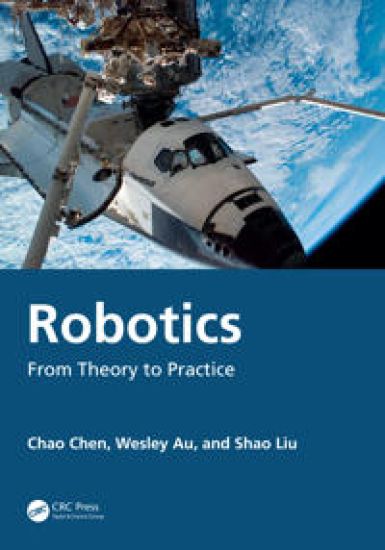
Robotics: From Theory to Practice introduces robotic theories and technologies to audiences, including university students, professionals with engineering backgrounds, and even high-school students interested in building their own robots. We aim to bridge the gap between classic theories and real-world applications of robotic manipulators, which, to date, have far exceeded the domain of conventional industry. The contents are divided into three parts. The first two cover classic theories of robotics, including kinematics, dynamics, path planning, control, and programming. Specifically, Part I is an introduction targeting junior students, featuring more simplistic topics and examples. Part II provides the senior students and professionals with more in-depth discussions on critical topics and more comprehensive examples. In Part III, we demonstrate how classic robotics theory can be extended to more advanced theoretical frameworks and adopted in real-world applications beyond conventional industries. This textbook is valuable to broad readers, including those who have limited background in general engineering and wish to explore non-conventional applications of robotic manipulators. The scaffolded contents from Part I to Part III are created to lower the prerequisites and smooth the learning curve.
Robotics

Robotics

Chao Chen; Wesley Au; Shao Liu

TAYLOR FRANCIS LTD
2025
nidottu
Robotics: From Theory to Practice introduces robotic theories and technologies to audiences, including university students, professionals with engineering backgrounds, and even high-school students interested in building their own robots. We aim to bridge the gap between classic theories and real-world applications of robotic manipulators, which, to date, have far exceeded the domain of conventional industry. The contents are divided into three parts. The first two cover classic theories of robotics, including kinematics, dynamics, path planning, control, and programming. Specifically, Part I is an introduction targeting junior students, featuring more simplistic topics and examples. Part II provides the senior students and professionals with more in-depth discussions on critical topics and more comprehensive examples. In Part III, we demonstrate how classic robotics theory can be extended to more advanced theoretical frameworks and adopted in real-world applications beyond conventional industries. This textbook is valuable to broad readers, including those who have limited background in general engineering and wish to explore non-conventional applications of robotic manipulators. The scaffolded contents from Part I to Part III are created to lower the prerequisites and smooth the learning curve.
Integrating Safety and Security Management to Protect Chemical Industrial Areas from Domino Effects

Integrating Safety and Security Management to Protect Chemical Industrial Areas from Domino Effects

Chao Chen; Genserik Reniers; Ming Yang

Springer Nature Switzerland AG
2022
nidottu
This book provides insight into domino effects in industrial chemical sites and process industries. It is about the integration of safety and security resources to prevent and mitigate domino effects in the process industries. It explains how chemical industrial areas, comprised of various hazardous installations, are susceptible to a chain of undesired events, or domino effects, triggered by accidental events or intentional attacks and then presents solutions to prevent them. Firstly, the book provides a dynamic graph approach to model the domino effects induced by accidental fire or intentional fire, considering the spatial-temporal evolution of fires. Then, a dynamic risk assessment method based on a discrete dynamic event tree is proposed to assess the likelihood of VCEs and the vulnerability of installations, addressing the time dependencies in vapor cloud dispersion and the uncertainty of delayed ignitions. A dynamic methodology based on dynamic graphs and Monte Carlois provided to assess the vulnerability of individuals and installations exposed to multi-hazards, such as fire, explosion and toxic release during escalation events. Based on these domino effect models, an economic approach is developed to integrate safe and security resources, obtaining the most cost–benefit protection strategy for preventing domino effects. Finally, a resilience-based approach is provided to find out the most cost-resilient way to protect chemical industrial areas, addressing possible domino effects. This integrated approach will be of interest to researchers, industrial engineers, chemical engineers and safety managers and will help professionals to new solutions in the area of safety and security.
Integrating Safety and Security Management to Protect Chemical Industrial Areas from Domino Effects

Integrating Safety and Security Management to Protect Chemical Industrial Areas from Domino Effects

Chao Chen; Genserik Reniers; Ming Yang

Springer Nature Switzerland AG
2021
sidottu
This book provides insight into domino effects in industrial chemical sites and process industries. It is about the integration of safety and security resources to prevent and mitigate domino effects in the process industries. It explains how chemical industrial areas, comprised of various hazardous installations, are susceptible to a chain of undesired events, or domino effects, triggered by accidental events or intentional attacks and then presents solutions to prevent them. Firstly, the book provides a dynamic graph approach to model the domino effects induced by accidental fire or intentional fire, considering the spatial-temporal evolution of fires. Then, a dynamic risk assessment method based on a discrete dynamic event tree is proposed to assess the likelihood of VCEs and the vulnerability of installations, addressing the time dependencies in vapor cloud dispersion and the uncertainty of delayed ignitions. A dynamic methodology based on dynamic graphs and Monte Carlois provided to assess the vulnerability of individuals and installations exposed to multi-hazards, such as fire, explosion and toxic release during escalation events. Based on these domino effect models, an economic approach is developed to integrate safe and security resources, obtaining the most cost–benefit protection strategy for preventing domino effects. Finally, a resilience-based approach is provided to find out the most cost-resilient way to protect chemical industrial areas, addressing possible domino effects. This integrated approach will be of interest to researchers, industrial engineers, chemical engineers and safety managers and will help professionals to new solutions in the area of safety and security.
Toleration

Toleration

Chao Chen

Springer Verlag, Singapore
2019
nidottu
This book uncovers the mysterious social and political structures of China's "Third Front," the large state-sponsored development of inland China during the late Maoist period. This movement gave birth to a few important industrial bases such as Panzhihua and Liupanshui and had significant impact on megacities such as Lanzhou, Wuhan, and Chongqing. Yet, this is scarcely known to the West and even the younger generation of Chinese. Chen explores the ways that new industrial structures and hierarchies were created and operated, using political and sociological methodologies to understand what is distinctive in the history of the Chinese corporation. This book will be of immense interest to political scientists, sociologists, China scholars, and researchers of alternative economic structures.
Toleration

Toleration

Chao Chen

Springer Verlag, Singapore
2018
sidottu
This book uncovers the mysterious social and political structures of China's "Third Front," the large state-sponsored development of inland China during the late Maoist period. This movement gave birth to a few important industrial bases such as Panzhihua and Liupanshui and had significant impact on megacities such as Lanzhou, Wuhan, and Chongqing. Yet, this is scarcely known to the West and even the younger generation of Chinese. Chen explores the ways that new industrial structures and hierarchies were created and operated, using political and sociological methodologies to understand what is distinctive in the history of the Chinese corporation. This book will be of immense interest to political scientists, sociologists, China scholars, and researchers of alternative economic structures.