
Kirjojen hintavertailu – 12 903 737 kirjaa ja 27 kauppaa

Kirjailija

Chao-Shun Hung

Kirjat ja teokset yhdessä paikassa: 2 kirjaa, julkaisuja vuodelta 1987, suosituimpiin kuuluu The Economics of Imperfect Competition. Vertaile teosten hintoja ja tarkista saatavuus suomalaisista kirjakaupoista.

2 kirjaa

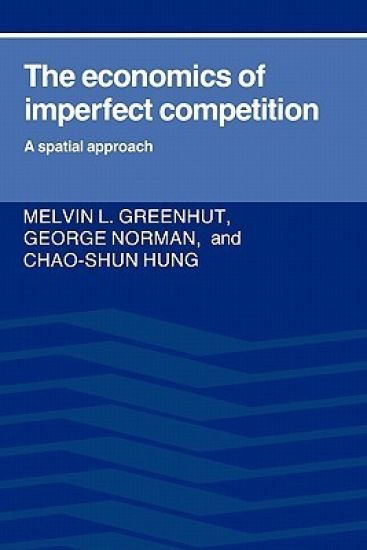
The Economics of Imperfect Competition

The Economics of Imperfect Competition

Melvin L. Greenhut; George Norman; Chao-Shun Hung

Cambridge University Press
1987
pokkari
This book takes a different approach to traditional price theory and to the analysis of imperfect competition. It represented a breakthrough in the development of a 'new' microeconomic theory. Increasingly, it has been recognized that the perfectly competitive paradigm is inappropriate to the explanation of pricing behaviour in many 'real life' markets characterized by a significant separation between producers and consumers. The spatial perspective adopted by the authors provides a natural separation of markets, but provides as well a powerful analogy for apparently nonspatial issues such as product differentiation, pricing over time, problems of storage and transportation, and the economics of intraindustry trade and of the multinational enterprise. A major concern of The Economics of Imperfect Competition: A Spatial Approach is to make these analogies explicit by applying this spatial analysis to a wide variety of nonspatial problems.
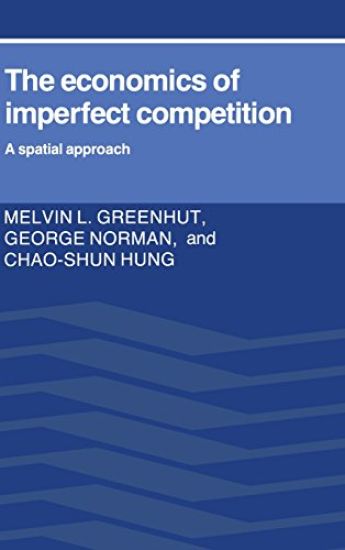
The Economics of Imperfect Competition

The Economics of Imperfect Competition

Melvin L. Greenhut; George Norman; Chao-Shun Hung

Cambridge University Press
1987
sidottu
This book takes a different approach to traditional price theory and to the analysis of imperfect competition. It represented a breakthrough in the development of a 'new' microeconomic theory. Increasingly, it has been recognized that the perfectly competitive paradigm is inappropriate to the explanation of pricing behaviour in many 'real life' markets characterized by a significant separation between producers and consumers. The spatial perspective adopted by the authors provides a natural separation of markets, but provides as well a powerful analogy for apparently nonspatial issues such as product differentiation, pricing over time, problems of storage and transportation, and the economics of intraindustry trade and of the multinational enterprise. A major concern of The Economics of Imperfect Competition: A Spatial Approach is to make these analogies explicit by applying this spatial analysis to a wide variety of nonspatial problems.