Kirjojen hintavertailu – 12 903 724 kirjaa ja 27 kauppaa

Kirjailija

Chaoqun Ma

Kirjat ja teokset yhdessä paikassa: 3 kirjaa, julkaisuja vuosilta 2007–2020, suosituimpiin kuuluu Data Clustering. Vertaile teosten hintoja ja tarkista saatavuus suomalaisista kirjakaupoista.

3 kirjaa

Kirjojen julkaisuvuodet: 2007–2020.

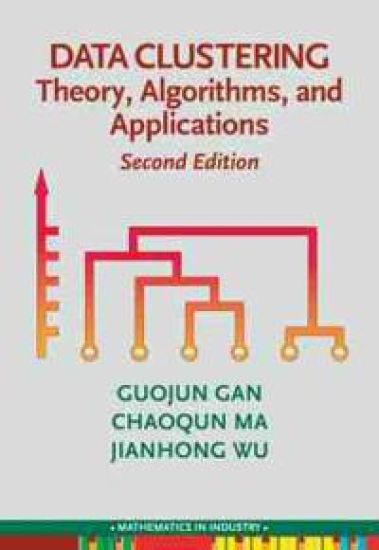
Data Clustering

Data Clustering

Guojun Gan; Chaoqun Ma; Jianhong Wu

Society for Industrial Applied Mathematics,U.S.
2020
nidottu
Data clustering, also known as cluster analysis, is an unsupervised process that divides a set of objects into homogeneous groups. Since the publication of the first edition of this monograph in 2007, development in the area has exploded, especially in clustering algorithms for big data and open-source software for cluster analysis. This second edition reflects these new developments. Data Clustering: Theory, Algorithms, and Applications, Second Edition:covers the basics of data clustering,includes a list of popular clustering algorithms, andprovides program code that helps users implement clustering algorithms.
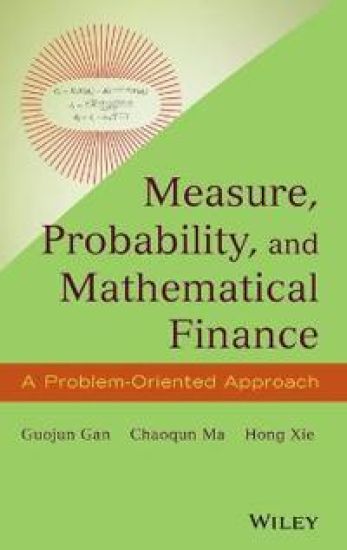
Measure, Probability, and Mathematical Finance

Measure, Probability, and Mathematical Finance

Guojun Gan; Chaoqun Ma; Hong Xie

John Wiley Sons Inc
2014
sidottu
An introduction to the mathematical theory and financial models developed and used on Wall Street Providing both a theoretical and practical approach to the underlying mathematical theory behind financial models, Measure, Probability, and Mathematical Finance: A Problem-Oriented Approach presents important concepts and results in measure theory, probability theory, stochastic processes, and stochastic calculus. Measure theory is indispensable to the rigorous development of probability theory and is also necessary to properly address martingale measures, the change of numeraire theory, and LIBOR market models. In addition, probability theory is presented to facilitate the development of stochastic processes, including martingales and Brownian motions, while stochastic processes and stochastic calculus are discussed to model asset prices and develop derivative pricing models. The authors promote a problem-solving approach when applying mathematics in real-world situations, and readers are encouraged to address theorems and problems with mathematical rigor. In addition, Measure, Probability, and Mathematical Finance features: A comprehensive list of concepts and theorems from measure theory, probability theory, stochastic processes, and stochastic calculusOver 500 problems with hints and select solutions to reinforce basic concepts and important theoremsClassic derivative pricing models in mathematical finance that have been developed and published since the seminal work of Black and Scholes Measure, Probability, and Mathematical Finance: A Problem-Oriented Approach is an ideal textbook for introductory quantitative courses in business, economics, and mathematical finance at the upper-undergraduate and graduate levels. The book is also a useful reference for readers who need to build their mathematical skills in order to better understand the mathematical theory of derivative pricing models.
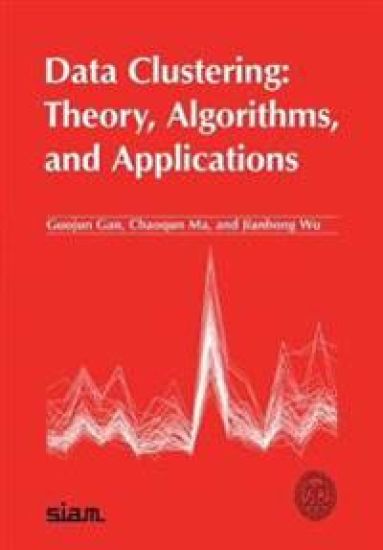
Data Clustering

Data Clustering

Guojun Gan; Chaoqun Ma; Jianhong Wu

Society for Industrial Applied Mathematics,U.S.
2007
pokkari
Cluster analysis is an unsupervised process that divides a set of objects into homogeneous groups. This book starts with basic information on cluster analysis, including the classification of data and the corresponding similarity measures, followed by the presentation of over 50 clustering algorithms in groups according to some specific baseline methodologies such as hierarchical, center-based, and search-based methods. As a result, readers and users can easily identify an appropriate algorithm for their applications and compare novel ideas with existing results. The book also provides examples of clustering applications to illustrate the advantages and shortcomings of different clustering architectures and algorithms. Application areas include pattern recognition, artificial intelligence, information technology, image processing, biology, psychology, and marketing. Readers also learn how to perform cluster analysis with the C/C++ and MATLAB(R) programming languages.