Kirjojen hintavertailu – 12 903 739 kirjaa ja 27 kauppaa

Kirjailija

Charles Babbage

Kirjat ja teokset yhdessä paikassa: 91 kirjaa, julkaisuja vuosilta 1968–2026, suosituimpiin kuuluu Reflections on the Decline of Science in England, and on Some of Its Causes. Vertaile teosten hintoja ja tarkista saatavuus suomalaisista kirjakaupoista.

91 kirjaa

Kirjojen julkaisuvuodet: 1968–2026.

Reflections On The Decline Of Science In England, And On Some Of Its Causes

Reflections On The Decline Of Science In England, And On Some Of Its Causes

Charles Babbage

Createspace Independent Publishing Platform
2012
nidottu
Charles Babbage, FRS (26 December 1791 - 18 October 1871) was an English mathematician, philosopher, inventor and mechanical engineer who originated the concept of a programmable computer. Considered a "father of the computer", Babbage is credited with inventing the first mechanical computer that eventually led to more complex designs. Parts of his uncompleted mechanisms are on display in the London Science Museum. In 1991, a perfectly functioning difference engine was constructed from Babbage's original plans. Built to tolerances achievable in the 19th century, the success of the finished engine indicated that Babbage's machine would have worked. Nine years later, the Science Museum completed the printer Babbage had designed for the difference engine. -wikipedia
Passages from the Life of a Philosopher

Passages from the Life of a Philosopher

Charles Babbage

Cambridge University Press
2011
pokkari
The mathematician and engineer Charles Babbage (1791–1871) is best remembered for his 'calculating machines', which are considered the forerunner of modern computers. Over the course of his life he wrote a number of books based on his scientific investigations, but in this volume, published in 1864, Babbage writes in a more personal vein. He points out at the beginning of the work that it 'does not aspire to the name of autobiography', though the chapters sketch out the contours of his life, beginning with his family, his childhood and formative years studying at Cambridge, and moving through various episodes in his scientific career. However, the work also diverges into his observations on other topics, as indicated by chapter titles such as 'Street Nuisances' and 'Wit'. Babbage's colourful recollections give an intimate portrait of the life of one of Britain's most influential inventors.
Babbage's Calculating Engines

Babbage's Calculating Engines

Charles Babbage

Cambridge University Press
2010
pokkari
The famous and prolific nineteenth-century mathematician, engineer and inventor Charles Babbage (1791–1871) was an early pioneer of computing. He planned several calculating machines, but none was built in his lifetime. On his death his youngest son, Henry P. Babbage, was charged with the task of completing an unfinished volume of papers on the machines, which was finally published in 1889 and is reissued here. The papers, by a variety of authors, were collected from journals including The Philosophical Magazine, The Edinburgh Review and Scientific Memoirs. They relate to the construction and potential application of Charles Babbage's calculating engines, notably the Difference Engine and the more complex Analytical Engine, which was to be programmed using punched cards. The book also includes correspondence with members of scientific societies, as well as proceedings, catalogues and drawings. Included is a complete catalogue of the drawings of the Analytical Engine.
On the Economy of Machinery and Manufactures

On the Economy of Machinery and Manufactures

Charles Babbage

Cambridge University Press
2010
pokkari
In this famous book, first published in 1832, Charles Babbage (1791–1871), the mathematician, philosopher, engineer and inventor who originated the concept of a programmable computer, surveys manufacturing practices and discusses the political, moral and economic factors affecting them. The book met with hostility from the publishing industry on account of Babbage's analysis of the manufacture and sale of books. Babbage describes the many different printing processes of the time, analyses the costs of book production and explains the publication process, before discussing the 'too large' profit margins of booksellers. Babbage succeeded in his aim 'to avoid all technical terms, and to describe in concise language', making this an eminently readable historical account. His analysis and promotion of mechanisation and efficient 'division of labour' (still known as the 'Babbage principle') continue to resonate strongly for modern industrial engineering.
The Ninth Bridgewater Treatise

The Ninth Bridgewater Treatise

Charles Babbage

Cambridge University Press
2009
pokkari
Charles Babbage (1791-1871) was an English mathematician, philosopher and mechanical engineer who invented the concept of a programmable computer. From 1828 to 1839 he was Lucasian Professor of Mathematics at Cambridge, a position whose holders have included Isaac Newton and Stephen Hawking. A proponent of natural religion, he published The Ninth Bridgewater Treatise in 1837 as his personal response to The Bridgewater Treatises, a series of books on theology and science that had recently appeared. Disputing the claim that science disfavours religion, Babbage wrote 'that there exists no such fatal collision between the words of Scripture and the facts of nature'. He argues on the basis of reason and experience alone, drawing a parallel between his work on the calculating engine and God as the divine programmer of the universe. Eloquently written, and underpinned by mathematical arguments, The Ninth Bridgewater Treatise is a landmark work of natural theology.
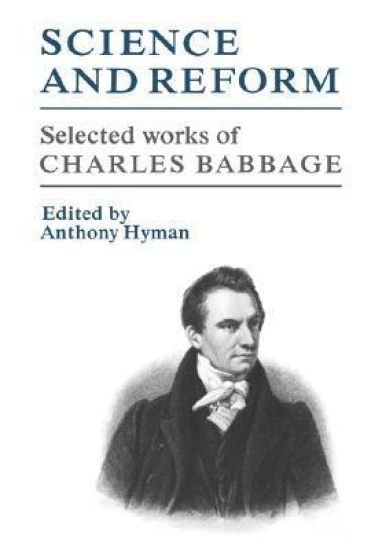
Science and Reform

Science and Reform

Charles Babbage

Cambridge University Press
2007
pokkari
Charles Babbage was a key figure of a great era of British history. Best remembered for his pioneering Difference and Analytical Engines, forerunners of the modern computer, Babbage was also an active reformer of science and society. Among his friends were the Bonapartes, the Duke of Wellington, the Duke of Somerset, Byron's daughter Ada Lovelace and the reforming Earl of Shaftesbury, whose interest Babbage directed to the factories. In this book, Anthony Hyman has selected passages from Babbage's many publications, including his proposals on profit sharing and life peerages and his ideas on such topics as the applications of science, scientific management, taxation and life assurance. Setting each extract in perspective, Hyman has provided the passages with an explanatory editorial commentary. Together with his concern for the systematic application of science, technology and mathematical method to commercial, industrial and economic problems, his work on computing makes Charles Babbage one of the most remarkable as well as one of the most colourful figures in the history of science.
The Works of Charles Babbage Vol 6

The Works of Charles Babbage Vol 6

Charles Babbage; Martin Campbell-Kelly

Routledge
1989
sidottu
A set of 11 volumes which contains all the known works of Charles Babbage, who has been described as the "pioneer of the computer". His mathematical, scientific and engineering work is highly significant for its original approach to problem-solving and is reset for today's reader.