Kirjailija
Charles Baudelaire
Kirjat ja teokset yhdessä paikassa: 404 kirjaa, julkaisuja vuosilta 1846–2026, suosituimpiin kuuluu Les fleurs du mal, prÃ(c)cÃ(c)dÃ(c)es d'une notice par ThÃ(c)ophile Gautier. Vertaile teosten hintoja ja tarkista saatavuus suomalaisista kirjakaupoista.
404 kirjaa
Kirjojen julkaisuvuodet: 1846–2026.
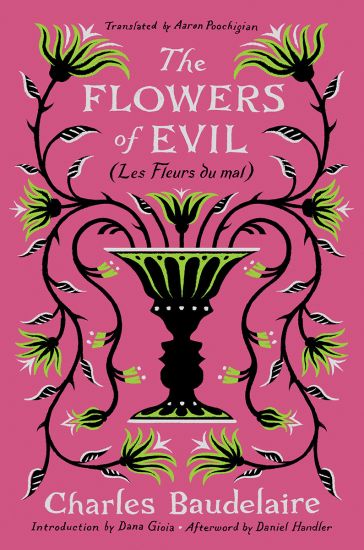
The dark, brooding, gothic poetry of Baudelaire has been cherished for over a century. This small collection is a classic glimpse into the corpus of his unsettling vision. Translated from the French by Cyril Scott.
The Flowers of Evil
Charles Baudelaire; Daniel Handler

Liveright Publishing Corporation
2022
sidottu
Known to his contemporaries primarily as an art critic, but ambitious to secure a more lasting literary legacy, Parisian bohemian Charles Baudelaire, spent much of the 1840s composing gritty, often perverse, poems that expressed his disgust with the banality of modern city life. First published in 1857, the book that collected these poems together, Les Fleurs du mal, was an instant sensation—earning Baudelaire plaudits and, simultaneously, disrepute. Only a year after Gustave Flaubert had endured his own public trial for published indecency (for Madame Bovary), a French court declared Les Fleurs du mal an offense against public morals and six poems within it were immediately suppressed (a ruling that would not be reversed until 1949, nearly a century after Baudelaire’s untimely death). Subsequent editions expanded on the original, including new poems that have since been recognised as Baudelaire’s masterpieces, producing a body of work that stands as the most consequential, controversial and influential book of poetry from the nineteenth century. Acclaimed translator and poet Aaron Poochigian tackles this revolutionary text with an ear attuned to Baudelaire’s lyrical innovations—rendering them in “an assertive blend of full and slant rhymes and fluent iambs” (A. E. Stallings)—and an intuitive feel for the work’s dark and brooding mood. Poochigian’s version captures the incantatory, almost magical, effect of the original—reanimating for today’s reader Baudelaire’s “unfailing vision” that “trumpeted the space and light of the future” (Patti Smith). An introduction by Dana Gioia offers a probing reassessment of the supreme artistry of Baudelaire’s masterpiece, and an afterword by Daniel Handler explores its continued relevance and appeal. Featuring the poems in English and French, this deluxe dual-language edition allows readers to commune both with the original poems and with these electric, revelatory translations.
"Ganz der Kenner stellt Baudelaire geistreich die Wirkung von Haschisch vor und kommt dabei zu Schlussfolgerungen, die wir dem Freigeist nicht notwendigerweise zugetraut h tten..." Redaktion Gr ls-Verlag (Edition Werke der Weltliteratur)
"Wenn ein Buch schon gleich bei Erscheinen landesweit wegen "Gottesl sterung" und "Gef hrdung der Moral" verboten wird und im brigen einen Skandal hervorruft, dann scheint der Autor einen Nerv getroffen zu haben. Baudelaires "Die Blumen des B sen" ist ein solches Werk und heute ein unbedingter Klassiker der Weltliteratur." Redaktion Gr ls-Verlag (Edition Werke der Weltliteratur)
Diktsamlingen Det ondas blommor är ett poetiskt mästerverk av den stora 1800-talsförfattaren Charles Baudelaire. Poesin chockerade den litterära världen i 1800-talets Frankrike med dess frispråkiga skildring av kärlek, kopplingen mellan sexualitet och död, dess obevekliga ironi och hyllandet av den sömnlösa storstaden. Poesin är ofta mycket dramatisk. Baudelaire blev fälld i domstol och dömd till böter för sex av dikterna efter utgivningen 1857, då de ansågs som sedlighetssårande. De sex dikterna fick sedan inte ges ut i Frankrike förrän förbudet hävdes 1949.
V etot sbornik voshli dve knigi Bodlera - "Stikhotvorenija v proze" i prinesshie avtoru gromkuju mezhdunarodnuju slavu programmnye "Tsvety zla". Kniga-manifest frantsuzskogo simvolizma vpervye byla opublikovana v 1857 godu i vyzvala burnuju obschestvennuju reaktsiju. Dlja poeta skandal zakonchilsja sudebnym shtrafom, tirazh knigi byl arestovan, a naibolee "neprilichnye" stikhotvorenija izjaty iz sbornika. Vremja rasstavilo vse po svoim mestam: davno zabyty imena kosnykh gonitelej, a stikhotvorenija Bodlera, s ikh jarkim koloritom, sverkajuschej obraznostju i svobodnym poletom voobrazhenija, po-prezhnemu voskhischajut i zavorazhivajut istinnykh ljubitelej poeticheskogo slova vsego mira.
The Flowers of Evil (1857) is a collection of poems by Charles Baudelaire. Translated into English by Cyril Scott in 1909, Baudelaire’s poems remain lively and idiosyncratic nearly two centuries after they came into existence. Comprised mostly of sonnets and short lyrics, The Flowers of Evil captures Baudelaire’s sense of the changing role of the poet in modern life. Rather than focus on beauty and other ideals, Baudelaire explores the totality of human experience—the good, bad, and ugly of life on earth. “When by the changeless Power of a Supreme Decree / The poet issues forth upon this sorry sphere, / His mother, horrified, and full of blasphemy, / Uplifts her voice to God, who takes compassion on her.” In his opening benediction, Baudelaire reverses the typical trope of invoking the muses or celebrating poetry as a divine gift. Instead, he depicts the poet as a being cursed, a “hideous Child of Doom.” Childhood for Baudelaire is a subject of particular interest, a time described, in his poem “The Enemy,” as “a ravaging storm, / Enlivened at times by a brilliant sun…” The youthful experience of melancholy clearly informs the poet’s outlook as an adult: “Time devours our lives, / And the enemy black, which consumeth our hearts / On the blood of our bodies, increases and thrives!” While much of Baudelaire’s work deals with darkness and despair, his poems can rise to the heights of celebration and ecstasy, his voice soft and sweet as he invites his sister on a journey to an imagined land of “order and loveliness, / Luxury, calm and voluptuousness.” Ultimately, Baudelaire’s vision—however irreverent—is guided by truth and morality, which drive him on a torturous path from good to evil, beauty to death, and back. With a beautifully designed cover and professionally typeset manuscript, this edition of The Flowers of Evil is a classic of French literature reimagined for modern readers.
First published posthumously in 1869, "Paris Spleen" is a collection of 51 short prose poems by Charles Baudelaire. Baudelaire was inspired by Aloysius Bertrand's "Gaspard de la Nuit-Fantaisies la mani re de Rembrandt et de Callot" or "Gaspard of the Night-Fantasies in the Manner of Rembrandt and Callot", commenting that he had read Bertrand's work at least twenty times for starting "Paris Spleen". A commentary on Parisian contemporary life, Baudelaire remarked on his work that "These are the flowers of evil again, but with more freedom, much more detail, and much more mockery." The themes present in "Paris Spleen" are wide-ranging. In a stream of consciousness style Baudelaire discusses pleasure, intoxication, artistry, women, poverty and social status, city life, religion, and morality. These little snapshots of daily life in the city of Paris capture the tumultuous time in which they were written, the middle of the 19th century, and establish "Paris Spleen" as a classic of the modernist literary movement. This edition is printed on premium acid-free paper.
CHARLES BAUDELAIREPOEMS IN PROSEPoems translated by Arthur SymonsCharles Baudelaire (1821-1867) was a celebrated 19th century French poet, author of the famous Flowers of Evil poetic sequence, first published in 1857. Baudelaire is a poet's poet par excellence, a brilliant craftsman who produced some of the finest poems in the French language. Baudelaire was known as a dandy who led a bohemian lifestyle; he knew many of the artists of the era (Manet, Nadar, Delacroix, and Gautier). Baudelaire's influence on subsequent poets and artists has been immense. This edition of Baudelaire's prose poems is a selection by British author Arthur Symons. The book includes two introductions to Baudelaire. With the French text of Baudelaire's poetry. Illustrated. 92 pages. Paperback, with a full colour cover.www.crmoon.com
Baudelaire; His Prose and Poetry, has been considered important throughout the human history, and so that this work is never forgotten we have made efforts in its preservation by republishing this book in a modern format for present and future generations. This whole book has been reformatted, retyped and designed. These books are not made of scanned copies of their original work and hence the text is clear and readable.
Lorsqu'il commence publier ses petits po mes en prose dans des revues et des journaux, Baudelaire a beau les qualifier modestement de bagatelles, il a pleinement conscience de ce qu'ils ont de singulier. Et nous le savons mieux d sormais, ce qui s'inaugure de mani re capitale dans ces textes qui visent capter l' tranget du quotidien de son temps, ce n'est rien moins qu'une forme litt raire nouvelle. Rimbaud et Mallarm vont s'en souvenir tr s vite - et bien d'autres apr s eux. Bien que le po te y songe t depuis 1857, l'-ann e des Fleurs du Mal, Le Spleen de Paris ne parut que deux ans apr s sa mort, en 1869. Ses po mes en prose constituaient pourtant ses yeux le pendant de ses pi ces en vers, et les deux livres, en effet, se font cho maints gards. Mais, la diff rence des Fleurs du Mal, ce n'est pas ici un recueil compos qui nous est offert: un espace de libert , bien plut t, o le neur t moigne d'un nouveau regard venu l'homme moderne pour lequel la r alit multiplie ses images. Extrait: Au milieu de ce tohu-bohu et de ce vacarme, un ne trottait vivement, harcel par un malotru arm d'un fouet. Comme l' ne allait tourner l'angle d'un trottoir, un beau monsieur gant , verni, cruellement cravat et emprisonn dans des habits tout neufs, s'inclina c r monieusement devant l'humble b te, et lui dit, en tant son chapeau: Je vous la souhaite bonne et heureuse puis se retourna vers je ne sais quels camarades avec un air de fatuit , comme pour les prier d'ajouter leur approbation son contentement. L' ne ne vit pas ce beau plaisant, et continua de courir avec z le o l'appelait son devoir. Pour moi, je fus pris subitement d'une incommensurable rage contre ce magnifique imb cile, qui me parut concentrer en lui tout l'esprit de la France. Vers la fin de sa vie, Baudelaire a "r v le miracle d'une prose po tique, musicale sans rythme et sans rime, assez souple et assez heurt e pour s'adapter aux mouvements lyriques de l' me, aux ondulations
In his introduction to Charles Baudelaire’s Salon of 1846, the renowned art historian Michael Fried presents a new take on the French poet and critic’s ideas on art, criticism, romanticism, and the paintings of Delacroix. Charles Baudelaire, considered a father of modern poetry, wrote some of the most daring and influential prose of the nineteenth century. Prior to publishing international bestseller Les Fleurs du mal (1857), he was already notable as a forthright and witty critic of art and literature. Captivated by the Salons in Paris, Baudelaire took to writing to express his theories on modern art and art philosophy. br> The Salon of 1846 expands upon the tenets of Romanticism as Baudelaire methodically takes his reader through paintings by Delecroix and Ingres, illuminating his belief that the pursuit of the ideal must be paramount in artistic expression. Here we also see Baudelaire caught in a fundamental struggle with the urban commodity of capitalism developing in Paris at that time. Baudelaire’s text proves to be a useful lens for understanding art criticism in mid-nineteenth-century France, as well as the changing opinions regarding the essential nature of Romanticism and the artist as creative genius. Acclaimed art historian and art critic Michael Fried’s introduction offers a new reading of Baudelaire’s seminal text and highlights the importance of his writing and its relevance to today’s audience.
Cet article des Curiosit s Esth tiques (1855) intitul De l'essence du rire et g n ralement du comique dans les arts plastiques fut initialement crit par Baudelaire en guise d'introduction son tude consacr e la caricature. Il n'en crira finalement que deux chapitres, intitul s: "Quelques caricaturistes" et "Quelques caricaturistes trangers". Pour Baudelaire, le rire est sans aucun doute mauvais, satanique. Il est le signe du p ch originel. "Le Sage ne rit qu'en tremblant", rappelle-t-il, adaptant une maxime attribu e Bossuet. Voici un cours magistral et tr s p dagogique o Baudelaire, on le reconna t bien l , fait une brillante d monstration de toute la cruaut du rire: "le rire est caus par la vue du malheur d'autrui" ou "le rire est au fond satanique, il est donc profond ment humain." Il n'est pas question pour lui du comique "ordinaire", ou significatif, comme il le nomme, pas de celui de la traditionnelle satire sociale, d clench la vue d'une caricature et la monarchie de Juillet, temps de la jeunesse de Baudelaire, fut la grande poque de la caricature, avec Gavarni ou Daumier. La caricature est selon lui toujours un peu complaisante, elle flatte le spectateur, en fait un comp re; c'est le comique des contes de Voltaire, typique de l'esprit fran ais que Baudelaire n'aime pas, celui des com dies de Moli re, qui suscitent des r serves chez Baudelaire; et c'est m me celui de Rabelais, chez qui le rire est utile, sert faire la le on et a "la transparence d'un apologue". Non, il s'agit du rire en ce qu'il est l'une des manifestations humaines les plus mouvantes, les plus myst rieuses, les plus intelligentes aussi, ce que Baudelaire appelle, dans ce trait De l'essence du rire, le "comique absolu".
Die künstlichen Paradiese
Charles Baudelaire
Henricus - Klassiker in Neuer Rechtschreibung
2021
sidottu
In der Reihe Klassiker in neuer Rechtschreibung gibt Klara Neuhaus-Richter die 10.000 wichtigsten B cher der Weltliteratur in der empfohlenen Schreibweise nach Duden heraus. Charles Baudelaire: Die k nstlichen Paradiese. Von Haschisch und Wein Haschisch] besitzt au erordentlich berauschende Eigenschaften, die seit einigen Jahren in Frankreich die Aufmerksamkeit der Gelehrten und Weltleute auf sich gezogen haben. Er wird mehr oder weniger seiner Heimat nach gesch tzt. Der bengalische ist der von Liebhabern bevorzugte; indessen haben der gyptische, t rkische, persische und algerische dieselben Eigenschaften, wenn auch in etwas geringerem Grade. Les Paradis artificiels. Erstdruck: 1860. Her in der deutschen bersetzung von Erik-Ernst Schwabach, M nchen, G. M ller, 1925. Inhaltsverzeichnis: Die k nstlichen Paradiese. Widmung. Das Gedicht vom Haschisch. Der Wein. Biografie. Neu herausgegeben und mit einer Biografie des Autors versehen von Klara Neuhaus-Richter, Berlin 2021. Umschlaggestaltung von Rainer Richter unter Verwendung einer Portr tzeichnung von Josefine Weinschrott. Gesetzt aus der Minion Pro, 11 pt. Henricus - Edition Deutsche Klassik GmbH ber den Autor: 1821 in Paris als einziges Kind eines wohlhabenden Beamten geboren, rutscht Charles-Pierre Baudelaire bereits in seiner Jugend in zweifelhafte Kreise ab. Drogen, Schulden, Prostituierte und die Syphilis sind fr h Bestandteil seines Lebens. Er sieht sich als K nstler und verweigert b rgerliche Erwerbsarbeit. Das stattliche v terliche Erbe verschleudert der verruchte Dandy in kurzer Zeit. Er h lt sich mit bersetzungen und Zeitschriftenbeitr gen ber Wasser. Von Krankheit, Drogen und Depression gezeichnet stirbt 1867 mit dem zu Lebzeiten kaum bekannten Charles Baudelaire einer der aus heutiger Sicht bedeutendsten Lyriker franz sischer Sprache.