Kirjojen hintavertailu – 12 859 818 kirjaa ja 27 kauppaa

Kirjailija

Charles Cros

Kirjat ja teokset yhdessä paikassa: 15 kirjaa, julkaisuja vuosilta 2011–2025, suosituimpiin kuuluu Théâtre de Campagne. Série 6. H. Bocage, E. Ceillier, Charles Cros, Paul Delair, Paul Déroulède. Vertaile teosten hintoja ja tarkista saatavuus suomalaisista kirjakaupoista.

15 kirjaa

Kirjojen julkaisuvuodet: 2011–2025.

The Science of Love and Other Writings

The Science of Love and Other Writings

Charles Cros

WAKEFIELD PRESS
2024
nidottu
The first English collection of Cros’ writings: from treatises on interplanetary communication to a sardonic science of seduction An indefinable polymath of fin de siècle Paris, Charles Cros made work that was simultaneously grounded in literature and science. The Science of Love and Other Writings brings together for the first time in English all of his literary prose. The collection includes proto-science-fiction stories; prose poems; an essay on methods of communication with other planets; and the patent application written with his brother for a (never-built) notating keyboard. The literary imagination Cros was able to bring into the field of science was matched by the humorous scientific sobriety he introduced into his literature, which he did nowhere so effectively as in the title piece, “The Science of Love”: depicting a young scientist’s painstakingly executed seduction of a woman for the sake of scientific analysis. Also included are stories such as “The Newspaper of the Future” (which presents a 19th-century imagining of artificial intelligence) and “The Stone Who Died of Love.” Charles Cros (1842–88) was a French writer and inventor. He is credited with submitting the earliest method for recording sound, but his idea for the “Paleophone” was obscured by Thomas Edison’s patent for the phonograph less than a year later.
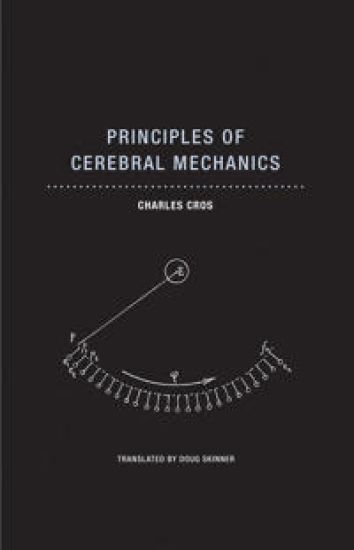
Principles of Cerebral Mechanics

Principles of Cerebral Mechanics

Charles Cros

WAKEFIELD PRESS
2021
nidottu
A visionary treatise on perception from the extraordinary polymath Charles Cros—poet, friend to Rimbaud and Verlaine, and inventor of color photography and the phonograph Establishing the author’s standing as the inventeur maudit of his time, Principles of Cerebral Mechanics was first presented to the Academy of Sciences in 1872, but was not published until 1879, and then only in fragmentary form. Setting out to understand the mechanics of perception—the organs of which at the time were too small and inaccessible to be studied directly—Cros instead attempted to reverse-engineer the sensory organs. Whereas his previous inventions in the realms of audio recording and color photography had focused on technology for the senses, with this ambitious essay Cros turned to conceptualizing the technology of the senses themselves: rather than the transmission of color to the retina, here he instead attempted to conceive of how color was transmitted from the retina to the brain. By approaching the human brain as a “mechanism of registration,” Cros’ essay can be set alongside the groundbreaking work of such revolutionary figures who transformed modern vision as Étienne-Jules Marey and Eadweard Muybridge. Charles Cros (1842–88) was as much Renaissance man as he was poète maudit. A bohemian poet who drank with Verlaine and provided housing to Rimbaud, he also developed the comic monologue as a theatrical genre, and invented both the phonograph (which he named the “paléophone”) and color photography (though he failed to patent either before Thomas Edison or Louis Ducos du Hauron), among other such inventions as a nonmetallic battery and a musical stenographer.
Charles Cros: Collected Monologues

Charles Cros: Collected Monologues

Charles Cros

Black Scat Books
2018
nidottu
CHARLES CROS (1842-1888) was one of the most brilliant minds of his generation, equally adept at poetry, fiction, and scientific inquiry. He wrote smutty verses with Verlaine, synthesized gems with Alphonse Allais, contributed wild prose fantasies to LE CHAT NOIR, and experimented with color photography and sound recording, only to die young, poor, and alcoholic. Not incidentally, he also invented the comic monologue for the actor Coquelin Cadet. In these strikingly spontaneous and modern sketches, he introduces a gallery of fools and obsessives-The Clean Man, The Fencing Master, The Capitalist, The Friend of the Family-all nattering away, assaulting the audience with trivia, and blithely unaware of their own failings. This edition collects all 22 of Cros's monologues, most translated for the first time, as well as performance notes by Coquelin and two biographical essays by his friend and colleague Alphonse Allais. "The sheer playfulness of certain fanciful parts of Cros's work must not let us forget that in the center of some of his finest poems, a revolver is aimed at us."-Andr Breton