
Kirjailija
Charles Dickens
Kirjat ja teokset yhdessä paikassa: 4 944 kirjaa, julkaisuja vuosilta 1843–2027, suosituimpiin kuuluu Saiturin joulu. Vertaile teosten hintoja ja tarkista saatavuus suomalaisista kirjakaupoista.
Nimi esiintyy myös muodoissa: Charles Dickens.
4 944 kirjaa
Kirjojen julkaisuvuodet: 1843–2027.

The Uncommercial Traveller Charles Dickens
Charles Dickens
Createspace Independent Publishing Platform
2017
nidottu
The Uncommercial Traveller is a collection of literary sketches and reminiscences written by Charles Dickens. In 1859 Dickens founded a new journal called All the Year Round and the Uncommercial Traveller articles would be among his main contributions. He seems to have chosen the title and persona of the Uncommercial Traveller as a result of a speech he gave on the 22 December 1859 to the Commercial Travellers' School London in his role as honorary chairman and treasurer. The persona sits well with a writer who liked to travel, not only as a tourist, but also to research and report what he found; visiting Europe, America and giving book readings throughout Britain. Dickens began by writing seventeen episodes, which were printed in All the Year Round between 28 January and 13 October 1860 and these were published in a single edition in 1861. He sporadically produced eleven more articles between 1863-65 and an expanded edition of the work was printed in 1866. Once more he returned to the persona with some more sketches written 1868-69 and a complete set of these articles was published posthumously in 1875.


Pictures from Italy is a travelogue by Charles Dickens, written in 1846. The book reveals the concerns of its author as he presents, according to Kate Flint, the country "like a chaotic magic-lantern show, fascinated both by the spectacle it offers, and by himself as spectator".
Dickens the Dramatist: Plays by Charles Dickens
Charles Dickens
Createspace Independent Publishing Platform
2017
nidottu
The Mystery of Edwin Drood is the final novel by Charles Dickens. The novel was unfinished at the time of Dickens's death (9 June 1870) and his ending for it is unknown. Though the novel is named after the character Edwin Drood, the story focuses on Drood's uncle, precentor, choirmaster and opium addict, John Jasper, who is in love with his pupil, Rosa Bud. Miss Bud, Drood's fianc e, has also caught the eye of the high-spirited and hot-tempered Neville Landless, who comes from Ceylon with his twin sister, Helena. Landless and Drood take an instant dislike to one another. Drood later disappears under mysterious circumstances. The story is set in Cloisterham, a lightly disguised Rochester. Mr Crisparkle, for example, lives in a clergy house in Minor Canon Corner, which corresponds to a genuine address within the precincts of Rochester Cathedral, namely Minor Canon Row.

There are not many people-and as it is desirable that a story-teller and a story-reader should establish a mutual understanding as soon as possible, I beg it to be noticed that I confine this observation neither to young people nor to little people, but extend it to all conditions of people: little and big, young and old: yet growing up, or already growing down again-there are not, I say, many people who would care to sleep in a church. I don't mean at sermon-time in warm weather (when the thing has actually been done, once or twice), but in the night, and alone. A great multitude of persons will be violently astonished, I know, by this position, in the broad bold Day. But it applies to Night. It must be argued by night, and I will undertake to maintain it successfully on any gusty winter's night appointed for the purpose, with any one opponent chosen from the rest, who will meet me singly in an old churchyard, before an old church-door; and will previously empower me to lock him in, if needful to his satisfaction, until morning.
The Chimes: A Goblin Story of Some Bells that Rang an Old Year Out and a New Year In, a short novel by Charles Dickens, was written and published in 1844, one year after A Christmas Carol. It is the second in his series of "Christmas books": five short books with strong social and moral messages that he published during the 1840's.
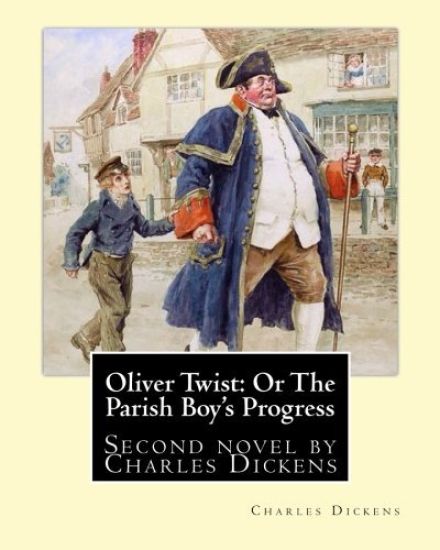
Oliver Twist (1867). By: Charles Dickens or, the Parish Boy's Progress: Oliver Twist, or The Parish Boy's Progress, is the second novel by Engl
Charles Dickens
Createspace Independent Publishing Platform
2017
nidottu
Oliver Twist, or The Parish Boy's Progress, is the second novel by English author Charles Dickens and was first published as a serial 1837-39. The story is of the orphan Oliver Twist, who starts his life in a workhouse and is then sold into apprenticeship with an undertaker. He escapes from there and travels to London, where he meets the Artful Dodger, a member of a gang of juvenile pickpockets led by the elderly criminal, Fagin. Oliver Twist is notable for its unromantic portrayal by Dickens of criminals and their sordid lives, as well as for exposing the cruel treatment of the many orphans in London in the mid-19th century. The alternate title, The Parish Boy's Progress, alludes to Bunyan's The Pilgrim's Progress, as well as the 18th-century caricature series by William Hogarth, A Rake's Progress and A Harlot's Progress. In this early example of the social novel, Dickens satirizes the hypocrisies of his time, including child labour, the recruitment of children as criminals, and the presence of street children. The novel may have been inspired by the story of Robert Blincoe, an orphan whose account of working as a child labourer in a cotton mill was widely read in the 1830s. It is likely that Dickens's own youthful experiences contributed as well. Oliver Twist has been the subject of numerous adaptations for various media, including a highly successful musical play, Oliver , and the multiple Academy Award-winning 1968 motion picture. Disney also put its spin on the novel with the movie called Oliver & Company in 1988. PLOT: Oliver Twist was born into a life of poverty and misfortune in a workhouse in an unnamed town (although when originally published in Bentley's Miscellany in 1837, the town was called Mudfog and said to be within 70 miles north of London - in reality, this is the location of the town of Northampton). Orphaned by his mother's death in childbirth and his father's mysterious absence, Oliver is meagerly provided for under the terms of the Poor Law and spends the first nine years of his life living at a baby farm in the 'care' of a woman named Mrs. Mann. Oliver is brought up with little food and few comforts. Around the time of Oliver's ninth birthday, Mr. Bumble, the parish beadle, removes Oliver from the baby farm and puts him to work picking and weaving oakum at the main workhouse. Oliver, who toils with very little food, remains in the workhouse for six months. One day, the desperately hungry boys decide to draw lots; the loser must ask for another portion of gruel. The task falls to Oliver, who at the next meal tremblingly comes up forward, bowl in hand, and begs Mr. Bumble for gruel with his famous request: "Please, sir, I want some more". A great uproar ensues. The board of well-fed gentlemen who administer the workhouse hypocritically offer 5 to any person wishing to take on the boy as an apprentice. Mr. Gamfield, a brutal chimney sweep, almost claims Oliver. However, when he begs despairingly not to be sent away with "that dreadful man", a kindly old magistrate refuses to sign the indentures. Later, Mr. Sowerberry, an undertaker employed by the parish, takes Oliver into his service. He treats Oliver better and, because of the boy's sorrowful countenance, uses him as a mourner at children's funerals. However, Mr. Sowerberry is in an unhappy marriage, and his wife looks down to Oliver - primarily because her husband seems to like him better - and loses few opportunities to underfeed and mistreat him. He also suffers torment at the hands of Noah Claypole, an oafish but bullying fellow apprentice and "charity boy" who is jealous of Oliver's promotion to mute, and Charlotte, the Sowerberrys' maidservant, who is in love with Noah... Charles John Huffam Dickens (7 February 1812 - 9 June 1870) was an English writer and social critic.
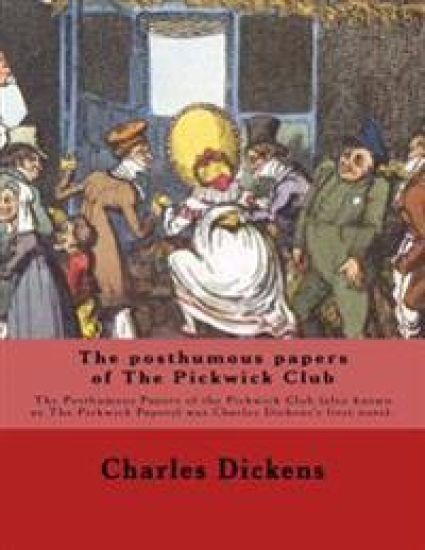
The posthumous papers of The Pickwick Club. By: Charles Dickens, with forty-three illustrations By: George Cruikshank (27 September 1792 - 1 February
George Cruikshank; Charles Dickens
Createspace Independent Publishing Platform
2017
nidottu
One of Dickens' Christmas stories, this was first published as part of the Christmas number of Household Words for 1854. The first chapter relates Dickens' visit to the ancient Richard Watts's Charity at Rochester. The second chapter is the touching story of "Richard Doubledick", which Dickens supposedly told the travellers, and Dickens' journey home on Christmas morning provides the short concluding chapter.
The Wreck of the Golden Mary
Charles Dickens
Createspace Independent Publishing Platform
2017
nidottu