Kirjojen hintavertailu – 12 903 725 kirjaa ja 27 kauppaa

Kirjailija

Charles Jacobs

Kirjat ja teokset yhdessä paikassa: 5 kirjaa, julkaisuja vuosilta 1973–2023, suosituimpiin kuuluu IS-136 TDMA Technology Economics and Services. Vertaile teosten hintoja ja tarkista saatavuus suomalaisista kirjakaupoista.

5 kirjaa

Kirjojen julkaisuvuodet: 1973–2023.

The Billion Dollar Sugar Cube

The Billion Dollar Sugar Cube

Charles Jacobs

Charles Jacobs
2023
pokkari
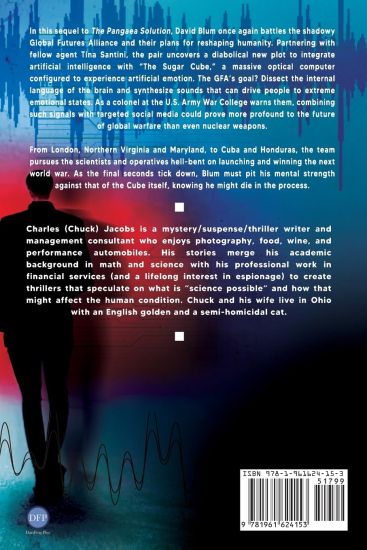
In this sequel to The Pangaea Solution, David Blum once again battles the shadowy Global Futures Alliance and their plans for reshaping humanity. Partnering with fellow agent Tina Santini, the pair uncovers a diabolical new plot to integrate artificial intelligence with "The Sugar Cube," a massive optical computer configured to experience artificial emotion. The GFA's goal? Dissect the internal language of the brain and synthesize sounds that can drive people to extreme emotional states. As a colonel at the U. S. Army War College warns them, combining such signals with targeted social media could prove more profound to the future of global warfare than even nuclear weapons. From London, Northern Virginia and Maryland, to Cuba and Honduras, the team pursues the scientists and operatives hell-bent on launching and winning the next world war. As the final seconds tick down, Blum must pit his mental strength against that of the Cube itself, knowing he might die in the process.
IS-136 TDMA Technology Economics and Services

IS-136 TDMA Technology Economics and Services

Lawrence Harte; Charles Jacobs; Adrian Smith

Artech House
1998
sidottu
This text presents big-picture descriptions of IS-136 TDMA technology in cellular, PCS, and cordless applications, and explains how the technology works, what its costs/benefits are, and what types of products and services are available. In 10 chapters and three appendices structured for quick, easy reference, the author unravels complex industry specifications and requirements and, using graphic illustrations, offers accessible information that should help the reader to: learn how IS-136 and IS-54 radio transmission, telephone equipment, and system network operation work; differentiate between IS-54 TDMA and the recently evolved IS-136 technology; recognize the benefits of these new digital systems, including enhanced battery life, voice privacy, anti-fraud, and the potential for messaging services; understand the conversion process required to change analog systems to IS-136 and IS-54 technology; and learn why cellular service providers in more than a dozen countries are moving from IS-54 technology to IS-136.
Francisco Correa de Arauxo

Francisco Correa de Arauxo

Charles Jacobs

Springer
1973
nidottu
Francisco Correa de Arauxo: how little does the name evoke for most musicians? Yet, this composer wrote music equal in interest and beauty to that of such better-known composers of his time as Bull, Titelouze, Gibbons, Sweelinck, and Frescobaldi. Unfortunately, Correa's music was published in a notation which, though excellent, was little-known beyond Spain. Only within the last twenty years has a complete -though regrettably deficient - edition of Correa's music become available. Cabezon, Correa de Arauxo's most significant immediate predecessor on the Hispanic musical scene (at least among keyboard composers whose music survives to any extent), figures among the greatest and most influential Renaissance composers. In Cabezon's works, the ricer- car (known as tiento in Spain) and variations forms reached full de- velopment. Manuel Rodrigues Coelho, Correa's Portuguese contemporary, al- though working well into the seventeenth century, did not venture beyond the formal boundaries established by Cabezon. On the other hand, a number of late sixteenth-century Spanish composers - Francisco Peraza, and others whose works seem irretriev- ably lost - apparently were writing music that incorporated into the contrapuntal flow of the tiento toccata-like episodes. The result, for- mally, was similar in many respects to toccatas of late-Renaissance Italy. Formal sectionality also appears in the late sixteenth-century Italian ricercar, particularly in those known as canzone francese. This formal trait is present in music by composers of Naples, then under Spanish dominion, and Venice. Correa could not have been working in cultural semi-isolation.