
Kirjailija
Charles Krauthammer
Kirjat ja teokset yhdessä paikassa: 4 kirjaa, julkaisuja vuosilta 2004–2019, suosituimpiin kuuluu Things That Matter. Vertaile teosten hintoja ja tarkista saatavuus suomalaisista kirjakaupoista.
4 kirjaa
Kirjojen julkaisuvuodet: 2004–2019.
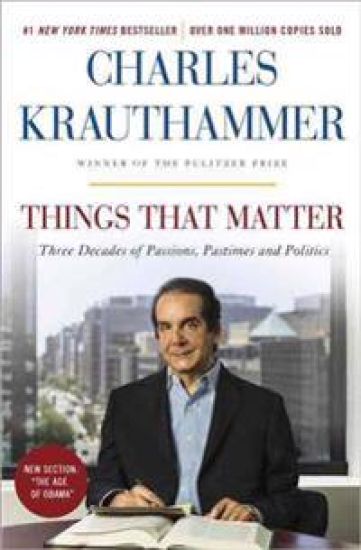
Things That Matter
Charles Krauthammer
Crown Publishing Group, Division of Random House Inc
2015
pokkari
From America's preeminent columnist, named by the Financial Times the most influential commentator in the nation, the long-awaited collection of Charles Krauthammer's essential, timeless writings. A brilliant stylist known for an uncompromising honesty that challenges conventional wisdom at every turn, Krauthammer has for decades daz-zled readers with his keen insight into politics and government. His weekly column is a must-read in Washington and across the country. Now, finally, the best of Krauthammer's intelligence, erudition and wit are collected in one volume. Readers will find here not only the country's leading conservative thinker offering a pas-sionate defense of limited government, but also a highly independent mind whose views--on feminism, evolution and the death penalty, for example--defy ideological convention. Things That Matter also features several of Krautham-mer's major path-breaking essays--on bioeth-ics, on Jewish destiny and on America's role as the world's superpower--that have pro-foundly influenced the nation's thoughts and policies. And finally, the collection presents a trove of always penetrating, often bemused re-flections on everything from border collies to Halley's Comet, from Woody Allen to Win-ston Churchill, from the punishing pleasures of speed chess to the elegance of the perfectly thrown outfield assist. With a special, highly autobiographical in-troduction in which Krauthammer reflects on the events that shaped his career and political philosophy, this indispensible chronicle takes the reader on a fascinating journey through the fashions and follies, the tragedies and triumphs, of the last three decades of American life.
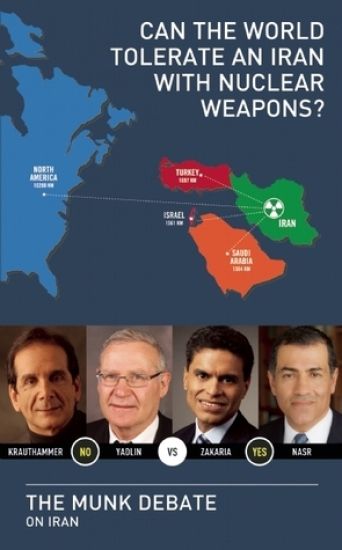
Can the World Tolerate an Iran with Nuclear Weapons?
Amos Yadlin; Charles Krauthammer; Fareed Zakaria; Vali Nasr
House of Anansi Press Ltd ,Canada
2013
pokkari
With tensions between Iran, Israel, and Western powers reaching new highs over the Islamic Republic’s nuclear enrichment program, the tenth edition of the Munk Debates investigates how the world should respond to Iran’s nuclear ambitions. For some, the case for a pre-emptive strike on Iran is ironclad. An Iranian bomb would flood the volatile Middle East with nuclear weapons and trap Israel in a state of perilous insecurity — along with much of the world’s oil supply. Others argue that a nuclear Iran could be the very stabilizing force that the region needs, as the threat of nuclear war makes conventional conflicts more risky. These same voices also ask: can the West and Israel afford to attack Iran when doing so could roll back the Arab Spring and re-entrench reactionary forces throughout the Middle East? In this edition of the Munk Debates — Canada’s premier international debate series — former Israel Defense Forces head of military intelligence Amos Yadlin, Pulitzer Prize–winning political commentator Charles Krauthammer, CNN host Fareed Zakaria, and Iranian-born academic Vali Nasr debate the consequences of a nuclear-armed Iran. For the first time ever, this electrifying debate, which played to a sold-out audience, is now available in print, along with candid interviews with the debaters. With tempers flaring between governments, the world’s oil supply in peril, and global security at risk, the Munk Debate on Iran tries to answer: Can the world tolerate an Iran with nuclear weapons?
In this essay, delivered as the Irving Kristol Lecture at the American Enterprise Institute in February 2004, Charles Krauthammer examines four contending schools of American foreign policy: isolationism, liberal internationalism, realism, and democratic globalism. After analyzing the sources and merits of each school, he concludes that a variant of realism and democratic globalism, which he calls democratic realism, is best suited to America's position of preeminent power and the challenges of confronting and subduing Arab-Islamic fanaticism. We will support democracy everywhere, but we will commit blood and treasure only in places where there is a strategic necessity_meaning, places central to the larger war against the existential enemy, the enemy that poses a global mortal threat to freedom.