Kirjojen hintavertailu – 12 903 735 kirjaa ja 27 kauppaa

Kirjailija

Charles P. Poole Jr.

Kirjat ja teokset yhdessä paikassa: 4 kirjaa, julkaisuja vuosilta 1996–2013, suosituimpiin kuuluu Electromagnetic Absorption in the Copper Oxide Superconductors. Vertaile teosten hintoja ja tarkista saatavuus suomalaisista kirjakaupoista.

4 kirjaa

Kirjojen julkaisuvuodet: 1996–2013.

The New Superconductors

The New Superconductors

Frank J. Owens; Charles P. Poole Jr.

Springer-Verlag New York Inc.
2013
nidottu
In The New Superconductors, Frank J. Owens and Charles P. Poole, Jr., offer a descriptive, non-mathematical presentation of the latest superconductors and their properties for the non-specialist. Highlights of this up-to-date text include chapters on superfluidity, the latest copper oxide types, fullerenes, and prospects for future research. The book also features many examples of commercial applications; an extensive glossary that defines superconductivity terms in clear language; and a supplementary list of readings for the interested lay reader.

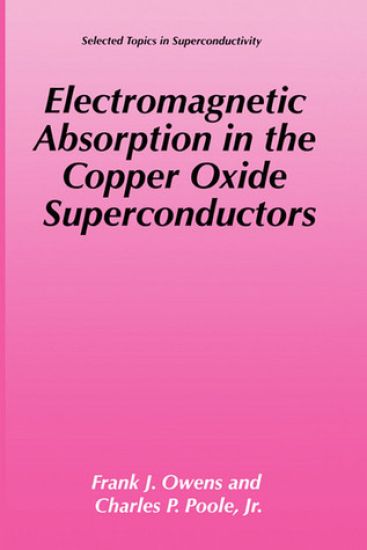
Electromagnetic Absorption in the Copper Oxide Superconductors

Electromagnetic Absorption in the Copper Oxide Superconductors

Frank J. Owens; Charles P. Poole Jr.

Springer-Verlag New York Inc.
2013
nidottu
In 1987 a major breakthrough occurred in materials science. A new family of materials was discovered that became superconducting above the temperature at which nitrogen gas liquifies, namely, 77 K or –196°C. Within months of the discovery, a wide variety of experimental techniques were brought to bear in order to measure the properties of these materials and to gain an understanding of why they superconduct at such high temperatures. Among the techniques used were electromagnetic absorption in both the normal and the superconducting states. The measurements enabled the determination of a wide variety of properties, and in some instances led to the observation of new effects not seen by other measu- ments, such as the existence of weak-link microwave absorption at low dc magnetic fields. The number of different properties and the degree of detail that can be obtained from magnetic field- and temperature-dependent studies of electromagnetic abso- tion are not widely appreciated. For example, these measurements can provide information on the band gap, critical fields, the H–T irreversibility line, the amount of trapped flux, and even information about the symmetry of the wave function of the Cooper pairs. It is possible to use low dc magnetic field-induced absorption of microwaves with derivative detection to verify the presence of superconductivity in a matter of minutes, and the measurements are often more straightforward than others. For example, they do not require the physical contact with the sample that is necessary when using four-probe resistivity to detect superconductivity.
Electromagnetic Absorption in the Copper Oxide Superconductors

Electromagnetic Absorption in the Copper Oxide Superconductors

Frank J. Owens; Charles P. Poole Jr.

Kluwer Academic/Plenum Publishers
1999
sidottu
In 1987 a major breakthrough occurred in materials science. A new family of materials was discovered that became superconducting above the temperature at which nitrogen gas liquifies, namely, 77 K or –196°C. Within months of the discovery, a wide variety of experimental techniques were brought to bear in order to measure the properties of these materials and to gain an understanding of why they superconduct at such high temperatures. Among the techniques used were electromagnetic absorption in both the normal and the superconducting states. The measurements enabled the determination of a wide variety of properties, and in some instances led to the observation of new effects not seen by other measu- ments, such as the existence of weak-link microwave absorption at low dc magnetic fields. The number of different properties and the degree of detail that can be obtained from magnetic field- and temperature-dependent studies of electromagnetic abso- tion are not widely appreciated. For example, these measurements can provide information on the band gap, critical fields, the H–T irreversibility line, the amount of trapped flux, and even information about the symmetry of the wave function of the Cooper pairs. It is possible to use low dc magnetic field-induced absorption of microwaves with derivative detection to verify the presence of superconductivity in a matter of minutes, and the measurements are often more straightforward than others. For example, they do not require the physical contact with the sample that is necessary when using four-probe resistivity to detect superconductivity.
The New Superconductors

The New Superconductors

Frank J. Owens; Charles P. Poole Jr.

Kluwer Academic/Plenum Publishers
1996
sidottu
In The New Superconductors, Frank J. Owens and Charles P. Poole, Jr., offer a descriptive, non-mathematical presentation of the latest superconductors and their properties for the non-specialist. Highlights of this up-to-date text include chapters on superfluidity, the latest copper oxide types, fullerenes, and prospects for future research. The book also features many examples of commercial applications; an extensive glossary that defines superconductivity terms in clear language; and a supplementary list of readings for the interested lay reader.