

Kirjailija
Charles R Brown
Kirjat ja teokset yhdessä paikassa: 25 kirjaa, julkaisuja vuosilta 1996–2027, suosituimpiin kuuluu The Government of Ohio, Its History, Resources and Jurisprudence, Also, A Brief Outline of the Government of the United States... by Charles R. Brown.. Vertaile teosten hintoja ja tarkista saatavuus suomalaisista kirjakaupoista.
Nimi esiintyy myös muodoissa: Charles R. Brown
25 kirjaa
Kirjojen julkaisuvuodet: 1996–2027.

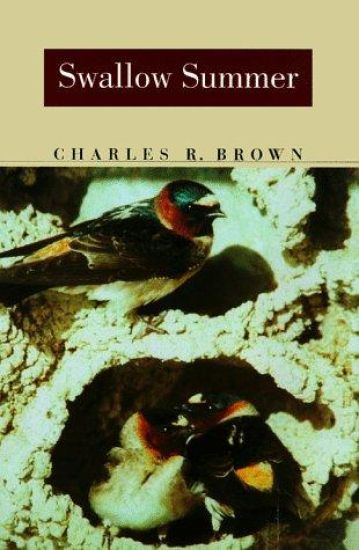
Each May for fifteen consecutive years, Charles R. Brown has trekked to the Cedar Point Biological Station in western Nebraska to learn more about the behavior of colonial cliff swallows. He, his wife, and several student assistants spend the summers observing, catching, and banding swallows to determine life span, migration patterns, and nesting habits. Why study one species of swallow for fifteen years? With Swallow Summer Brown answers all the tourists, highway patrolmen, and local residents who have asked why he was leaning over bridges with nets, wading in mud up to his knees, or staring fixedly into culverts, where swallows often build their mud nests. He finds these birds fascinating. This book is about a passion for birds, but it is also about the personal challenges of scientific research. Brown provides a daily chronicle of field work at Cedar Point—including the joy of holding a swallow that has returned to the same site for eleven years and the inevitable frictions between researchers and local residents. Blending humorous anecdotes and insightful scientific observations, Brown writes an engaging tale. Moreover, he makes sophisticated biology accessible to anyone who cares about nature.
Coloniality in the Cliff Swallow
Charles R. Brown; Mary Bomberger Brown
University of Chicago Press
1996
nidottu
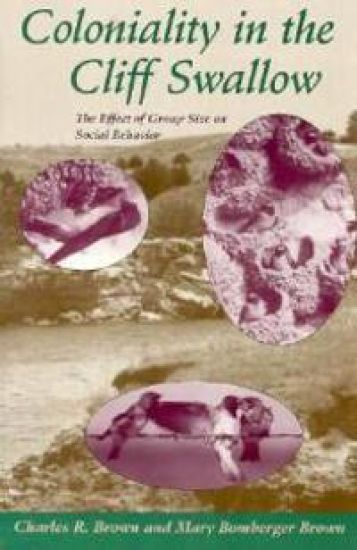
Many animal species live and breed in colonies. Although biologists have documented numerous costs (increased competition for limited resources) and benefits (more pairs of eyes to watch for predators) of group living, they often still do not agree on why coloniality evolved in the first place. Drawing on their 12-year study of a population of cliff swallows in Nebraska, USA, the authors investigate 26 social and ecological costs and benefits of coloniality. They explore how these costs and benefits are reflected in reproductive success and survivorship, and speculate on the evolution of cliff swallow coloniality. This study of vertebrate coloniality should be of interest to all who study social animals, including behavioural ecologists, population biologists, ornithologists and parasitologists. Its focus on the evolution of coloniality should also appeal to evolutionary biologists and to psychologists studying decision making in animals. The authors' research on swallows was the subject of an award-winning exhibition at the Peabody Museum of Natural History in New Haven, Connecticut, and was included in the BBC television production, "The Trials of Life".

Coloniality in the Cliff Swallow
Charles R. Brown; Mary Bomberger Brown
University of Chicago Press
1996
sidottu
Many animal species live and breed in colonies. Although biologists have documented numerous costs (increased competition for limited resources) and benefits (more pairs of eyes to watch for predators) of group living, they often still do not agree on why coloniality evolved in the first place. Drawing on their 12-year study of a population of cliff swallows in Nebraska, USA, the authors investigate 26 social and ecological costs and benefits of coloniality. They explore how these costs and benefits are reflected in reproductive success and survivorship, and speculate on the evolution of cliff swallow coloniality. This study of vertebrate coloniality should be of interest to all who study social animals, including behavioural ecologists, population biologists, ornithologists and parasitologists. Its focus on the evolution of coloniality should also appeal to evolutionary biologists and to psychologists studying decision making in animals. The authors' research on swallows was the subject of an award-winning exhibition at the Peabody Museum of Natural History in New Haven, Connecticut, and was included in the BBC television production, "The Trials of Life".