Kirjojen hintavertailu – 12 903 725 kirjaa ja 27 kauppaa

Kirjailija

Charles River

Kirjat ja teokset yhdessä paikassa: 4 673 kirjaa, julkaisuja vuosilta 2013–2022, suosituimpiin kuuluu William Powell and Myrna Loy: The Lives and Careers of One of Classical Hollywood's Most Iconic Duos. Vertaile teosten hintoja ja tarkista saatavuus suomalaisista kirjakaupoista.

4 673 kirjaa

Kirjojen julkaisuvuodet: 2013–2022.

Rousseau and Voltaire: The Lives of the Two Most Famous Intellectuals of the Enlightenment
*Includes pictures *Analyzes both men's lives and most famous works *Includes footnotes and a bibliography for further reading *Includes a table of contents "To hold a pen is to be at war." - Voltaire "Virtue is a state of war, and to live in it means one always has some battle to wage against oneself." - Rousseau The grand narrative of the Enlightenment, usually recounted and understood in terms of progress and modernity, generally appears as a simplified evolution from the trappings of superstition, feudalism, and everything "irrational" to a world more similar to today's world. Alongside the Renaissance, the Enlightenment is credited for the transition to an adherence to reason, secularism, and promotion of values such as individual and collective freedom and liberty. At the heart of the movement in France was Fran ois-Marie Arouet, better known by the pen name Voltaire, whose voluminous writings advocated for greater liberalism, including the freedom of religion and the separation of church and state. In addition to the classic Candide, Voltaire was a biting polemic whose satirical attacks on the Catholic Church were among the fiercest of his day. He also understood the risks he was taking with these writings, at one point explaining, "It is dangerous to be right in matters where established men are wrong." The Enlightenment is looked upon fondly, and it serves to reinforce the notion that the present is superior to the past, but things did not change as rapidly or as completely as many believe. In fact, some recent historians have challenged the belief that the Enlightenment was responsible for the French Revolution, which is a vital issue when it comes to Voltaire. After all, Voltaire, as his contemporaries and as most of his modern readers know him, is widely regarded as the pinnacle of Enlightenment thought, the symbol of the era of reason, and the harbinger of modern values. In that regard, his work is often considered to be the backbone of the French Revolution, which began about a decade after his death. Voltaire was unquestionably monumental, but he was also an exceptional product of his age, and his writings can introduce readers to the broader picture of the Enlightenment as a sum of contrasting and varied forces, tendencies and events. One of the towering figures of the age was Jean Jacques Rousseau, whose works were essential to the ideological developments of the 18th century. The prestige of French literature in the 18th century resides especially in its revolutionary character; while the writers of the previous century used to support the social order through their works and showed sympathy and even attempted to explain the political order of the time, in the 18th century, art, literature, philosophy and science all contribute actively and fiercely to the fight against the absolutist monarch and his regime. While this was a current manifesting all throughout Europe, there were differences in practice, especially between close countries (as was the case of England and France). There are many books and articles published constantly on the life and works of Rousseau. What generated such an abundance of writings is the turbulent life he led and the courage and audacity he manifested while fighting the prejudices of the time and establishing his ideas firmly within the academic community. His life can best be described as a constant conflict, whether it was conflict with his wife, his employers, his colleagues and even his friends. Rousseau and Voltaire examines the lives and works of the Enlightenment's most famous thinkers. Along with pictures of important people, places, and events, you will learn about Rousseau like never before, in no time at all.
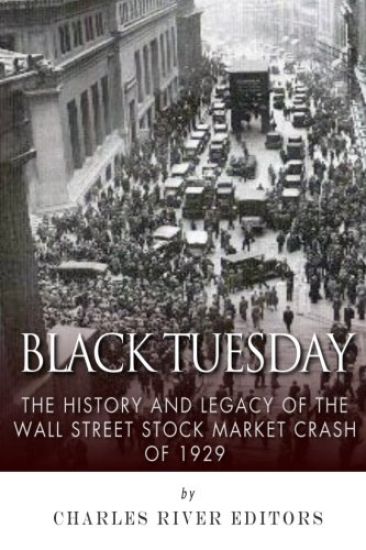
Black Tuesday: The History and Legacy of the Wall Street Crash of 1929

Black Tuesday: The History and Legacy of the Wall Street Crash of 1929

Charles River

Createspace Independent Publishing Platform
2015
nidottu
*Includes pictures *Includes accounts of the stock market crash written by newspapers and other contemporaries *Includes a bibliography for further reading *Includes a table of contents The Roaring Twenties were an age of optimism. New technology was being invented, and novel products were making their way to the store shelves. Americans believed that a new era, driven by technology, was upon them, and this optimism extended to financial markets. Investments especially soared in the bond market, where investors lent money to companies, and the stock market, where investors bought partial ownership of companies. During the 1920s, financiers believed that the economy would continue to boom, as it had been since the end of World War I. As a result, investors and financiers increasingly accepted lower and lower returns on money they lent. In the stock market, the result was much the same: stocks skyrocketed throughout the 1920s, led by new technology stocks, such as Radio Corporation of America, or RCA, which made radios and owned broadcasters. However, the rampant purchasing and rise in prices meant that stock prices soon bore little relationship to the underlying value of the businesses, because the prices were bid up by investors. Prior to 1920, few middle class Americans owned shares in the stock market, but as the prices of stocks grew, the enthusiasm for purchasing stocks grew as well. More middle class Americans purchased stocks in the 1920s than ever before. As stock prices rose throughout the 1920s, some economists believed that stock prices would never fall back to where they had been before World War I. Economist Irving Fisher famously said "Stock prices have reached what looks like a permanently high plateau." Some speculators even sought to capitalize on rising stock prices by borrowing money to buy stocks. Buying stocks with borrowed money had previously seemed very risky, because if the stock market declined, the speculator would be required to post additional collateral to back the loan. But with share prices continuously rising, buying with borrowed money seemed like a good way to make larger profits. However, during the fall of 1929, the stock market was becoming increasingly unstable. Prices would rise and fall rapidly, and some investors were becoming more cautious. Then, on October 24, 1929, the stock market lost 11% of its value right at the opening of the stock market. Panic ensued, but several prominent investment bankers were able to restore confidence by buying stocks well above the market rate. Investors were still extremely nervous, however, and when word of the panic spread over the weekend, investors flooded their brokers with sell orders for Monday morning. On Monday, October 28, the market fell almost 13%, earning it the moniker "Black Monday". The market fared no better the next day, falling nearly another 12% during what became known as "Black Tuesday". This time, efforts by wealthy investors, including members of the Rockefeller family and General Motors founder William C. Durant to restore confidence failed. Durant believed he could single-handedly restore confidence to the market by committing his whole fortune to buying stocks; instead, his business failed. Black Tuesday was a catastrophe the country wasn't ready for, and in fact, the market would not return to its 1929 peak until the 1950s. Black Tuesday is best remembered for investors and consumers making a run on banks that could not service everyone, and banks failed often during the Great Depression, due to bad loans and a lack of public confidence that produced further bank runs. The Federal Reserve was reluctant to backstop banks and protect them against bank runs, so banks were unable to borrow enough money to cover depositors' demands. When banks failed, depositors who couldn't get their money out of the bank were wiped out.
The Weird Wild West: Tall Tales and Legends about the Frontier

The Weird Wild West: Tall Tales and Legends about the Frontier

Charles River; Sean McLachlan

Createspace Independent Publishing Platform
2015
nidottu
*Includes pictures *Includes contemporary accounts of the legends *Includes a bibliography for further reading *Includes a table of contents Space may be the final frontier, but no frontier has ever captured the American imagination like the "Wild West", which still evokes images of dusty cowboys, outlaws, gunfights, gamblers, and barroom brawls over 100 years after the West was settled. A constant fixture in American pop culture, the 19th century American West continues to be vividly and colorful portrayed not just as a place but as a state of mind. Even for those who travel through the West today, there are plenty of traces of the old times. Ghost towns still stand in remote parts of the desert and prairie, Native American rock art still tell their mute legends, and old prospectors' mines still dot the hillsides. Even some of the places' names, such as Bloody Basin, Arizona and Soldier's Hill, New Mexico, have their stories to tell. In November 2014, one lucky archaeologist at Nevada's Great Basin National Park spotted an old rifle leaning against a pine tree; the sun and wind had weathered the wooden stock until it was as gray as the tree trunk, making it almost invisible to passersby. When the gun was examined, it turned out to be a Winchester rifle. The serial number was still legible and records showed that it had been manufactured and shipped in 1882. Some prospector or hunter had set the rifle against a tree more than a century ago and never came back for it. It had been leaning there ever since. As popular as works about the West remain today, the Wild West captured the imagination of people all the way back to the days when it really was wild. Even in the 19th century, its fame spread thanks to dime novels, travelogues, Wild West shows, and theater plays, and people were thrilled by tales of exploration and gunfights. Naturally, in the process of settling the frontier, the adventures contained countless numbers of strange stories, ranging from tales of monsters and lost mines to those about hidden cities and men coming back from the dead. It was a vast, unexplored country, and many mysteries could hide in the unmapped mountain ranges and seemingly endless plains. The Weird Wild West: Tall Tales and Legends about the Frontier is a collection of tales about America's frontier that range from the possible to the downright ridiculous. Some are adaptations of old folk tales immigrants brought with them or creations of overly eager newspaper reporters, but many have their basis in fact. Along with pictures and a bibliography, you will learn about the Weird Wild West like never before, in no time at all.
The 1759 Battle of Quebec: The History and Legacy of Britain's Most Important Victory of the French & Indian War
*Includes pictures *Explains the development of French and British colonies in the New World *Includes accounts of the fighting *Includes a bibliography for further fighting *Includes a table of contents " W]e observed the Enemy marching down towards us in three Columns, at 10 they formed their Line of Battle, which was at least six deep, having their Flanks covered by a thick Wood on each Side, into which they threw above 3000 Canadians and Indians, who gauled us much; the Regulars then marched briskly up to us, and gave us their first Fire, at about Fifty Yards Distance, which we did not return, as it was General Wolfe's express Orders not to fire till they came within twenty Yards of us..." - The British Sergeant-Major of Gen. Hopson's Grenadiers On September 13, 1759, a battle was fought on the Plains of Abraham outside the old city of Qu bec that was one of the turning point battles in world history. Thanks to the British victory and the events that followed, Canada went from being a colony of France (New France) to being a colony of Great Britain, which permanently changed Canadian history. In many ways, the outcome of the battle brought about several American attempts to seize Canada during the Revolutionary War and War of 1812, and ultimately it ensured that when Canada became an independent country, it was part of the British Commonwealth with an Anglophone majority and a Francophone minority. Frictions over cultural and political issues between the English Canadians and the Qu b cois, dating back to the battle, continue to impact the state of affairs in Canada today. While the battle had a profound impact, it has also been romanticized and mythologized beyond even epic proportions. Though often forgotten today (more than 250 years after the battle), the Battle of the Plains of Abraham was the culmination of a long siege, and the decisive action itself was an incredibly short affair at less than half an hour. Despite that brevity, both commanding generals were mortally wounded in the exchange, making British General James Wolfe a national hero on both sides of the Atlantic and French General Louis-Joseph de Montcalm a convenient scapegoat. Only a few thousand soldiers were engaged on each side, and the battle ended with less than 1,500 casualties combined. Regardless, the French were compelled to quit Quebec after the battle, giving up one of their most important colonial possessions in the New World, and when the fighting ended in North America in 1760, the British still held the city. When the Seven Years War ended on the European continent, the subsequent treaty forced the French to cede most of their North American possessions to the British, and it also left Britain in tough economic straits, which would set about a chain of events that brought about the American Revolution in the following decade. The 1759 Battle of Quebec: The History and Legacy of Britain's Most Important Victory of the French & Indian War looks at the campaign that culminated with the pivotal battle of the French & Indian War. Along with pictures of important people, places, and events, you will learn about the Battle of Quebec like never before, in no time at all.
The Vikings in North America: The History and Legacy of the Norse Settlements in Greenland and Vinland
*Includes pictures *Includes accounts of the Vikings' expeditions from medieval sagas *Includes a bibliography for further reading *Includes a table of contents Over the centuries, the West has become fascinated by the Vikings, one of the most mysterious and interesting European civilizations. In addition to being perceived as a remarkably unique culture among its European counterparts, what's known and not known about the Vikings' accomplishments has added an intriguing aura to the historical narrative. Were they fierce and fearsome warriors? Were they the first Europeans to visit North America? It seems some of the legends are true, and some are just that, legend. The ubiquitous picture of the Vikings as horn-helmeted, brutish, hairy giants that mercilessly marauded among the settlements of Northern Europe is based on a smattering of fact combined with an abundance of prejudicial historical writing by those who were on the receiving end of Viking depredations. At the same time, much of the popular picture of the Vikings is a result of the romantic imagination of novelists and artists. However, the Vikings' reputation for ferocious seaborne attacks along the coasts of Northern Europe is no exaggeration. It is true that the Norsemen, who traded extensively throughout Europe, often increased the profits obtained from their nautical ventures through plunder, acquiring precious metals and slaves. Of course, the Vikings were not the only ones participating in this kind of income generation; between the 8th and the 11th centuries, European tribes, clans, kingdoms and monastic communities were quite adept at fighting with each other for the purpose of obtaining booty. The Vikings were simply more consistently successful than their contemporaries and thus became suitable symbols for the iniquity of the times. Of course, the military reputation came about because the Vikings were the great mariners and explorers of medieval Europe. While many of their journeys were ones of conquest, they also had a deep love of exploration, and from their homeland in Scandinavia, they traveled as far as North America and became the first Europeans who are known to have set foot on what is now Canada. It was not until 1960 that the actual site of a Viking settlement in Vinland was found. At the tip of the Great Northern Peninsula in Newfoundland, Canada, a small Viking settlement at L'Anse aux Meadows was excavated, with the foundations of three residential halls have been found. These halls would have housed between 70 and 90 people. As well as the sod covered halls, a smithy where nails were made and a small boat repair building have been found. It is believed that this settlement, which may have had as many as 500 inhabitants, is one of two settlements called Straumfjord and H p mentioned in the Saga of Erik the Red as being his Vinland bases. L'Anse aux Meadows is thought to be the former, and it is believed that H p was a summer camp perhaps as far south as New Brunswick. The native inhabitants of the New World were called Skrellings by the Vikings, and there is evidence that they engaged in battle with the Beothuks at L'Anse aux Meadows and the Mi'kmaq people further south. While there is still debate over where exactly the Norse settled the land, there is no hard evidence that they ventured further south than Newfoundland, where remains of a settlement have been found. If they had rounded Cape Breton and crossed the Cabot Strait, they would have come to a markedly different environment that would probably have compelled the explorers to come up with a fourth name for the region south of Vinland. The Vikings in North America chronicles the historic voyages the Vikings made to North America and what's known and unknown about their pre-Columbian settlements. Along with pictures of important people, places, and events, you will learn about the Norse colonization of North America like never before, in no time at all.
The Night of the Long Knives: The History and Legacy of Adolf Hitler's Notorious Purge of the SA
*Includes pictures *Explains Hitler's rise to power and the roles played by the SA and other paramilitary groups like the SS *Includes eyewitness accounts of the purge *Includes a bibliography for further reading *Includes a table of contents Germany's Nazi Party was remarkably implacable in the hostility it showed to the outside world, staunchly opposing both Communism and liberal democracy from the moment of its inception to that of its violent dissolution. The Nazis likewise showed steely, unwavering resolve in their lethal hatred of the Jews, the Slavs, and many others whom they labeled as "untermenschen," subhumans unworthy of rights, cultural standing, or life itself. They pursued their dark vision of "Aryan" superiority with a terrifying clarity and zeal, and they were willing to incur the enmity of the entire world in the process. At the same time, despite this fanatic dedication to their overall vision, the Nazis had their own share of factional strife, and perhaps not surprisingly, the internecine struggle often led to violence, executions, and assassinations, byproducts of a totalitarian environment in which power appeared in its most undisguised and aggressive form. The firing squad, the bomb, the torture chamber, the extermination camp, the crematorium, and the noose of piano wire took the place of debate and persuasion in Hitler's Germany. Like other totalitarian regimes, the leader of the Nazis kept an iron grip on power in part by making sure nobody else could attain too much of it, leading to purges of high-ranking officials in the Nazi party. Of these purges, the most notorious was the Night of the Long Knives, a purge in the summer of 1934 that came about when Hitler ordered the surprise executions of several dozen leaders of the SA. This fanatically National Socialist paramilitary organization had been a key instrument in overthrowing democratic government in Germany and raising Hitler to dictatorial power in the first place. However, the SA was an arm of the Nazi phenomenon which had socialist leanings and which was the private army of Ernst R hm, which was enough for Hitler to consider the organization dangerous. R hm was a challenger to the Fuhrer's position with his mushrooming SA ranks, which were more loyal to him than to the nominal head of Nazi Germany. Though the SA as a whole survived Hitler's purge, its star was eclipsed by the rise of the newly favored Schutzstaffel (SS), which was instrumental in implementing the Night of the Long Knives. Additionally, the SA's senior leadership was decimated, leading to a loss of cohesion and focus. Even its overall commander, Ernst R hm, fell victim to Hitler's violence, and Hitler himself later spoke words which summed up the calculated ruthlessness he used to deal with his enemies, both domestic and foreign: "The victor will not be asked afterwards whether he told the truth or not. When starting and waging war it is not right that matters, but victory. Close your hearts to pity. Act brutally." Several other factions were also involved. The German Army, or Reichswehr, was theoretically limited to a total of 100,000 men by the treaties ending World War I, but the German military was one of the major keys to power. R hm dreamed of subsuming it totally into the SA, a nightmare from the point of view of the highly conservative and aristocratic officer corps. A man who championed the cause of the Reichswehr and kept it free of subordination to the SA could likely win its loyalty for years to come regardless of his own political and cultural agenda, which Hitler managed to accomplish with the purge. The Night of the Long Knives chronicles the history of the Nazis' most notorious purge. Along with pictures of important people, places, and events, you will learn about the Night of the Long Knives like never before, in no time at all.
The Weapons of World War I: A History of the Guns, Tanks, Artillery, Gas, and Planes Used during the Great War
*Includes pictures*Profiles weapons such as superartillery, poison gas, rifles, grenades, flamethrowers, planes, and more.*Includes a bibliography for further reading*Includes a table of contents"God would never be cruel enough to create a cyclone as terrible as that Argonne battle. Only man would ever think of doing an awful thing like that. It looked like 'the abomination of desolation' must look like. And all through the long night those big guns flashed and growled just like the lightning and the thunder when it storms in the mountains at home... And it all made me think of the Bible and the story of the Anti-Christ and Armageddon. And I'm telling you the little log cabin in Wolf Valley in old Tennessee seemed a long long way off." - Alvin C. York World War I, also known in its time as the "Great War" or the "War to End all Wars", was an unprecedented holocaust in terms of its sheer scale. Fought by men who hailed from all corners of the globe, it saw millions of soldiers do battle in brutal assaults of attrition which dragged on for months with little to no respite. Tens of millions of artillery shells and untold hundreds of millions of rifle and machine gun bullets were fired in a conflict that demonstrated man's capacity to kill each other on a heretofore unprecedented scale, and as always, such a war brought about technological innovation at a rate that made the boom of the Industrial Revolution seem stagnant. The arms race before the war and the attempt to break the deadlock of the Western and Eastern Fronts by any means possible changed the face of battle in ways that would have previously been deemed unthinkable. Before 1914, flying machines were objects of public curiosity; the first flights of any account on rotor aircraft had been made less than 5 years before and were considered to be the province of daredevils and lunatics. By 1918, all the great powers were fielding squadrons of fighting aircraft armed with machine-guns and bombs, to say nothing of light reconnaissance planes. Tanks, a common feature on the battlefield by 1918, had not previously existed outside of the realm of science fiction stories written by authors like H. G. Wells. Machine guns had gone from being heavy, cumbersome pieces with elaborate water-cooling systems to single-man-portable, magazine-fed affairs like the Chauchat, the Lewis Gun and the M1918 BAR. To these grim innovations were added flamethrowers, hand grenades, zeppelins, observation balloons, poison gas, and other improvements or inventions that revolutionized the face of warfare. These technological developments led to an imbalance. Before the introduction of the man-portable light machine gun (which took place in the second half of the war), not to mention tanks (which also joined the fight late in the game), defensive firepower vastly outweighed offensive capability. Massed batteries of artillery, emplaced heavy machine guns, barbed wire entanglements, and bewildering fortifications meant that ground could not be taken except at incredible cost. This led to the (somewhat unjustified) criticism famously leveled at the generals of World War I that their soldiers were "lions led by donkeys". Certainly, every army that fought in the Great War had its share of officers, at all levels of command, who were incompetent, unsuitable, foolish, or just plain stupid, but there were plenty of seasoned professionals who understood their job and did it well. The main problem facing commanders in the war was that there was such a bewildering array of new armaments, with such vast destructive potential, that previous military doctrines were virtually useless. The Weapons of World War I analyzes the technological advancements in weaponry that produced the deadliest conflict in history up to that time. Along with pictures of important people, places, and events, you will learn about the weapons of World War I like never before, in no time at all.