Kirjojen hintavertailu – 12 903 733 kirjaa ja 27 kauppaa

Kirjailija

Charles S. Bullock

Kirjat ja teokset yhdessä paikassa: 15 kirjaa, julkaisuja vuosilta 2000–2021, suosituimpiin kuuluu The South and the Transformation of U.S. Politics. Vertaile teosten hintoja ja tarkista saatavuus suomalaisista kirjakaupoista.

15 kirjaa

Kirjojen julkaisuvuodet: 2000–2021.

Special Elections

Special Elections

Charles S. Bullock; Karen L. Owen

Oxford University Press Inc
2021
sidottu
Most members of Congress begin their careers through regularly scheduled elections, but terms may be cut short due to death, scandal, or different career opportunities. In these cases, special elections are held to fill vacancies. In fact, a number of prominent political figures, including Lyndon Johnson, Nancy Pelosi, and John Dingell, began their long and distinguished careers through special election to Congress. While the media often look to special elections as a way of measuring public sentiment on presidential performance, even though voter turnout tends to be significantly lower than in regular elections, these events have rarely attracted academic attention. Oftentimes, studies of these contests lead to generalizations about how a party should proceed if it hopes to wrest a seat away from the opposition in a special election. This book is the first large-scale scholarly treatment of special elections: both in terms of explaining what factors influence outcomes and in determining whether special elections are bellwethers for general elections. Charles S. Bullock, III and Karen L. Owen argue that special elections offer parties a testing ground for messaging and strategies for mobilizing voters in anticipation of general elections. Moreover, these elections provide opportunities for diversification of Congress as reduced commitment to resources for campaigning has led more women and candidates of color to compete in them--and win. Based on 75 years of data, the authors closely examine several competitive special elections during the first two years of the Trump era and quantitatively assess the almost 300 House special elections held since World War II.
Redistricting

Redistricting

Charles S. Bullock

Rowman Littlefield
2021
sidottu
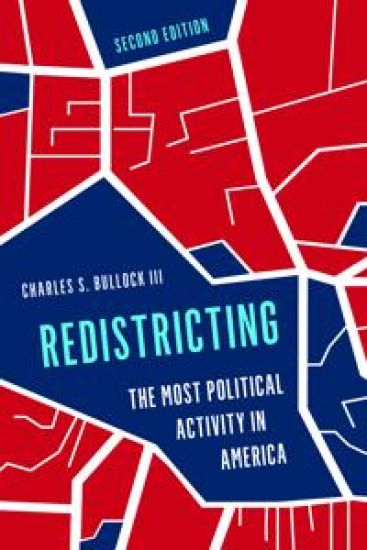
This authoritative overview of election redistricting at the congressional, state legislative, and local level provides offers an overview of redistricting for students and practitioners. The updated second edition pays special attention to the significant redistricting controversies of the last decade, from the Supreme Court to state courts.
Redistricting

Redistricting

Charles S. Bullock

Rowman Littlefield
2021
nidottu
This authoritative overview of election redistricting at the congressional, state legislative, and local level provides offers an overview of redistricting for students and practitioners. The updated second edition pays special attention to the significant redistricting controversies of the last decade, from the Supreme Court to state courts.
The South and the Transformation of U.S. Politics

The South and the Transformation of U.S. Politics

Charles S. Bullock; Susan A. MacManus; Jeremy D. Mayer; Mark J. Rozell

Oxford University Press Inc
2019
sidottu
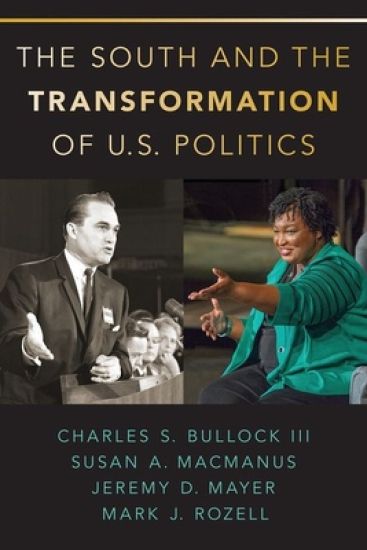
A strong case can be made that the South has had the greatest impact of any region on the transformation of U. S. politics and government. Since 1968, we have seen the demise of the "solid (Democratic) South" and the rise of the Republican-dominated South; the rise of the largely southern white evangelical religious right movement; and demographic changes that have vastly altered the political landscape of the region and national politics. Overriding all of these changes is the major constant of southern politics: race. Since the 1990s, the Republican Party has dominated politics in the Southern United States. Race relations were a large factor in this shift that began about a half century ago, but nonetheless, race and demographic change are once again realigning party politics in the region, this time back toward an emergent Democratic Party. Membership in the Southern Democratic Party is majority African American, Latino, and Asian, and rapidly expanding with an influx of immigrants, primarily Latino. While race continues to shape politics in the region, population growth is, as this book argues, the major factor affecting politics in the South. In fact, the populations of Georgia, North Carolina, South Carolina, and Virginia have grown more rapidly than the population of the nation as a whole over the past half century--and each of these states has gained at least one seat in Congress. These growth states are the ones in which populations are diversifying, economies are surging, and Democrats are making headway. They, along with Florida and Texas, are also among the most competitive states with the largest numbers of Electoral College votes in the region. It is likely, therefore, that among the key battlegrounds for determining the presidency will be the southern states with the fastest growing populations. This will especially be the case once the Latino population in Texas mobilizes. This book describes and analyzes the ways in which demographic change has shaped politics in the South since the late 1960s and may enable the Democratic Party in the future to re-take politics in the region, and even shut out Republicans from the nation's highest office.
The South and the Transformation of U.S. Politics

The South and the Transformation of U.S. Politics

Charles S. Bullock; Susan A. MacManus; Jeremy D. Mayer; Mark J. Rozell

Oxford University Press Inc
2019
nidottu
A strong case can be made that the South has had the greatest impact of any region on the transformation of U. S. politics and government. Since 1968, we have seen the demise of the "solid (Democratic) South" and the rise of the Republican-dominated South; the rise of the largely southern white evangelical religious right movement; and demographic changes that have vastly altered the political landscape of the region and national politics. Overriding all of these changes is the major constant of southern politics: race. Since the 1990s, the Republican Party has dominated politics in the Southern United States. Race relations were a large factor in this shift that began about a half century ago, but nonetheless, race and demographic change are once again realigning party politics in the region, this time back toward an emergent Democratic Party. Membership in the Southern Democratic Party is majority African American, Latino, and Asian, and rapidly expanding with an influx of immigrants, primarily Latino. While race continues to shape politics in the region, population growth is, as this book argues, the major factor affecting politics in the South. In fact, the populations of Georgia, North Carolina, South Carolina, and Virginia have grown more rapidly than the population of the nation as a whole over the past half century--and each of these states has gained at least one seat in Congress. These growth states are the ones in which populations are diversifying, economies are surging, and Democrats are making headway. They, along with Florida and Texas, are also among the most competitive states with the largest numbers of Electoral College votes in the region. It is likely, therefore, that among the key battlegrounds for determining the presidency will be the southern states with the fastest growing populations. This will especially be the case once the Latino population in Texas mobilizes. This book describes and analyzes the ways in which demographic change has shaped politics in the South since the late 1960s and may enable the Democratic Party in the future to re-take politics in the region, and even shut out Republicans from the nation's highest office.
The Rise and Fall of the Voting Rights Act

The Rise and Fall of the Voting Rights Act

Charles S. Bullock; Ronald Keith Gaddie; Justin J. Wert

University of Oklahoma Press
2018
nidottu
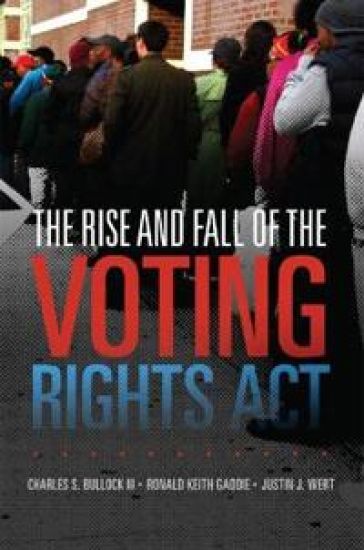
On June 25, 2013, the U. S. Supreme Court handed down its decision in Shelby County v. Holder, invalidating a key provision of voting rights law. The decision - the culmination of an eight-year battle over the power of Congress to regulate state conduct of elections - marked the closing of a chapter in American politics. That chapter had opened a century earlier in the case of Guinn v. United States, which ushered in national efforts to knock down racial barriers to the ballot. A detailed and timely history, The Rise and Fall of the Voting Rights Act analyzes changing legislation and the future of voting rights in the United States. In tracing the development of the Voting Rights Act from its inception, Charles S. Bullock III, Ronald Keith Gaddie, and Justin J. Wert begin by exploring the political and legal aspects of the Jim Crow electoral regime. Detailing both the subsequent struggle to enact the law and its impact, they explain why the Voting Rights Act was necessary. The authors draw on court cases and election data to bring their discussion to the present with an examination of the 2006 revision and renewal of the act, and its role in shaping the southern political environment in the 2008 and 2012 presidential elections, when Barack Obama was chosen. Bullock, Gaddie, and Wert go on to closely evaluate the 2013 Shelby County decision, describing how the ideological makeup of the Supreme Court created an appellate environment that made the act ripe for a challenge. Rigorous in its scholarship and thoroughly readable, this book goes beyond history and analysis to provide compelling and much-needed insight into the ways voting rights legislation has shaped the United States. The Rise and Fall of the Voting Rights Act illuminates the historical roots - and the human consequences - of a critical chapter in U. S. legal history.
The Three Governors Controversy

The Three Governors Controversy

Charles S. Bullock; Scott E. Buchanan; Ronald Keith Gaddie

University of Georgia Press
2017
pokkari
The death of Georgia governor-elect Eugene Talmadge in late 1946 launched a constitutional crisis that ranks as one of the most unusual political events in U. S. history: the state had three active governors at once, each claiming that he was the true elected official. This is the first full-length examination of that episode, which wasn’t just a crazy quirk of Georgia politics (though it was that) but the decisive battle in a struggle between the state’s progressive and rustic forces that had continued since the onset of the Great Depression. In 1946, rural forces aided by the county unit system, Jim Crow intimidation of black voters, and the Talmadge machine’s “loyal 100,000” voters united to claim the governorship. In the aftermath, progressive political forces in Georgia would shrink into obscurity for the better part of a generation. In this volume is the story of how the political, governmental, and Jim Crow social institutions not only defeated Georgia’s progressive forces but forestalled their effectiveness for a decade and a half.
The Rise and Fall of the Voting Rights Act

The Rise and Fall of the Voting Rights Act

Charles S. Bullock; Ronald Keith Gaddie; Justin J. Wert

University of Oklahoma Press
2016
sidottu
On June 25, 2013, the U. S. Supreme Court handed down its decision in Shelby County v. Holder, invalidating a key provision of voting rights law. The decision - the culmination of an eight-year battle over the power of Congress to regulate state conduct of elections - marked the closing of a chapter in American politics. That chapter had opened a century earlier in the case of Guinn v. United States, which ushered in national efforts to knock down racial barriers to the ballot. A detailed and timely history, The Rise and Fall of the Voting Rights Act analyzes changing legislation and the future of voting rights in the United States. In tracing the development of the Voting Rights Act from its inception, Charles S. Bullock III, Ronald Keith Gaddie, and Justin J. Wert begin by exploring the political and legal aspects of the Jim Crow electoral regime. Detailing both the subsequent struggle to enact the law and its impact, they explain why the Voting Rights Act was necessary. The authors draw on court cases and election data to bring their discussion to the present with an examination of the 2006 revision and renewal of the act, and its role in shaping the southern political environment in the 2008 and 2012 presidential elections, when Barack Obama was chosen. Bullock, Gaddie, and Wert go on to closely evaluate the 2013 Shelby County decision, describing how the ideological makeup of the Supreme Court created an appellate environment that made the act ripe for a challenge. Rigorous in its scholarship and thoroughly readable, this book goes beyond history and analysis to provide compelling and much-needed insight into the ways voting rights legislation has shaped the United States. The Rise and Fall of the Voting Rights Act illuminates the historical roots - and the human consequences - of a critical chapter in U. S. legal history.
The Three Governors Controversy

The Three Governors Controversy

Charles S. Bullock; Scott E. Buchanan; Ronald Keith Gaddie

University of Georgia Press
2015
sidottu
The death of Georgia governor-elect Eugene Talmadge in late 1946 launched a constitutional crisis that ranks as one of the most unusual political events in U. S. history: the state had three active governors at once, each claiming that he was the true elected official. This is the first full-length examination of that episode, which wasn’t just a crazy quirk of Georgia politics (though it was that) but the decisive battle in a struggle between the state’s progressive and rustic forces that had continued since the onset of the Great Depression. In 1946, rural forces aided by the county unit system, Jim Crow intimidation of black voters, and the Talmadge machine’s “loyal 100,000” voters united to claim the governorship. In the aftermath, progressive political forces in Georgia would shrink into obscurity for the better part of a generation. In this volume is the story of how the political, governmental, and Jim Crow social institutions not only defeated Georgia’s progressive forces but forestalled their effectiveness for a decade and a half.
Key States, High Stakes

Key States, High Stakes

Charles S. Bullock

Rowman Littlefield
2011
nidottu
The 2010 elections were one of the most highly anticipated midterm elections in our nation's recent history. After the historic 2008 election, in which America elected its first black president, Sarah Palin's involvement and the emergence of the Tea Party in the 2010 congressional elections had the potential to transform the composition of congress and set the stage for the nation's politics for the next decade, or even the next generation. In this new edited volume, Charles S. Bullock III collects original contributions from top political scientists to evaluate Sarah Palin and the Tea Party's role in the 2010 midterm elections. Key States, High Stakes focuses on states where Republicans had the chance to pick up Senate seats, as well as examining GOP Senate primaries if they involved a Palin or a Tea Party nominee facing an establishment favorite. Bullock concludes the anthology with a chapter on the legacy of the Tea Party and of Sarah Palin on American politics. One thing is certain. In terms of control of the House and Senate (and its effect on President Obama's policy agenda), the prospects for the 2012 presidential race, and the long-term viability of the Tea Party movement, the stakes in the 2010 midterm elections could not have been higher.
Redistricting

Redistricting

Charles S. Bullock

Rowman Littlefield
2010
nidottu
This book will prepare readers for the redistricting of congressional, state legislative, and local collegial bodies that will follow the 2010 Census. Almost every state legislature will devote extensive time to redrawing its own districts along with the state's congressional districts during 2011-2012. Chapters 2 through 5 cover the major factors involved in drawing the new maps. These are arranged in the order of their legal prominence beginning with the need for equal populations before moving to the obligation to avoid discriminating against minorities. Chapter 4 examines the other elements weighed by those redrawing districts: compactness, respect for political boundaries and communities of interest. Chapter 5 deals with partisan considerations and consequences of redistricting. More than any other state, Georgia has probably been the locale for more precedent-setting cases and had more difficulty securing Department of Justice approval of its districting plans. Chapter 6 uses Georgia as a case study to demonstrate the application of a number of concepts discussed in the preceding four chapters. The seventh chapter provides a preview of the post-2010 redistricting with a discussion of projections of likely congressional reapportionment. The final chapter also considers how the changes in the Voting Rights Act adopted in 2006 may affect the next round of redistricting.
Redistricting

Redistricting

Charles S. Bullock

Rowman Littlefield
2010
sidottu
This book will prepare readers for the redistricting of congressional, state legislative, and local collegial bodies that will follow the 2010 Census. Almost every state legislature will devote extensive time to redrawing its own districts along with the state's congressional districts during 2011-2012. Chapters 2 through 5 cover the major factors involved in drawing the new maps. These are arranged in the order of their legal prominence beginning with the need for equal populations before moving to the obligation to avoid discriminating against minorities. Chapter 4 examines the other elements weighed by those redrawing districts: compactness, respect for political boundaries and communities of interest. Chapter 5 deals with partisan considerations and consequences of redistricting. More than any other state, Georgia has probably been the locale for more precedent-setting cases and had more difficulty securing Department of Justice approval of its districting plans. Chapter 6 uses Georgia as a case study to demonstrate the application of a number of concepts discussed in the preceding four chapters. The seventh chapter provides a preview of the post-2010 redistricting with a discussion of projections of likely congressional reapportionment. The final chapter also considers how the changes in the Voting Rights Act adopted in 2006 may affect the next round of redistricting.
The Triumph of Voting Rights in the South

The Triumph of Voting Rights in the South

Charles S. Bullock; Ronald Keith Gaddie

University of Oklahoma Press
2009
sidottu
The Voting Rights Act of 1965 achieved what two constitutional amendments and three civil rights acts could not: giving African Americans in the South access to the ballot free from restriction or intimidation. The most exhaustive treatment of elections and race in the region in sixty years, The Triumph of Voting Rights in the South explores the impact of that landmark legislation and highlights lingering concerns about minority political participation. In this state-by-state assessment, Charles S. Bullock III and Ronald Keith Gaddie show how minorities have become politically empowered thanks to the act - particularly its Section 5 provision, which requires jurisdictions that have had low levels of minority voting to obtain federal clearance before altering election laws. Blending data and anecdote, the authors demonstrate how minority participation in politics has improved as measured by voter registration and turnout, election of African Americans to political office, and minorities' success in electing preferred candidates. Eleven southern states are discussed, including Arkansas and Tennessee, where Section 5 was not implemented, and Florida and Texas, where the act takes into account Latino participation. Concluding chapters offer a comparative assessment of voting rights progress across the South, explore the political by-products of the act, and analyze the 2008 election of President Barack Obama in light of wider access to the polls. The authors also discuss whether Section 5, set to expire in 2031, will be needed any longer. Political scientists, historians, students, and all those interested in southern politics and minority voting rights will find this study rich in information and insight as it shows how race and party interact in the modern South.
Elections to Open Seats in the U.S. House

Elections to Open Seats in the U.S. House

Ronald Keith Gaddie; Charles S. Bullock

Rowman Littlefield Publishers
2000
sidottu
Shifting the focal point from incumbency to open seat competition in the U. S. House of Representatives is the task this book embraces. In the process, the authors demonstrate the importance of candidates and competition, and the role of money, gender, and special elections in determining how open seats get filled and when partisan changes occur.