Kirjojen hintavertailu – 12 903 725 kirjaa ja 27 kauppaa

Kirjailija

Charles S. Tapiero

Kirjat ja teokset yhdessä paikassa: 14 kirjaa, julkaisuja vuosilta 1998–2024, suosituimpiin kuuluu Applied Stochastic Models and Control for Finance and Insurance. Vertaile teosten hintoja ja tarkista saatavuus suomalaisista kirjakaupoista.

14 kirjaa

Kirjojen julkaisuvuodet: 1998–2024.

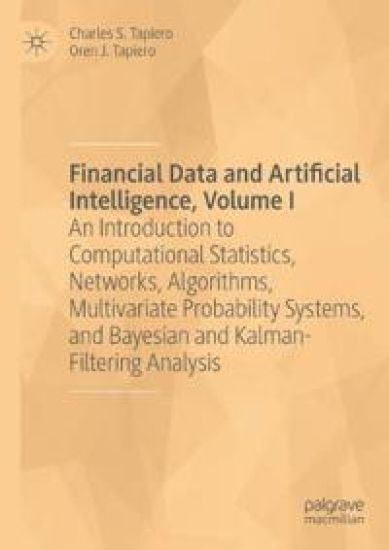
Financial Data and Artificial Intelligence, Volume I

Financial Data and Artificial Intelligence, Volume I

Charles S. Tapiero; Oren J. Tapiero

Springer Nature Switzerland AG
2024
sidottu
The growth of financial complexity, technology, and big data is transforming and integrating computational statistics and data science; in their wake, it’s also changing financial engineering. This first volume introduces elements of computational statistics and data algorithms and considers conventional financial models using statistical models. Such a method provides a more transparent approach to data-science methods when applied to financial data. This book focuses on financial data including time series, default models, and their increasing complexity in a technological and global financial world. It outlines elements of computational statistics and features applications, including problems and models of credit risks and time series applied to various financial problems. Based on multiple sources, academic research, and applications drawn from various domains and adapted to financial data, this book will be of interest to financial engineering researchers, students, and practitioners.
Managerial Planning

Managerial Planning

Charles S. Tapiero

CRC Press Inc
2019
nidottu
Originally published in 1977. Management is a dynamic process reflected in three essential functions: management of time, change and people. The book provides a bridging gap between quantitative theories imbedded in the systems approach and managerial decision-making over time and under risk. The conventional wisdom that management is a dynamic process is rendered operational. This title will be of interest to students of business studies and management.
Managerial Planning

Managerial Planning

Charles S. Tapiero

CRC Press Inc
2019
nidottu
Originally published in 1977. Management is a dynamic process reflected in three essential functions: management of time, change and people. The book provides a bridging gap between quantitative theories imbedded in the systems approach and managerial decision-making over time and under risk. The conventional wisdom that management is a dynamic process is rendered operational. This title will be of interest to students of business studies and management.
Managerial Planning

Managerial Planning

Charles S. Tapiero

CRC Press Inc
2018
sidottu
Originally published in 1977. Management is a dynamic process reflected in three essential functions: management of time, change and people. The book provides a bridging gap between quantitative theories imbedded in the systems approach and managerial decision-making over time and under risk. The conventional wisdom that management is a dynamic process is rendered operational. This title will be of interest to students of business studies and management.
Managerial Planning

Managerial Planning

Charles S. Tapiero

CRC Press Inc
2018
sidottu
Originally published in 1977. Management is a dynamic process reflected in three essential functions: management of time, change and people. The book provides a bridging gap between quantitative theories imbedded in the systems approach and managerial decision-making over time and under risk. The conventional wisdom that management is a dynamic process is rendered operational. This title will be of interest to students of business studies and management.
Globalization, Gating, and Risk Finance

Globalization, Gating, and Risk Finance

Unurjargal Nyambuu; Charles S. Tapiero

Wiley-Blackwell
2018
sidottu
An in-depth guide to global and risk finance based on financial models and data-based issues that confront global financial managers. Globalization, Gating, and Risk Finance offers perspectives on global risk finance in a world with economies in transition. Developed from lectures and research projects investigating the consequences of globalization and strategic approaches to fundamental economics and finance, it provides an approach based on financial models and data; it includes many case-study problems. The book departs from the traditional macroeconomic and financial approaches to global and strategic risk finance, where economic power and geopolitical issues are intermingled to create complex and forward-looking financial systems. Chapter coverage includes: Globalization: Economies in Collision; Data, Measurements, and Global Finance; Global Finance: Utility, Financial Consumption, and Asset Pricing; Macroeconomics, Foreign Exchange, and Global Finance; Foreign Exchange Models and Prices; Asia: Financial Environment and Risks; Financial Currency Pricing, Swaps, Derivatives, and Complete Markets; Credit Risk and International Debt; Globalization and Trade: A Changing World; and Compliance and Financial Regulation. Provides a framework for global financial and inclusive models, some of which are not commonly covered in other books. Considers risk management, utility, and utility-based multi-agent financial theories. Presents a theoretical framework to assist with a variety of problems ranging from derivatives and FX pricing to bond default to trade and strategic regulation. Provides detailed explanations and mathematical proofs to aid the readers’ understanding. Globalization, Gating, and Risk Finance is appropriate as a text for graduate students of global finance, general finance, financial engineering, and international economics, and for practitioners.
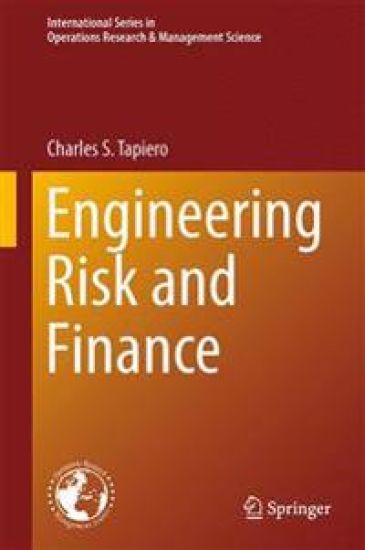
Engineering Risk and Finance

Engineering Risk and Finance

Charles S. Tapiero

Springer-Verlag New York Inc.
2015
nidottu
Risk models are models of uncertainty, engineered for some purposes. They are “educated guesses and hypotheses” assessed and valued in terms of well-defined future states and their consequences. They are engineered to predict, to manage countable and accountable futures and to provide a frame of reference within which we may believe that “uncertainty is tamed”. Quantitative-statistical tools are used to reconcile our information, experience and other knowledge with hypotheses that both serve as the foundation of risk models and also value and price risk. Risk models are therefore common to most professions, each with its own methods and techniques based on their needs, experience and a wisdom accrued over long periods of time. This book provides a broad and interdisciplinary foundation to engineering risks and to their financial valuation and pricing. Risk models applied in industry and business, heath care, safety, the environment and regulation are used to highlight their variety while financial valuation techniques are used to assess their financial consequences. This book is technically accessible to all readers and students with a basic background in probability and statistics (with 3 chapters devoted to introduce their elements). Principles of risk measurement, valuation and financial pricing as well as the economics of uncertainty are outlined in 5 chapters with numerous examples and applications. New results, extending classical models such as the CCAPM are presented providing insights to assess the risks and their price in an interconnected, dependent and strategic economic environment. In an environment departing from the fundamental assumptions we make regarding financial markets, the book provides a strategic/game-like approach to assess the risk and the opportunities that such an environment implies. To control these risks, a strategic-control approach is developed that recognizes that many risks resultingby “what we do” as well as “what others do”. In particular we address the strategic and statistical control of compliance in large financial institutions confronted increasingly with a complex and far more extensive regulation.
Engineering Risk and Finance

Engineering Risk and Finance

Charles S. Tapiero

Springer-Verlag New York Inc.
2013
sidottu
Risk models are models of uncertainty, engineered for some purposes. They are “educated guesses and hypotheses” assessed and valued in terms of well-defined future states and their consequences. They are engineered to predict, to manage countable and accountable futures and to provide a frame of reference within which we may believe that “uncertainty is tamed”. Quantitative-statistical tools are used to reconcile our information, experience and other knowledge with hypotheses that both serve as the foundation of risk models and also value and price risk. Risk models are therefore common to most professions, each with its own methods and techniques based on their needs, experience and a wisdom accrued over long periods of time. This book provides a broad and interdisciplinary foundation to engineering risks and to their financial valuation and pricing. Risk models applied in industry and business, heath care, safety, the environment and regulation are used to highlight their variety while financial valuation techniques are used to assess their financial consequences. This book is technically accessible to all readers and students with a basic background in probability and statistics (with 3 chapters devoted to introduce their elements). Principles of risk measurement, valuation and financial pricing as well as the economics of uncertainty are outlined in 5 chapters with numerous examples and applications. New results, extending classical models such as the CCAPM are presented providing insights to assess the risks and their price in an interconnected, dependent and strategic economic environment. In an environment departing from the fundamental assumptions we make regarding financial markets, the book provides a strategic/game-like approach to assess the risk and the opportunities that such an environment implies. To control these risks, a strategic-control approach is developed that recognizes that many risks resultingby “what we do” as well as “what others do”. In particular we address the strategic and statistical control of compliance in large financial institutions confronted increasingly with a complex and far more extensive regulation.
Applied Stochastic Models and Control for Finance and Insurance

Applied Stochastic Models and Control for Finance and Insurance

Charles S. Tapiero

Springer-Verlag New York Inc.
2012
nidottu
Applied Stochastic Models and Control for Finance and Insurance presents at an introductory level some essential stochastic models applied in economics, finance and insurance. Markov chains, random walks, stochastic differential equations and other stochastic processes are used throughout the book and systematically applied to economic and financial applications. In addition, a dynamic programming framework is used to deal with some basic optimization problems. The book begins by introducing problems of economics, finance and insurance which involve time, uncertainty and risk. A number of cases are treated in detail, spanning risk management, volatility, memory, the time structure of preferences, interest rates and yields, etc. The second and third chapters provide an introduction to stochastic models and their application. Stochastic differential equations and stochastic calculus are presented in an intuitive manner, and numerous applications and exercises are used to facilitate their understanding and their use in Chapter 3. A number of other processes which are increasingly used in finance and insurance are introduced in Chapter 4. In the fifth chapter, ARCH and GARCH models are presented and their application to modeling volatility is emphasized. An outline of decision-making procedures is presented in Chapter 6. Furthermore, we also introduce the essentials of stochastic dynamic programming and control, and provide first steps for the student who seeks to apply these techniques. Finally, in Chapter 7, numerical techniques and approximations to stochastic processes are examined. This book can be used in business, economics, financial engineering and decision sciences schools for second year Master's students, as well as in a number of courses widely given in departments of statistics, systems and decision sciences.
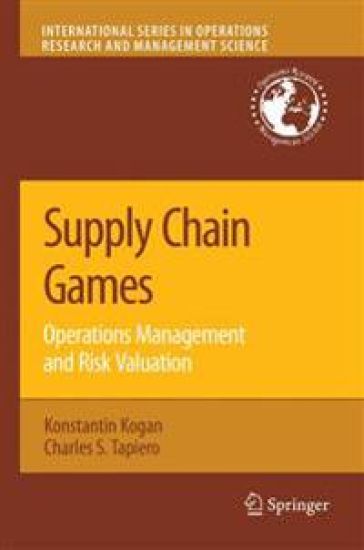
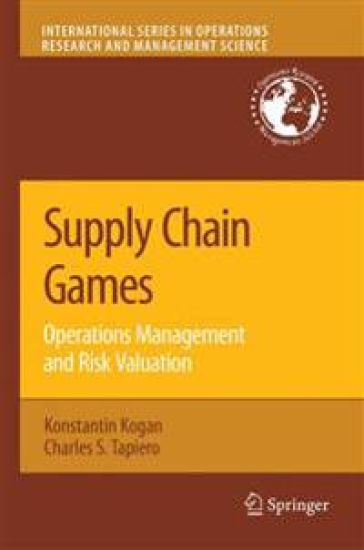
Supply Chain Games: Operations Management and Risk Valuation

Supply Chain Games: Operations Management and Risk Valuation

Konstantin Kogan; Charles S. Tapiero

Springer-Verlag New York Inc.
2010
nidottu
In today’s global economy, supply chains are an essential ingredient to corporate survival and growth. Operations strategy in supply chains must assume an ever-expanding and strategic role of risks that modern enterprises face when they operate in an interdependent supply chain environment. These operational and strategic facets entail a brand new set of operational problems and risks that have not always been understood or managed very well. It falls to supply chain managers to identify and to educate corporate managers on what these critical operational problems and risks involve. Supply Chain Games: Operations Management and Risk Valuation provides business students and practitioners with the means to understand, to model and to analyze these outstanding issues and problems that are the essential elements in managing supply chains today.
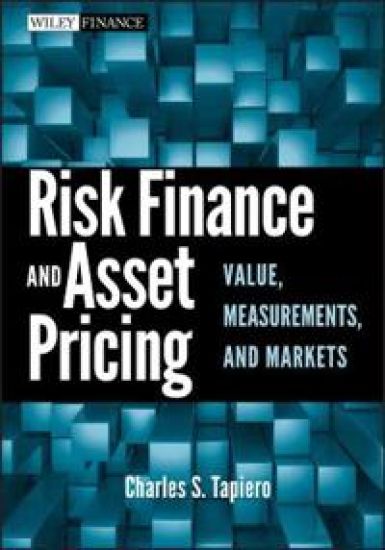
Risk Finance and Asset Pricing

Risk Finance and Asset Pricing

Charles S. Tapiero

John Wiley Sons Inc
2010
sidottu
A comprehensive guide to financial engineering that stresses real-world applications Financial engineering expert Charles S. Tapiero has his finger on the pulse of shifts coming to financial engineering and its applications. With an eye toward the future, he has crafted a comprehensive and accessible book for practitioners and students of Financial Engineering that emphasizes an intuitive approach to financial and quantitative foundations in financial and risk engineering. The book covers the theory from a practitioner perspective and applies it to a variety of real-world problems. Examines the cornerstone of the explosive growth in markets worldwidePresents important financial engineering techniques to price, hedge, and manage risks in generalAuthor heads the largest financial engineering program in the world Author Charles Tapiero wrote the seminal work Risk and Financial Management.
Supply Chain Games: Operations Management and Risk Valuation

Supply Chain Games: Operations Management and Risk Valuation

Konstantin Kogan; Charles S. Tapiero

Springer-Verlag New York Inc.
2007
sidottu
In today’s global economy, supply chains are an essential ingredient to corporate survival and growth. Operations strategy in supply chains must assume an ever-expanding and strategic role of risks that modern enterprises face when they operate in an interdependent supply chain environment. These operational and strategic facets entail a brand new set of operational problems and risks that have not always been understood or managed very well. It falls to supply chain managers to identify and to educate corporate managers on what these critical operational problems and risks involve. Supply Chain Games: Operations Management and Risk Valuation provides business students and practitioners with the means to understand, to model and to analyze these outstanding issues and problems that are the essential elements in managing supply chains today.
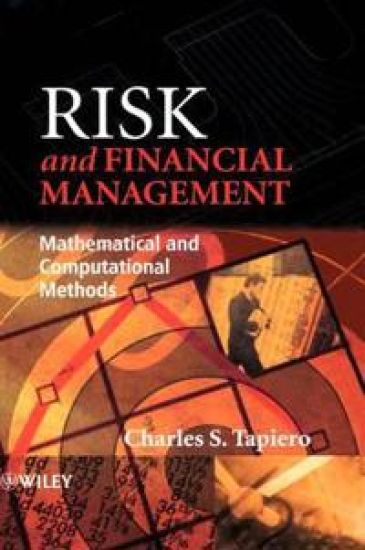
Risk and Financial Management

Risk and Financial Management

Charles S. Tapiero

John Wiley Sons Inc
2004
sidottu
Financial risk management has become a popular practice amongst financial institutions to protect against the adverse effects of uncertainty caused by fluctuations in interest rates, exchange rates, commodity prices, and equity prices. New financial instruments and mathematical techniques are continuously developed and introduced in financial practice. These techniques are being used by an increasing number of firms, traders and financial risk managers across various industries. Risk and Financial Management: Mathematical and Computational Methods confronts the many issues and controversies, and explains the fundamental concepts that underpin financial risk management. *Provides a comprehensive introduction to the core topics of risk and financial management. *Adopts a pragmatic approach, focused on computational, rather than just theoretical, methods. *Bridges the gap between theory and practice in financial risk management *Includes coverage of utility theory, probability, options and derivatives, stochastic volatility and value at risk. *Suitable for students of risk, mathematical finance, and financial risk management, and finance practitioners. *Includes extensive reference lists, applications and suggestions for further reading. Risk and Financial Management: Mathematical and Computational Methods is ideally suited to both students of mathematical finance with little background in economics and finance, and students of financial risk management, as well as finance practitioners requiring a clearer understanding of the mathematical and computational methods they use every day. It combines the required level of rigor, to support the theoretical developments, with a practical flavour through many examples and applications.
Applied Stochastic Models and Control for Finance and Insurance
Applied Stochastic Models and Control for Finance and Insurance presents at an introductory level some essential stochastic models applied in economics, finance and insurance. Markov chains, random walks, stochastic differential equations and other stochastic processes are used throughout the book and systematically applied to economic and financial applications. In addition, a dynamic programming framework is used to deal with some basic optimization problems. The book begins by introducing problems of economics, finance and insurance which involve time, uncertainty and risk. A number of cases are treated in detail, spanning risk management, volatility, memory, the time structure of preferences, interest rates and yields, etc. The second and third chapters provide an introduction to stochastic models and their application. Stochastic differential equations and stochastic calculus are presented in an intuitive manner, and numerous applications and exercises are used to facilitate their understanding and their use in Chapter 3. A number of other processes which are increasingly used in finance and insurance are introduced in Chapter 4. In the fifth chapter, ARCH and GARCH models are presented and their application to modeling volatility is emphasized. An outline of decision-making procedures is presented in Chapter 6. Furthermore, we also introduce the essentials of stochastic dynamic programming and control, and provide first steps for the student who seeks to apply these techniques. Finally, in Chapter 7, numerical techniques and approximations to stochastic processes are examined. This book can be used in business, economics, financial engineering and decision sciences schools for second year Master's students, as well as in a number of courses widely given in departments of statistics, systems and decision sciences.