Kirjojen hintavertailu – 12 859 818 kirjaa ja 27 kauppaa

Kirjailija

Charles Sanders Peirce

Kirjat ja teokset yhdessä paikassa: 20 kirjaa, julkaisuja vuosilta 1932–2026, suosituimpiin kuuluu Ny Jord 3-4. Vertaile teosten hintoja ja tarkista saatavuus suomalaisista kirjakaupoista.

20 kirjaa

Kirjojen julkaisuvuodet: 1932–2026.

Ny Jord 3-4

Ny Jord 3-4

Andreas Malm; Margaret Mead; Emil Leth Meilvang; Peter Handke; Rune Engelbreht Larsen; Christoffer Basse Eriksen; Simone Weil; Anders Dunker; Francisco Goya; Liv Sejrbo Lidegaard; Arno Schmidt; Phillip Martinussen; Walt Whitman; Emil Bønnelycke; Signe Gjessing; Daniel Flendt Dreesen; Gaston Bachelard; Jørn H. Sværen; Michael Stoltze; Lao Zi; Ursula K. Le Guin; Peter Sloterdijk; Oliver Bak; Anna Marie Ortese; Edith Södergran; August Strindberg; C.Y. Frostholm; Lea Marie Løppenthin; Max Klinger; Charles Sanders Peirce

Forlaget Virkelig
2020
nidottu
Ny Jord – Tidsskrift for naturkritik er et multidisciplinært tidsskrift, der orienterer sig på tværs af århundreder og landegrænser og bringer videnskab, litteratur og kunst side om side i ønsket om at bidrage til en kvalificeret samtale om naturen i en tid, hvor vores forestillinger og idéer om den ændres markant.
Das unentdeckte Land

Das unentdeckte Land

Charles Sanders Peirce; Charles Sanders Peirce; Eckhart Von Hochheim; Eckhart Von Hochheim; Konrad Fiedler; Konrad Fiedler

BoD - Books on Demand
2025
pokkari
Quellenband mit zentralen Texten zur modernen und trans-modernen Wahrnehmungsphilosophie samt postmodernistisch bzw. anti- sthetisch korrigierendem Kommentar-Schl ssel.
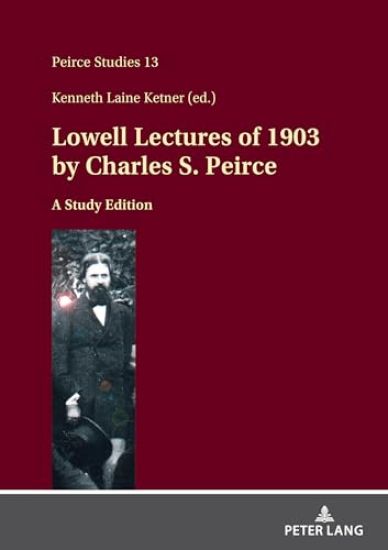
Lowell Lectures of 1903 by Charles S. Peirce

Lowell Lectures of 1903 by Charles S. Peirce

Charles Sanders Peirce

PETER LANG AG
2024
sidottu
This volume presents a study edition of the lectures delivered by Charles Peirce to the Lowell Institute in Boston in the Fall of 1903. These previously unpublished lectures present a comprehensive and revised statement of his work on the methods of science. Offering mature reflection on a lifetime’s thought and work, they represent the culmination of Peirce's research on scientific objectivity. Alongside the 'Cambridge Conferences Lectures' (1898, edited by K. L. Ketner), the 'Harvard Lectures on Pragmatism' (1903, edited by P. A. Turrisi), and the 'The Logic of Interdisciplinarity' (the project of Peirce’s Monist Series 1891-1909, edited by E. Bisanz), the 'Lowell Lectures of 1903' presented here offer significant insights into Peirce’s mature phase as an explorer of objective methods in interdisciplinary science. This collection will appeal to anyone interested in the work of this great thinker, the history of science, and the history of American intellectual life. The 1903 Lowell Lecture Series was Peirce’s last major public lecture.
Pragmatism och kosmologi

Pragmatism och kosmologi

Charles Sanders Peirce

Bokförlaget Daidalos
2020
nidottu
Den amerikanske filosofen Charles Sanders Peirce (1839–1914) är så gott som okänd i vårt land, men internationellt bekant som upphovsman till den amerikanska pragmatismen, en filosofi syftande till att befria vetenskapen ur dess positivistiska återvändsgränd till förmån för en konsekvensetisk, ansvarsbetonad linje. Peirce gjorde epok­görande insatser i relationslogik, matematik och semiotik, men skänkte med sin vida lärdom och sitt oförskräckta problemsinne viktiga impulser också åt discipliner som estetik, idéhistoria, kosmologi och teologi. Under större delen av sitt verksamma liv var han utstött ur det akademiska livet; det var mest bara den berömde psykologen William James och några till som troget stödde honom. Ingen sammanfattande redovisning av sitt tänkande lyckades han få tryckt, däremot en mängd uppsatser i skilda tidskrifter. Först i vår tid börjar Peirce få den uppskattning han förtjänar. I den här boken presenteras några centrala uppsat­ser av denne udda tänkare, som var så före sin tid. Boken är försedd med orienterande inledning och med förklarande anmärkningar.
Illustrations of the Logic of Science

Illustrations of the Logic of Science

Charles Sanders Peirce

Open Court Publishing Co ,U.S.
2014
pokkari
Charles S. Peirce's Illustrations of the Logic of Science is an early work in the philosophy of science and the official birthplace of pragmatism. It contains Peirce's two most influential papers: "The Fixation of Belief" and "How to Make Our Ideas Clear," as well as discussions on the theory of probability, the ground of induction, the relation between science and religion, and the logic of abduction. Unsatisfied with the result and driven by a constant, almost feverish urge to improve his work, Peirce spent considerable time and effort revising these papers. These efforts gained significant momentum after the turn of the century when Peirce sought to establish his role in the development of pragmatism while distancing himself from the more popular versions that had become current. The present edition brings together the original series as it appeared in Popular Science Monthly and a selection of Peirce's later revisions, many of which remained hidden in the mass of messy manuscripts that were left behind after his death in 1914.
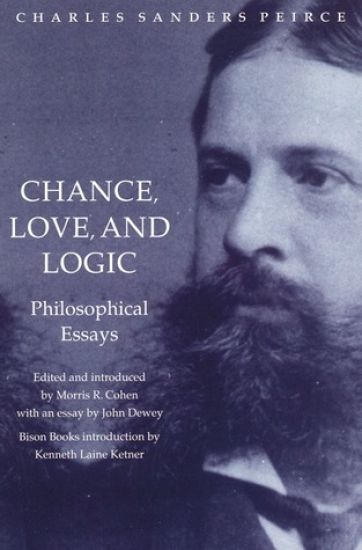
Chance, Love, and Logic

Chance, Love, and Logic

Charles Sanders Peirce

University of Nebraska Press
1998
pokkari
Chance, Love, and Logic contains two books by Charles Sanders Peirce (1839–1914) which are among his most important and widely influential. The first is Illustrations of the Logic of Science. The opening chapters, "The Fixation of Belief" and "How to Make Our Ideas Clear," mark the beginning of pragmatism. The second presents Peirce's innovative and influential essays on scientific metaphysics.
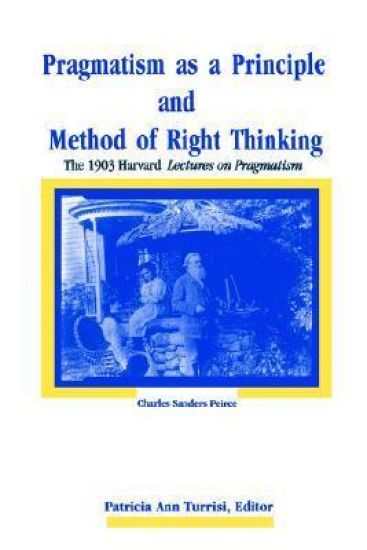
Pragmatism as a Principle and Method of Right Thinking

Pragmatism as a Principle and Method of Right Thinking

Charles Sanders Peirce

State University of New York Press
1997
pokkari
A study edition of Peirce's manuscripts for lectures on pragmatism given in spring 1903 at Harvard University, with notes, preface, and an original introduction by the editor introducing Peirce and interpreting Peirce's thinking for a more general readership. This is a study edition of Charles Sanders Peirce's manuscripts for lectures on pragmatism given in spring 1903 at Harvard University. Excerpts from these writings have been published elsewhere but in abbreviated form. Turrisi has edited the manuscripts for publication and has written a series of notes that illuminate the historical, scientific, and philosophical contexts of Peirce's references in the lectures. She has also written a Preface that describes the manner in which the lectures came to be given, including an account of Peirce's life and career pertinent to understanding the philosopher himself. Turrisi's introduction interprets Peirce's brand of pragmatism within his system of logic and philosophy of science as well as within general philosophical principles.
Reasoning and the Logic of Things

Reasoning and the Logic of Things

Charles Sanders Peirce

Harvard University Press
1993
nidottu
Charles Sanders Peirce (1839–1914) was an American philosopher, physicist, mathematician, and the founder of pragmatism. Despite his importance in the history of philosophy, a unified statement of his thought has been unavailable. With this publication, readers at long last are offered the philosopher’s only known, complete, and coherent account of his own work. Originally delivered as the Cambridge Conferences Lectures of 1898, Reasoning and the Logic of Things is the most accessible and thorough introduction to Peirce’s mature thought to be found within the compass of a single book. Beginning with an explanation of the nature of philosophy, Peirce proceeds to illustrate his claim that mathematics provides the foundation of our logic and metaphysics. We find here the clearest formulation of an idea present in Peirce’s thought since the 1860s, the distinction between three kinds of reasoning: induction, deduction, and retroduction. Then follows an introduction to Peirce’s chief logical doctrines, as well as his attempts to provide a classification of the sciences, a theory of categories, and a theory of science. In conclusion, turning from “reasoning” to the “logic of things,” Peirce called for an evolutionary cosmology to explain the reality of laws and described the kinds of reasoning he employed in developing this cosmology. At the urging of his friend William James, Peirce made an uncharacteristic effort in these lectures to present his ideas in terms intelligible to a general audience—those without advanced training in logic and philosophy. The introductory materials by Kenneth Ketner and Hilary Putman add to the volume’s lucidity. Consequently, this book will be a valuable source for readers outside of the circle of Peirce specialists.
Vorlesungen über Pragmatismus

Vorlesungen über Pragmatismus

Charles Sanders Peirce

Felix Meiner
1991
pokkari
In diesen Vorlesungen des Begr nders des amerikanischen Pragmatismus, Charles S. Peirce (1839-1914), werden die Verkn pfungen von Logik und Praxis, Denken und Handeln in der Philosophie des "gr ten amerikanischen Denkers" (K. O. Apel) deutlich. Aus dem Inhalt: Pragmatismus: Die normativen Wissenschaften; Die universalen Kategorien; Weiteres ber Kategorien; Die Realit t der Drittheit; Die drei Arten des Guten; Drei Typen des Schlie ens; Pragmatismus und Abduktion; Anmerkungen von Peirce. - Anmerkungen der Herausgeberin; Bibliographie, Namen- und Sachregister.
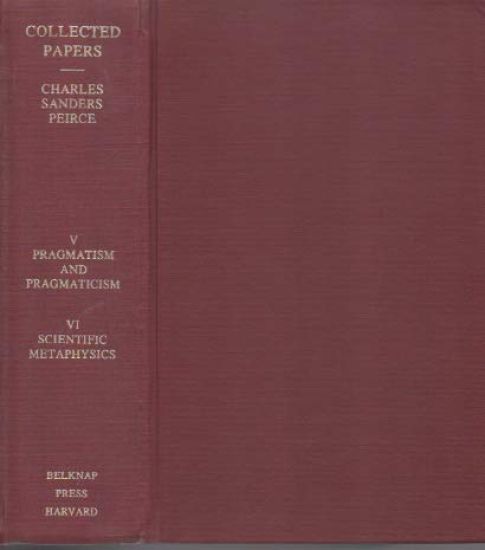
Collected Papers of Charles Sanders Peirce

Collected Papers of Charles Sanders Peirce

Charles Sanders Peirce

Harvard University Press
1958
sidottu
The first six volumes of the Collected Papers of Charles Sanders Peirce included Peirce’s main writings in general philosophy, logic (deductive, inductive, and symbolic), pragmatism, and metaphysics. Volumes VII and VIII are a continuation of this series. Originally published as two separate volumes, they now appear in one book as part of the Belknap Press edition. Volume VII contains papers on experimental science, scientific method, and philosophy of mind. Volume VIII contains selections from Peirce’s reviews and correspondence and a bibliography of his published works, speeches and correspondence, and works by other authors which quote or describe manuscripts by Peirce which are not included in Volumes I–VIII of Collected Papers. As is true of the series as a whole, the material in these volumes is not readily accessible elsewhere. Many of the manuscripts have never been published before, and the previously published material which is included is widely scattered in a number of journals. Peirce’s work in experimental science played an important role in his life and in the formation of his philosophy, and Volume VII is designed to show how the principal focus of his attention shifted from this sphere to the methods of science and finally to speculative metaphysics. Thus it includes his only published article in experimental psychology and two short pieces on gravity as well as the most important part of “The Logic of 1873” (in which pragmatism was first formulated in writing); “The Logic of Drawing History from Ancient Documents,” discussion of the historical method; “Economy of Research” (1879), containing many pertinent reflections on scientific methodology of interest to research directors today; and much more. America’s first original philosopher and logician, and the founder of the philosophy of pragmatism, Peirce was also influential in shaping the thinking of such figures as William James and John Dewey. The reviews and correspondence contained in Volume VIII show his attitude toward these philosophies and illustrate the nature of his relationships with the great thinkers of his day. The bibliography in Volume VIII lists chronologically all of Peirce’s known published works, giving a clear picture of the development of his thought from 1860 through 1911. It is more complete than any published so far in that many new items are included and items previously listed in different sources are here brought together. These volumes will be of great value to all persons interested in philosophy, scientific method, psychology, the methodology of history, and American studies in general.

Collected Papers of Charles Sanders Peirce

Collected Papers of Charles Sanders Peirce

Charles Sanders Peirce

Harvard University Press
1935
sidottu
With the present volume, the presentation of Peirce’s philosophical thought reaches its metaphysical culmination. It embodies the effort of the founder of Pragmatism to develop a metaphysics which will conform to the canons of scientific method, and at the same time provide for real novelty, objective universal laws of nature, cosmical and biological evolution, feeling, and mind. To his previously published papers on chance, continuity, God, and other metaphysical themes, the editors have added a considerable number of unpublished manuscripts which clarify and develop the implications of Peirce’s fundamental world-view. The volume contains those speculative views of Peirce which so deeply influenced his contemporaries, including his discussions of tychism and synechism and of the religious aspects of metaphysics.
Collected Papers of Charles Sanders Peirce

Collected Papers of Charles Sanders Peirce

Charles Sanders Peirce

Harvard University Press
1933
sidottu
This volume contains the published contributions of one of the founders of modern logic and America’s greatest logical genius. It is not only of historical but of contemporary interest because of its many acute discussions of fundamental logical problems. To assist the general reader, the editors have prefixed to the text a selected list of important topics and have provided many footnotes and an exhaustive index. The present, the longest volume of the series of Peirce’s Collected Papers, reveals most clearly his stature as a logician and a student of the foundations of mathematics. It includes not only some striking anticipations of recent work in logic and the foundations of mathematics but also a number of vital contributions to these subjects as now understood. In addition there is an entirely original treatment of logical diagrams which makes possible a detailed analysis of the process of reasoning and provides the link between modern logic and Peirce’s conception of pragmatism. It is the most advanced and important of the volumes on exact logic.
Collected Papers of Charles Sanders Peirce

Collected Papers of Charles Sanders Peirce

Charles Sanders Peirce

Harvard University Press
1932
sidottu
Charles Sanders Peirce has been characterized as the greatest American philosophic genius. He is the creator of pragmatism and one of the founders of modern logic. James, Royce, Schroder, and Dewey have acknowledged their great indebtedness to him. A laboratory scientist, he made notable contributions to geodesy, astronomy, psychology, induction, probability, and scientific method. He introduced into modern philosophy the doctrine of scholastic realism, developed the concepts of chance, continuity, and objective law, and showed the philosophical significance of the theory of signs and mathematical logic. The present series is the first published edition of his systematic works.