
Kirjojen hintavertailu – 12 903 725 kirjaa ja 27 kauppaa

Kirjailija

Charles W. Fox

Kirjat ja teokset yhdessä paikassa: 2 kirjaa, julkaisuja vuodelta 2026, suosituimpiin kuuluu Foundations of Robotics. Vertaile teosten hintoja ja tarkista saatavuus suomalaisista kirjakaupoista.

2 kirjaa

Foundations of Robotics

Foundations of Robotics

Charles W. Fox; Jonathan Aitken

TAYLOR FRANCIS LTD
2026
sidottu
This book introduces readers to graduate-level study of robotics through an integrated, interdisciplinary approach that spans mechatronics, control theory, computer science, and AI. It is designed to unite students from these fields, equipping them with the collaborative skills needed to excel in robotics. It is structured around three core pillars: Mechatronics, Cybernetics, and AI. Mechatronics introduces practical tools and materials for robot building, programming, and design, covering open-source hardware, sensors, actuators, and embedded systems like ROS2. Cybernetics explores feedback, control, kinematics, and dynamics, enabling the execution of complex trajectories for robots such as drones, mobile robots, and robotic arms, grounded in linear algebra and Lagrangian mechanics. AI explores modern transformer-based models, including GPTs and diffusion models, teaching robots to perceive, learn, and plan using Bayesian probability, neural networks, and PyTorch programming. Together, these sections provide a comprehensive foundation for understanding and innovating in robotics. Bridging foundational theory and real-world applications, this book is core course reading for advanced undergraduate and graduate students of robotics, mechatronics, and artificial intelligence. It is also a valuable resource for maker communities, equipping them with the skills needed to succeed in this cutting-edge field.
Foundations of Robotics

Foundations of Robotics

Charles W. Fox; Jonathan Aitken

TAYLOR FRANCIS LTD
2026
nidottu
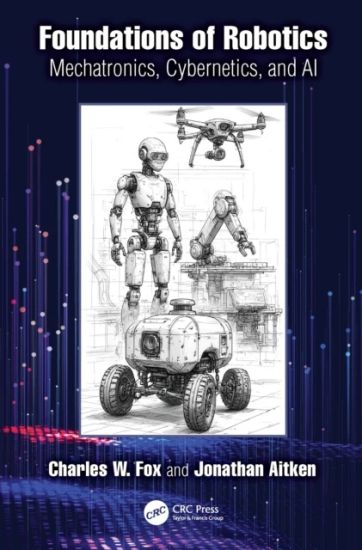
This book introduces readers to graduate-level study of robotics through an integrated, interdisciplinary approach that spans mechatronics, control theory, computer science, and AI. It is designed to unite students from these fields, equipping them with the collaborative skills needed to excel in robotics. It is structured around three core pillars: Mechatronics, Cybernetics, and AI. Mechatronics introduces practical tools and materials for robot building, programming, and design, covering open-source hardware, sensors, actuators, and embedded systems like ROS2. Cybernetics explores feedback, control, kinematics, and dynamics, enabling the execution of complex trajectories for robots such as drones, mobile robots, and robotic arms, grounded in linear algebra and Lagrangian mechanics. AI explores modern transformer-based models, including GPTs and diffusion models, teaching robots to perceive, learn, and plan using Bayesian probability, neural networks, and PyTorch programming. Together, these sections provide a comprehensive foundation for understanding and innovating in robotics. Bridging foundational theory and real-world applications, this book is core course reading for advanced undergraduate and graduate students of robotics, mechatronics, and artificial intelligence. It is also a valuable resource for maker communities, equipping them with the skills needed to succeed in this cutting-edge field.