Kirjojen hintavertailu – 12 859 818 kirjaa ja 27 kauppaa

Kirjailija

Charles Williams

Kirjat ja teokset yhdessä paikassa: 217 kirjaa, julkaisuja vuosilta 1949–2026, suosituimpiin kuuluu Wan in Heaven. Vertaile teosten hintoja ja tarkista saatavuus suomalaisista kirjakaupoista.

217 kirjaa

Kirjojen julkaisuvuodet: 1949–2026.

He Came Down from Heaven and the Forgiveness of Sins
These two long essays make up, with The Descent of the Dove, Charles Williams' principal theological writing. With these books and with The Figure of Beatrice the reader is as fully equipped as possible for studying the religious thought of this brilliant poet, novelist, essayist and historian. Charles Williams was one of the finest-not to mention one of the most unusual-theologians of the twentieth century. His mysticism is palpable-the unseen world interpenetrates ours at every point, and spiritual exchange occurs all the time, unseen and largely unlooked for. His novels are legend, and as a member of the Inklings, he contributed to the mythopoetic revival in contemporary culture.
Witchcraft

Witchcraft

Charles Williams

Apocryphile Press
2005
pokkari
"These pages must stand for what they are-a brief account of the history of that perverted way of the soul which we call magic, and with the reaction against it. No one will derive any knowledge of initiation from this boook. I have not wished to titillate or to thrill; so far as I can manage it, this is history, and accurate history." -adapted from the Preface Charles Williams was one of the finest-not to mention one of the most unusual-theologians of the twentieth century. His mysticism is palpable-the unseen world interpenetrates ours at every point, and spiritual exchange occurs all the time, unseen and largely unlooked for. His novels are legend, and as a member of the Inklings, he contributed to the mythopoetic revival in contemporary culture.
The Figure of Beatrice

The Figure of Beatrice

Charles Williams

Apocryphile Press
2005
pokkari
One of the most ambitious essays in the interpretation of Dante our time has seen...his interpretation of the role of Beatrice is a subtle and individual one. Charles Williams was one of the finest-not to mention one of the most unusual-theologians of the twentieth century. His mysticism is palpable-the unseen world interpenetrates ours at every point, and spiritual exchange occurs all the time, unseen and largely unlooked for. His novels are legend, and as a member of the Inklings, he contributed to the mythopoetic revival in contemporary culture.
He Came Down from Heaven and the Forgiveness of Sins
Charles Williams was one of the finest--not to mention one of the most unusual--theologians of the twentieth century. These two long essays make up, with The Descent of the Dove, Charles Williams' principal theological writing. With these books and with The Figure of Beatrice the reader is as fully equipped as possible for studying the religious thought of this brilliant poet, novelist, essayist and historian. His mysticism is palpable-the unseen world interpenetrates ours at every point, and spiritual exchange occurs all the time, unseen and largely unlooked for. His novels are legend, and as a member of the Inklings, he contributed to the mythopoetic revival in contemporary culture.
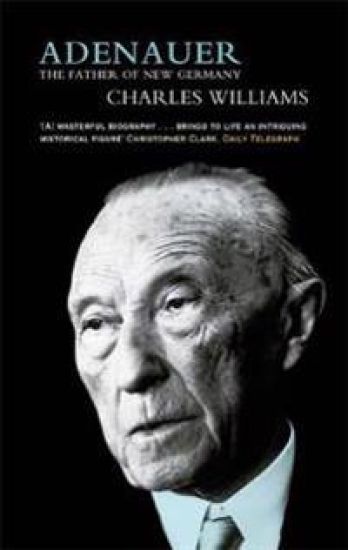
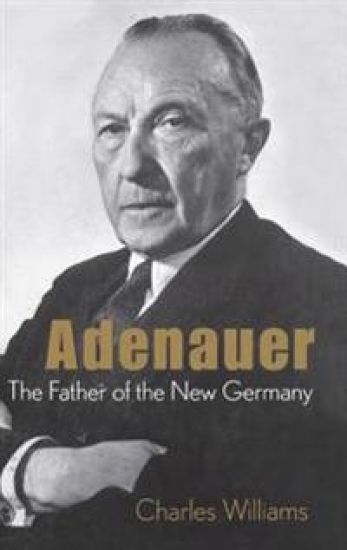
Adenauer

Adenauer

Charles Williams

Abacus
2003
nidottu
After the Second World War Germany lay in ruins. To Konrad Adenauer (1876-1967) belongs much of the credit for raising West Germany to a position of economic prosperity and making it a respected free-world ally. Adenauer was born in 1876, in Cologne, part of a devout Roman Catholic family. He was elected mayor of Cologne in 1917, a post he held for 16 years, then a representative in the Prussian State Council of which he became president in 1928. After the Nazis came to power in 1933, Adenauer was stripped of all his political positions, imprisoned and then sent to a concentration camp. But after the war he organised a new party, the Christian Democratic Union and in 1949 he became West Germany's first chancellor, retiring after four consecutive re-elections in 1963. Charles Williams' magisterial biography of a great twentieth-century statesman - and German - is also a monumental history of modern Germany. The book's four sections: 'The Kaiser's Germany', 'Weimar Germany', 'Nazi Germany' and 'Adenauer's Germany' - bear eloquent testimony to this most singular of nations.
Adenauer: The Father of the New Germany

Adenauer: The Father of the New Germany

Charles Williams

WILEY
2001
sidottu

Halvin toimitettuna 43,90 €

Critical Acclaim for ADENAUER "A gripping narrative . . . brings to life an intriguing historical figure . . . an enthralling perspective on the processes that shaped the postwar world." --Daily Telegraph (London) "Charts the ironies of Adenauer's complicated life. This is the story of a marathon man, but it is narrated at the pace of a sprinter and with the elegance of a hurdler."--The Times (London) "Lucid and engaging. This is a well-researched and elegantly written volume which deserves a wider readership than the purely political."--The Herald (Glasgow) "A highly readable, thoroughly reliable, intelligently critical life-and-times. . . . This portrait does justice to a man who is often invoked as a prophet of a United States of Europe, but who was in truth the greatest of German patriots."--Literary Review (London) "Well-researched and admirably written . . . reveals Adenauer the man--with all his authority and strength, his persistence and endurance, and his streak of ruthlessness and political cunning."--The Independent (London) THE LAST GREAT FRENCHMAN "Knowledgeable, lucid . . . the best English biography of de Gaulle."--The New York Times Book Review "Charles Williams has matched a great subject by something near to a great book."--Daily Telegraph (London)
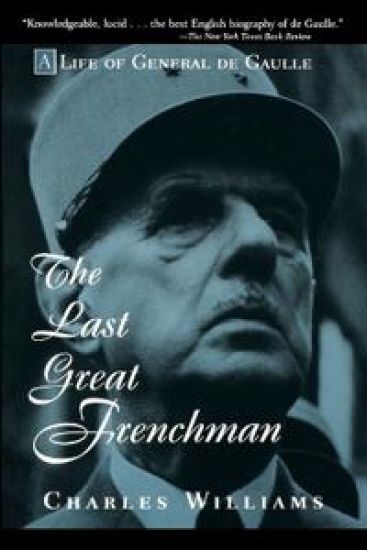
The Last Great Frenchman

The Last Great Frenchman

Charles Williams

John Wiley Sons Inc
1997
nidottu
Critical acclaim for The Last Great Frenchman "This is a splendid popular biography . . . recounted with verve and anecdotal warmth, along with fresh appraisals of de Gaulle's career as soldier, politician, and head of state." —Publishers Weekly. "Highly readable. . . . It is to Williams' credit that he is able to get so close to such a prickly personality." —San Francisco Chronicle "Charles Williams has matched a great subject by something near to a great book." —Daily Telegraph (London) "Marvelous vignettes. . . . Williams tells his story with pace and skill." —Martin Gilbert
The Last Great Frenchman: A Life of General de Gaulle

The Last Great Frenchman: A Life of General de Gaulle

Charles Williams

WILEY
1995
sidottu

Halvin toimitettuna 39,90 €

THE LAST GREAT FRENCHMAN "I am France," General Charles de Gaulle announced when he formed the Free French in 1941. It was no idle boast. Following France's rapid capitulation to Nazi forces, de Gaulle alone stood for a France undefeated and still fighting. Through sheer force of will, he made himself heard, rescuing French dignity and insuring that at the end of World War II France would be among the victorious armies, her status as a world power recognized. It was an immense achievement, one that only a man of de Gaulle's raw nerve, stubbornness, arrogance, and messianic conviction could have accomplished. Though he had virtually no resources and commanded only a few thousand men, he insisted that Britain and America treat France as an equal. His relationship with Churchill was stormy in the extreme but based on a strong mutual admiration; with Roosevelt his relationship was icy. Nonetheless he achieved his goal: France took her place among the Big Five nations in the postwar world. The man who had been sentenced to death as a traitor by the Vichy government returned to France in 1944 a hero and a legend, soon to be elected president. In 1946 de Gaulle shocked the world by resigning. When he stepped back into the political arena twelve years later, it was to once again save a France in crisis. With the adroit maneuvering of a political mastermind he extricated France from Algeria and pulled the country back from the brink of civil war. He barely escaped with his life, surviving numerous assassination attempts by French-Algerians angered by his apparent betrayal. De Gaulle's second presidency lasted ten years until 1968, when student-led revolts toppled his government, but his extraordinary legacy endured in France's most effective constitution since the Revolution, and in international prestige that would have been unthinkable in the previous decade. Charles de Gaulle died in November 1970, a few days before his eightieth birthday. He was a product of northern French provincial society of the nineteenth century— austere, Catholic, and nationalist—truly the "last great Frenchman." In this fully rounded portrait of one of the twentieth century's most outstanding statesmen, Charles Williams interprets the facts and the motives of his subject with the insights of the distinguished politician he is himself. Charles Williams's deft analysis opens a window on the enigma at the core of de Gaulle's character—a private man who was affectionate and emotional, a public man who was cold, ruthless, proud, yet undeniably great. The result is a masterful chronicle that takes a fast-paced and defining look at the life and times of one of the twentieth century's most important figures. Praise for Charles Williams's The Last Great Frenchman "An excellent new biography . . . . Charles Williams has matched a great subject with something near to a great book . . . . A fine portrait of a formidable subject." - Daily Telegraph (London) "Very well told indeed . . . . Marvelous vignettes . . . . Williams tells his story with pace and skill."- Martin Gilbert in The Guardian (London)

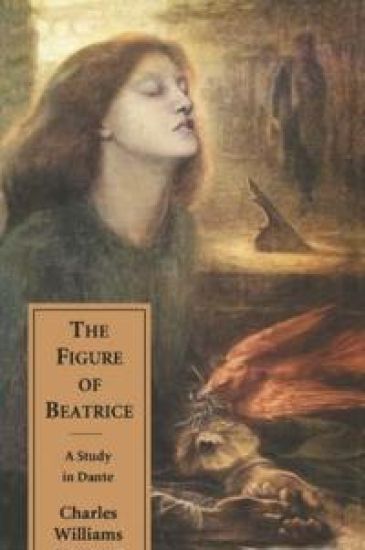
The Figure of Beatrice

The Figure of Beatrice

Charles Williams

D.S. Brewer
1994
pokkari
Reappearance of a classic work of Dante criticism interpreting the central female image of Beatrice. Dante is unequalled among poets in conveying an extraordinary intensity of thought and experience, but this very power may make his work seem formidable to approach. Charles Williams's Figure of Beatriceis outstanding amongst Dante scholarship and criticism for the sympathetic enthusiasm and clarity with which he eases that approach without simplifying the achievement in a highly personal introduction to Dante's work. The first half of the book traces the way in which the central image of Beatrice, representing transcendent beauty in feminine form, animates Dante's earlier works. The second half richly expounds The Divine Comedy, meditating on its significance in Dantesque terms. Williams foreshadows the valuable modern emphasis on Dante as philosopher-poet; he also touches on many later concerns in Dante criticism, including ambiguities of language, the inherent self-contradiction ofall powerful discourse, and the place of the feminine. The Figure of Beatrice is also a moving and poetic work in its own right CHARLES WILLIAMS(1886-1945) is known to many as a prolific and unusual playwright, novelist and critic; his poetic works include `Taliessin through Logres' and `The Region of the Summer Stars'.
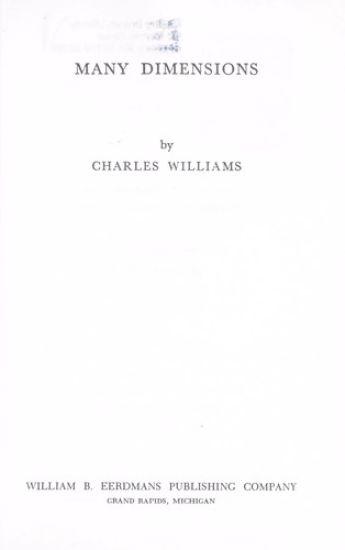
Many Dimensions

Many Dimensions

Charles Williams

William B Eerdmans Publishing Co
1959
nidottu
This penetrating study of evil in the human heart revolves around a mysterious Stone of many dimensions, by which one can move at will through space, time, and thought. Replete with rich religious imagery, Many Dimensions explores the relation between predestination and free will as it depicts different human responses to redemptive transcendence.
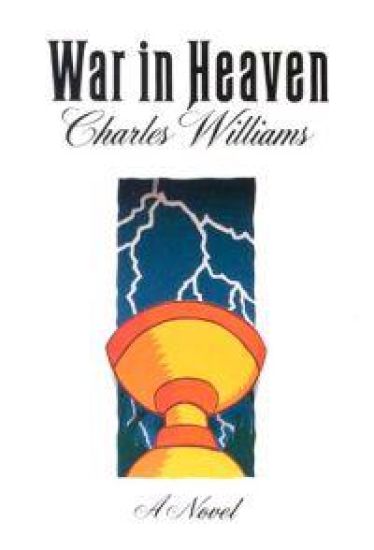
War in Heaven

War in Heaven

Charles Williams

William B Eerdmans Publishing Co
1959
nidottu
Williams gives a contemporary setting to the traditional story of the Search for the Holy Grail. Examining the distinction between magic and religion, War in Heaven is an eerily disturbing book, one that graphically portrays a metaphysical journey through the shadowy crevices of the human mind.
Descent into Hell

Descent into Hell

Charles Williams

William B Eerdmans Publishing Co
1949
nidottu
The key to William's mystically oriented theological thought, Descent into Hell (arguably William's greatest novel) is a multidimensional story about human beings who shut themselves up in their own narcissicstic projections, so that they are no longer able to love, to "co-inhere". The result is a veritable hell.